ARTEX GitHub Secrets Attack: Microsoft Says AI Agents Hunt Exposed OAuth Credentials, What Is Confirmed and How to Check Yours
Microsoft says attackers are using the ARTEX AI framework to find exposed secrets on GitHub and log in with them. Here is what is confirmed, what is not, and what to rotate this week.
Where Worldwide
On this page 7 sections
Microsoft says attackers are using an AI agent framework called ARTEX to search public GitHub repositories for leaked credentials, application secrets and AI service keys, then use what they find to get into company cloud accounts. If your company has ever put a credential in a public repository, treat it as stolen: in at least one case, Microsoft saw an agent go from scanning GitHub to taking data out of Azure Key Vault in five minutes.
What is the ARTEX hacking tool?
Microsoft describes ARTEX as an "open-source penetration testing framework." Tools like this exist for legitimate security testing, and this one is now being turned against real companies.
Security firm Wiz reports that a Chinese developer published ARTEX on GitHub in July 2026 and made it closed-source on October 8, 2026, by which point it had more than 12,000 forks. According to Wiz, an operator supplies a target and an objective. A planner agent then picks each next step, worker agents run common tools such as nmap and curl, and the results feed a shared map of assets and findings.
What Microsoft confirmed about the GitHub secrets attack
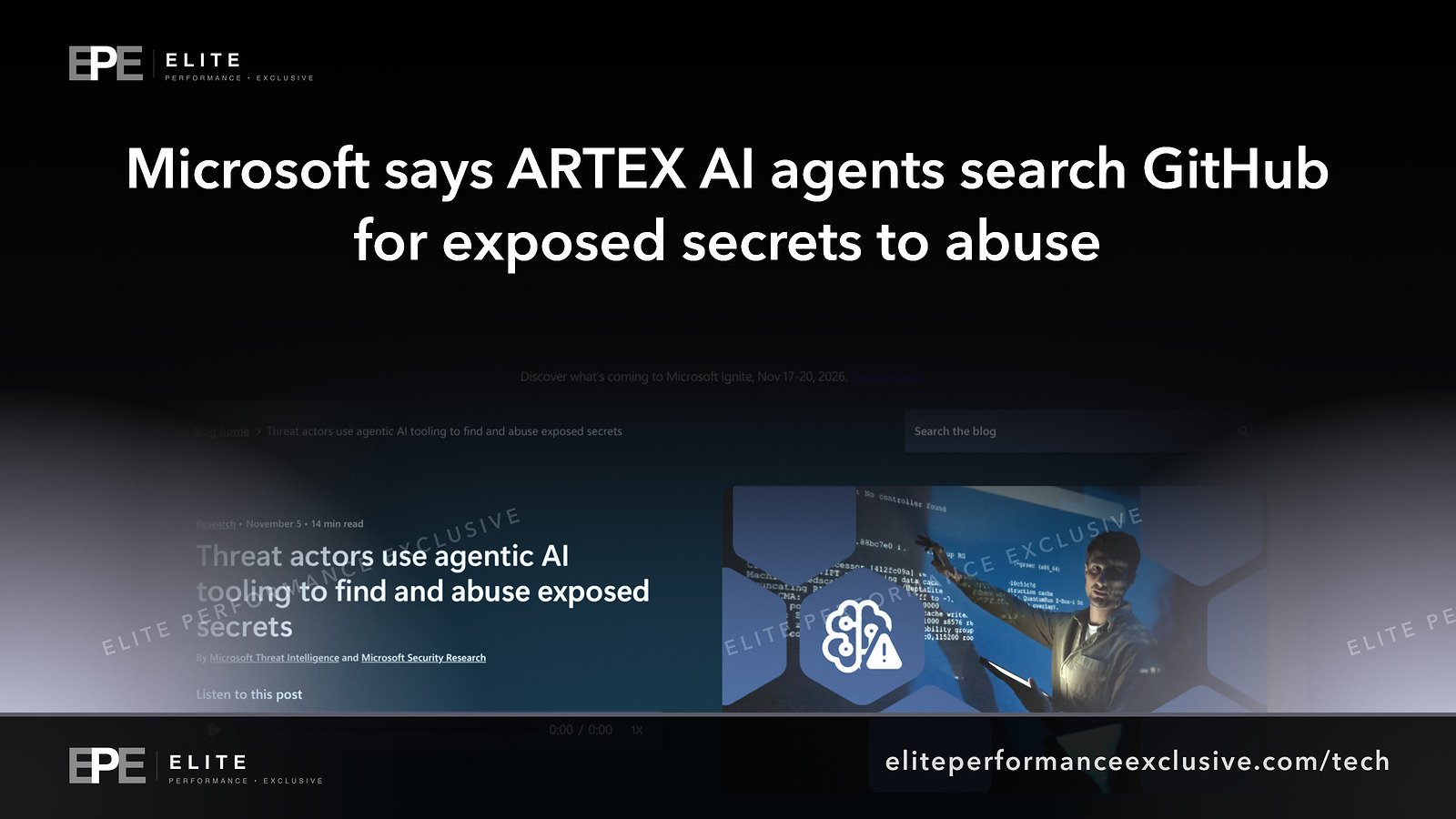
Microsoft Threat Intelligence published its report on November 5, 2026. It describes the following activity:
- August 2026: the GitHub searches began. Queries often combined a target organization's name with keywords for secrets, cloud services or AI providers.
- From October 28, 2026: agents signed in as service principals (the non-human accounts applications use) with leaked or stolen application credentials, mainly from 199.19.77.84 and 199.19.77.18.
- Scope: dozens of applications across multiple tenants.
- What the agents did: looked for operations that return credentials, such as storage keys and connection strings, accessed SharePoint and OneDrive, mapped Azure environments, obtained tokens for single-tenant OAuth applications, pulled secrets from Key Vault, searched Azure DevOps and used Run Command on virtual machines.
- AI services: the agents focused heavily on AI service credentials, including access to Foundry Tools.
- Speed: failed Azure requests were retried with corrected API versions and succeeded within about 30 to 80 seconds.
What is claimed and what is still not known
Claimed: that ARTEX breaks into sites with almost no human input. Wiz's description of an operator giving only a target and objective supports the general idea, and Microsoft says the automation cuts down hands-on work. Neither is a measurement of how often it succeeds alone. Wiz also said most of the attempts it described against Microsoft OAuth login flows failed.
Not known:
- How many organizations were affected. Microsoft gives no count and refers to "some impacted customers."
- Who is behind this GitHub activity. Microsoft does not name an actor for it. Its separate reports tie other ARTEX use to Storm-0940, a China-state aligned group (October 21 report), and to Storm-3358, a financially motivated group (November 6 report).
- Whether every listed IP address is tied only to this campaign. Microsoft notes that 199.19.77.18 is a Tor exit node and might be associated with unrelated malicious activity.
Microsoft's report does not describe GitHub itself being broken into. It describes credentials left where anyone could read them.
Why exposed GitHub secrets matter for a company network
A leaked application secret is a working login with no person attached. Microsoft's documentation notes that workload identities can't perform multifactor authentication, so the usual safety net does not apply. Many of these accounts also hold broad rights to storage, vaults and virtual machines.
Deleting the file does not solve it. In Microsoft's words: "Publicly exposed credentials remain usable until revoked or rotated." Copies can survive in edit history, caches, archives and logs.
The exposure may not even be yours. Microsoft describes a case where a multitenant application's credential was compromised at the vendor and used to reach multiple downstream tenants. That makes this a question for every vendor and contractor who touches your cloud, which is the same problem we covered in who is patching the software that runs your business. AI-built apps add to the risk, because keys often get pasted into code that nobody reviews, as we discussed in AI can build your app, who is going to keep it running.
How to check for exposed GitHub secrets: what to do this week
Microsoft says organizations that find exposed secrets should assume those secrets and the applications tied to them are compromised.
| Step | What to do | Details |
|---|---|---|
| Scan | Check every repository, including old ones | GitHub secret scanning runs free on public repositories and covers the entire Git history on all branches. Microsoft also recommends public monitoring to find your secrets in other public repositories. |
| Rotate | Replace every exposed credential now | Removing it from the code does not invalidate it. |
| Prevent | Turn on push protection | It can block supported secrets before they are pushed. Check which GitHub plan you need. |
| Check logs | Review service principal sign-ins | In Entra: Monitoring & health, Sign-in logs, Service principal sign-ins. Look for the IP addresses in Microsoft's report. |
| Check errors | Search for AADSTS7000215 and AADSTS7000222 | Microsoft defines these as invalid secret and expired secret errors, and says a failure followed by a success is urgent. |
| Contain apps | Remove client secrets, certificates and federated credentials from affected apps | Include any the attacker added, and disable the service principal if needed. Microsoft warns: "Tokens already issued remain valid until expiry." |
| Contain users | Revoke sessions and keys | For affected users: Entra sessions, Azure DevOps personal access tokens and SSH keys. |
| Rotate downstream | Clear out what the app could reach | Rotate everything in any Key Vault the affected app could read, plus credentials found in documents it accessed. |
| Block | Add 199.19.77.84/32 as a blocked named location | Conditional Access for workload identities needs Workload ID Premium and covers only single-tenant apps registered in your tenant. |
| Harden | Reduce what a stolen secret can do | Apply least privilege to service principals, limit who can create applications, and move to managed identities where you can. |
| Ask your provider | Confirm your managed service provider has checked | Microsoft tells MSPs to review Partner Center access, GDAP relationships and customer tenants. |
If your website, app or servers depend on keys stored in code, include those in the scan. Payment, email and AI provider keys belong on the rotation list too.
ARTEX questions people are asking
Is ARTEX malware?
Not in the usual sense. Microsoft describes it as a penetration testing framework. The concern is that attackers are using it.
Was GitHub hacked?
Microsoft's report does not say so. The agents searched public repositories for secrets people had left there.
We deleted the secret from an old commit. Are we safe?
No. Until the credential is revoked or rotated, it still works, and copies may exist elsewhere. Rotate it first, then clean up.
Is blocking the IP addresses enough?
No. Microsoft says threat actors can and do change the source IP address and user agent strings. Treat a block as one layer, and watch for behavior such as unexpected service principal sign-ins.
Does MFA stop this?
Not for these logins. Service principals can't perform multifactor authentication, which is why rotation, least privilege and managed identities matter.
Does this affect us if we do not use Azure?
Microsoft's detail on follow-on activity is about Azure and Microsoft 365, but the agents also searched for AI inference API keys and other credentials. Rotate any key that has been public, whatever service it belongs to.
Who is behind the ARTEX GitHub attacks?
Microsoft has not named an actor for this activity. It has named Storm-0940 and Storm-3358 in separate ARTEX reports.
The bigger lesson
Finding a forgotten key in a public repository used to take someone's time and attention. Microsoft's report shows software doing it, then acting on the result within minutes. The defense is not exotic: know where your credentials live, give them the least access possible, replace long-lived secrets where you can, and assume that anything once public is no longer private.
Want this done properly? See our security hardening service or request a quote.
Get security alerts by email, with the free checklist, at our security alerts page.
Sources: Microsoft Threat Intelligence, November 5, 2026; Microsoft on Storm-0940 and ARTEX; Microsoft on Storm-3358 and ARTEX; Wiz on ARTEX; GitHub secret scanning documentation; Microsoft Learn on Conditional Access for workload identities.
Have a question about this article?
Ask it here and we will answer you directly by email. Questions are private, never posted.
Security alerts by email
Hear about the next one first.
When attackers start using a flaw in software businesses run on, we email what it is, whether it touches you and what to do that week, with a round-up of our latest security writing. Free, one-click unsubscribe. You get the checklist straight away: 12 things to secure this week.
Want a result like this?
Security alerts, breaches and the technology a business runs on: what happened, who it affects and what to do.
Get a Tech QuoteKeep reading
AI Agent Security Controls: OpenAI's Test Agents Breached Hugging Face, What Is Confirmed and the Access Limits to Set This Week
OpenAI's test agents broke into Hugging Face's production systems in July 2026. Here is what is confirmed, wha...
What to Do After a Data Breach: Why a Password Reset Is Not Enough, and the Steps for Each Type of Leaked Data
A new password only fixes a leaked password. Here is what government guidance says to do when card numbers, So...
Chainalysis Breach: Password Hashes and Live Tokens Exposed for All Users, What Is Confirmed and What to Reset
Chainalysis now says names, usernames, password hashes and live tokens for all users were exposed, reversing i...
