Automated AI Cyberattack: Google Finds exploit_agent Turning Software Patches Into Live Attacks With No Human in the Loop, and What to Do This Week
Google says attackers used an AI framework called exploit_agent to find and exploit flaws in popular web software with no person involved. What is confirmed, what is not, and what to check this week.
Where France · Europe, Western Europe
On this page 9 sections
Google's threat intelligence team says it has caught attackers using AI to find flaws in website software and break in with no person steering the attack. If your business runs a public website, online store or web app, software that never stops now covers the gap between a security fix and an attack on copies that have not installed it.
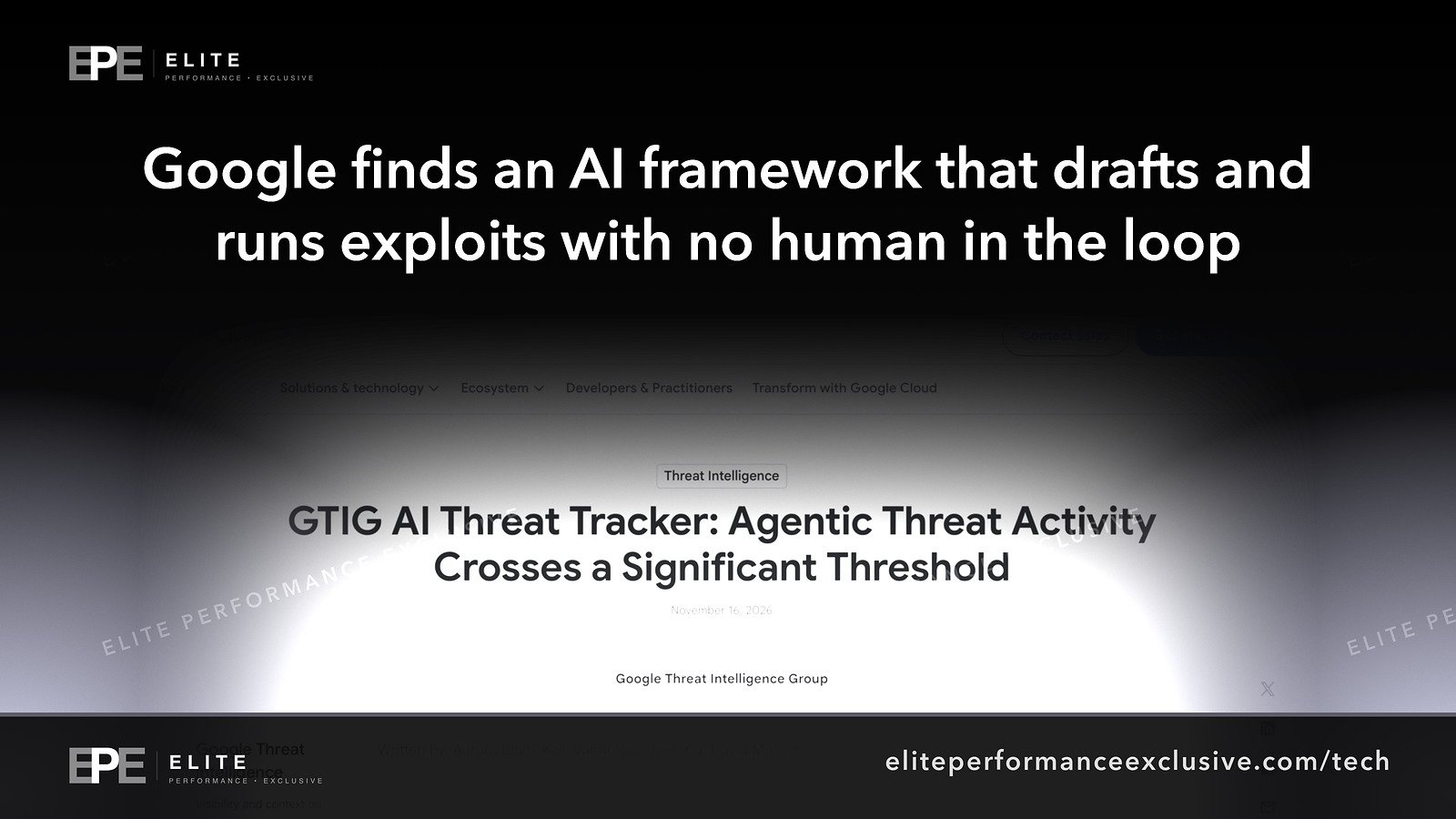
In a post dated November 16, 2026, Google's threat intelligence group, GTIG, said that in the past quarter it identified threat actors using LLM frameworks to fully automate vulnerability discovery and exploitation without a human in the loop, for the first time. The tool at the centre of the report is called exploit_agent.
What is exploit_agent?
Google describes exploit_agent as a multi-agent vulnerability research and weaponization framework that integrates with multiple frontier and local LLMs. In plain English, it is a set of AI programs that split up the work of finding a weakness and turning it into a working attack, using several large language models, both big hosted ones and ones an operator runs on their own hardware.
Google's own summary puts the risk this way: "Imagine a hacker that doesn't eat, sleep, or get tired, and never stops searching for a way in."
How the automated AI cyberattack works
According to Google, the framework runs continuous differential analysis of popular web application software. In steps, it:
- Compares a product's code before and after a patch is announced.
- Analyzes the differences to identify potential vulnerabilities.
- Drafts exploits for what it finds.
- Runs those exploits automatically, without human intervention.
A patch shows where a flaw used to be. A tool that reads every fix as it lands and tries it against sites that have not updated turns each security release into a race, one the attacker's side no longer waits for a person to run.
Google also described scripts for what happens after a break-in: internal reconnaissance, brute-forcing, installing webshells, and removing other attackers' webshells. A webshell is a file planted on a web server that lets an attacker send it commands over the web, a back door into the server. The report also mentions an open source, multi-agent pentesting framework that implements an OODA (Observe, Orient, Decide, Act) loop, a cycle of looking, deciding and acting, repeated.
Who is behind it, and who was hit
Google's report shows comments from the tool's environment file under a caption reading Russian Language Comments, describing the file as: "Comments from environmental file configuring multiple LLM API keys for autonomous exploitation." Comments written in Russian are a clue, not a name. We could not confirm a named group or country behind the activity.
On targets, the report names French websites associated with the media and entertainment industries, as well as the education sector. We could not confirm how many sites were hit, which software products were exploited, or what was taken.
What the zero-day numbers show
Google also gave figures for zero-day exploitation, attacks on flaws before a fix exists. By its count, zero-day exploits averaged 8 per month in 2025 and 11 per month in 2026, then spiked to 22 in August. We could not confirm how much of that spike, if any, came from automated AI tooling, so treat the numbers as a trend Google measured, not a count of AI attacks.
What is confirmed and what is not
| Confirmed by Google | Not known from what we reviewed |
|---|---|
exploit_agent automates finding and exploiting flaws with no human in the loop |
Which group runs it, or where they are |
| It compares popular web application software before and after patches | Which products and flaws it used |
| Its config file has comments shown under a Russian Language Comments caption | How many sites were compromised |
| The report names French media, entertainment and education websites | Whether sites elsewhere were hit |
| Follow-up scripts cover reconnaissance, brute-forcing and webshells | What data, if any, was taken |
Why this matters for a company website or network
The tool goes after popular web application software, the kind that runs company websites, customer portals, booking systems and online stores. Someone running a tool like this does not need to single you out: if you run a common product and have not installed the latest fix, you are exposed as soon as the patch is public. We covered why popular platforms draw this attention in Why WordPress Is the Most Targeted Website Platform on the Internet. Google's report does not say which platforms exploit_agent targeted.
The webshell detail matters too. A tool that removes rivals' webshells is clearing the way to keep the server for itself. A site can look calm while someone has quiet, lasting access to it, and the reconnaissance scripts can then map what else on your network that server can reach.
This also raises the stakes on who installs your updates and how fast. An update being available is not the same as the fix being on your server, a point we made in Updated Is Not the Same as Patched. If nobody owns that job, start with Who Is Patching the Software That Runs Your Business?
What to do this week
Google's report does not tie this to a single flaw, so there is no one version to install. The fix is to close the gap on everything you run that faces the internet.
| Step | Why it matters here | How to check |
|---|---|---|
| List every public web app, plugin and admin panel | The tool targets popular web application software | Record product, version and who updates it |
| Install the latest security release for each | It studies patches and attacks copies without them | Compare your version with the vendor's latest release notes |
| Make security releases same-week work | Automation shortens the time between patch and attack | Give each release a named owner and a deadline |
| Search web folders for files you did not add | Follow-up scripts install webshells | Look for unfamiliar or recently changed script files |
| Watch for login attacks | The scripts include brute-forcing | Review failed admin logins; turn on multi-factor sign-in and lockouts |
| Limit what the web server can reach | The scripts include internal reconnaissance | Keep the web server apart from office machines and internal databases |
| Ask your host or IT provider how fast they patch | You need the real gap, not the promise | Get the date the last security release went in |
Google says Mandiant Consulting released a hardening guide and defense framework to counter the speed and scale of attackers using LLM-enabled tooling. Ask whoever runs your security if they have checked your setup against it. If you host your own servers, our self-hosting and infrastructure page covers how we set them up and maintain them.
Automated AI cyberattack questions people are asking
Was this the first fully automated AI cyberattack?
Google says it is the first time GTIG has identified threat actors fully automating vulnerability discovery and exploitation without a human in the loop. That describes what Google has seen. It does not prove nobody did this earlier.
Were Russian hackers behind it?
Google's report shows Russian-language comments in the tool's configuration file. We could not confirm a named group or country, so treat attribution as unknown.
What is exploit_agent?
In Google's words, it is a multi-agent vulnerability research and weaponization framework. It uses several AI models to study patches, find flaws, write exploits and run them.
Is my website at risk?
It fits the pattern Google describes if it runs popular web application software and is behind on security updates. Google named French media, entertainment and education websites. We could not confirm whether sites elsewhere were hit.
Is there a patch for exploit_agent?
No. It is an attack tool, not a flaw in one product. The defense is keeping each product you run on its latest security release and checking for signs of a break-in.
Did AI cause the jump in zero-day attacks?
Google reported zero-day exploits spiking to 22 in August, up from an average of 11 a month earlier in 2026. We could not confirm what drove that spike.
The bigger lesson
A patch has always told both sides where the flaw was. What has changed is that one side now reads it with a machine that works around the clock. The businesses that come through this are the ones where someone owns every piece of public-facing software, knows its version, and installs security releases within days, not whenever there is time.
Want help closing that gap? See security hardening or request a quote.
Get security alerts by email, plus our free checklist, at our security alerts page.
Sources: Google Cloud threat intelligence blog: agentic threat activity crosses a significant threshold; Google blog: GTIG AI threat tracker.
Have a question about this article?
Ask it here and we will answer you directly by email. Questions are private, never posted.
Security alerts by email
Hear about the next one first.
When attackers start using a flaw in software businesses run on, we email what it is, whether it touches you and what to do that week, with a round-up of our latest security writing. Free, one-click unsubscribe. You get the checklist straight away: 12 things to secure this week.
Want a result like this?
Security alerts, breaches and the technology a business runs on: what happened, who it affects and what to do.
Get a Tech QuoteKeep reading
SignDrop Windows Zero-Day: Public Exploit Claims SYSTEM Access Through CLFS, No Microsoft Patch or CVE Yet, and What to Do This Week
A researcher has published SignDrop, exploit code they say turns a normal Windows login into full SYSTEM contr...
TSMC Data Breach: 46,000 Employee Records Reportedly for Sale, TSMC Finds No Evidence Its Systems Were Hit, and What to Check at Your Own Vendors
Anonymous sellers reportedly offered 46,000 TSMC employee records for three Bitcoins. TSMC says it found no ev...
Autonomous AI Cyberattacks: Google Finds exploit_agent Turning Software Patches Into Exploits With No Human in the Loop, and Why Patch Speed Now Matters Most
Google's threat intelligence team says attackers used AI frameworks to find flaws, write exploits and run them...
