Cacti Zero-Day Vulnerability: Public Exploit Runs Commands on Cacti 1.2.31 With No Login When Guest Access Is On, No Patch Yet, and How to Turn Off the Guest Account
A public exploit lets attackers with no login run commands on Cacti Core 1.2.31 servers that have the guest account enabled. No patch or CVE exists yet. Here is what is confirmed, what is not, and what to do this week.
Where Worldwide
On this page 8 sections
Someone has published exploit code that lets an attacker with no username or password run commands on a Cacti network monitoring server; it works on Cacti Core 1.2.31 when the guest account is enabled. If your team uses Cacti to graph routers, switches and servers, this matters: there is no patch yet, so the fix for now is a setting, and you should turn the guest account off this week.
What happened with the Cacti zero-day
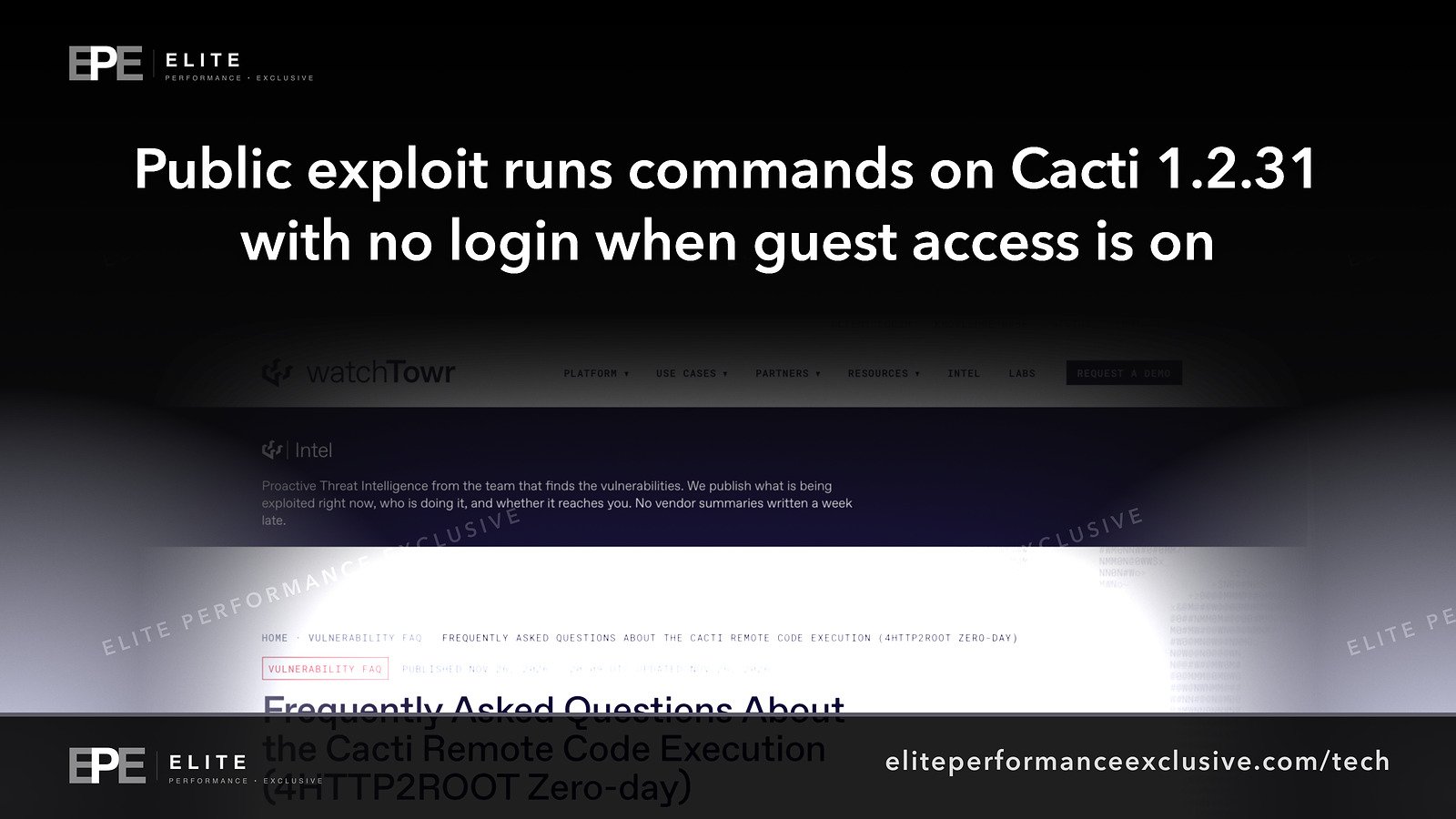
watchTowr's FAQ on the flaw says a proof-of-concept exploit was published on Thursday, November 26, 2026, at 20:09 UTC. The researcher, ek0ms savi0r, put it on GitHub under the title "Four Requests to Root: A Cacti 0day".
The Hacker News quotes the researcher's summary of the attack: "I found a path from a fresh, unauthenticated HTTP session to command execution as the Cacti server user in four requests".
BleepingComputer's report puts the requirements just as plainly: "No login. No valid API key. No phishing. Just four HTTP requests against the default guest surface."
According to BleepingComputer, the flaw was not reported to Cacti before it was released. That is what makes it a zero-day: the project heard about the problem when everyone else did, with working exploit code already public.
Cacti vulnerability: what is confirmed and what is not
| Question | What the sources say |
|---|---|
| CVE number | Not assigned (watchTowr) |
| Affected version | Cacti Core 1.2.31, the latest version, when the guest account is enabled |
| Patch | Cacti has not published a fixed version |
| Attacks seen | As of November 27, 2026, no exploitation in the wild has been reported |
| Login needed | No |
| What an attacker gets | Command execution as whichever account runs the Cacti web server and poller process |
| Severity score | watchTowr lists 0.0 (v3.1) |
| Workaround | Deactivate the Cacti guest account until a patch is released |
A note on that 0.0 score: do not read it as "harmless". What the researcher describes is command execution with no login, and the flaw has no CVE yet.
What is not known from the sources we checked:
- Whether Cacti releases before 1.2.31 are affected. The sources name 1.2.31 only.
- When Cacti will release a fix, or what version number it will have.
- How many Cacti servers are reachable from the internet with guest access on.
- Whether anyone has used the exploit since November 27, 2026. No exploitation being reported is not the same as no exploitation happening.
- Any statement from Cacti itself. None appears in the sources we checked.
Is Cacti 1.2.31 vulnerable, and who is affected?
Yes, if the guest account is enabled. The awkward part is that 1.2.31 is the latest version, so the teams that kept Cacti up to date are the ones the sources name. Updating will not help until Cacti ships a fix.
You are most exposed if your Cacti server can be reached from the internet, or from any network you do not fully trust, and the guest account is turned on so people can view graphs without logging in.
Why a Cacti server matters for a business network
A monitoring server is built to see the rest of your network. It usually sits inside, with routes to the routers, switches and servers it watches, so an attacker who gets commands running on it starts from a useful position.
The exploit's title says "root", but watchTowr describes the impact as commands running as whichever account runs the Cacti web server and poller process. So how far an attacker gets depends on your setup. If that account has wide rights on the server, so does the attacker. If it is a limited service account, the damage is smaller, but it is still a foothold inside your network.
What to do this week: Cacti zero-day checklist
| Step | What to do | How to check |
|---|---|---|
| 1. Find every Cacti install | List every Cacti server, including test boxes and ones a past contractor set up | Check the version shown in each install; 1.2.31 is the version the sources name |
| 2. Turn off the guest account | Deactivate the Cacti guest account until a patch is released | As an admin, review Cacti's user and authentication settings and confirm nobody can view pages without logging in |
| 3. Keep Cacti off the public internet | Allow access only from your internal network or VPN | Try to reach the Cacti page from outside your network, for example from a phone with Wi-Fi off |
| 4. Check the service account | Find out which account runs the Cacti web server and poller | Make sure it is not root or an administrator account |
| 5. Review recent activity | Look for unexpected requests or processes on the Cacti server since November 26, 2026 | Check the web server and system logs, and treat anything unexplained as a reason to investigate further |
| 6. Watch for the fix | Install Cacti's fixed version as soon as it is published | Follow Cacti's official releases and our security alerts |
If you use the guest account to share dashboards with staff or customers, turning it off will break that. Until a patch arrives, give those viewers their own logins instead of leaving anonymous access on.
Why public disclosure with no warning changes your timeline
Usually a vendor gets a private report, ships a fix, and the details come out afterwards. Here the exploit and the news arrived together, and the fix has not arrived at all. BleepingComputer's report includes the line "Security researchers are not the bad guys. We're the ones trying to help." Whatever you think of how this one was released, the result for a business is the same: the gap between the exploit being public and a patch existing is yours to cover, and the only cover right now is a setting.
That is why someone has to own each piece of software you run, including the quiet internal tools nobody logs into. A monitoring server set up years ago and left alone is exactly the kind of box that misses a workaround like this.
Cacti zero-day questions people are asking
Is there a patch for the Cacti zero-day?
No. Cacti has not published a fixed version. Until it does, the advice is to deactivate the guest account.
Does the Cacti exploit need a login?
No. The attack needs no login, no valid API key and no phishing: four HTTP requests against the guest surface.
Is the Cacti vulnerability being exploited?
As of November 27, 2026, no exploitation in the wild had been reported. The exploit code is public, so that could change.
Does the Cacti flaw have a CVE number?
Not yet. watchTowr lists the CVE as not assigned.
Which Cacti versions are affected?
The sources name Cacti Core 1.2.31, the latest version, when the guest account is enabled. They do not say whether older versions are affected.
What can an attacker do with the Cacti exploit?
Run commands as whichever account runs the Cacti web server and poller process. How much damage that does depends on that account's rights.
Will turning off the Cacti guest account break anything?
Only anonymous viewing. Anyone who used guest access to see graphs will need their own login.
The bigger lesson
The tools that watch your network are part of your network's attack surface. Running the latest version is not enough: you also need to know which features are switched on, who can reach the server, and what account it runs as. A setting someone turned on for convenience years ago is what this exploit depends on. If you would like those questions answered for every server you run, that is the work in self-hosting and infrastructure.
See how we approach security hardening, or get a quote for a review of your servers.
Get security alerts like this by email, plus our free checklist, at /security-alerts.
Sources: watchTowr: 4http2root Cacti zero-day FAQ; ek0ms savi0r: Four Requests to Root on GitHub; BleepingComputer; The Hacker News.
Have a question about this article?
Ask it here and we will answer you directly by email. Questions are private, never posted.
Security alerts by email
Hear about the next one first.
When attackers start using a flaw in software businesses run on, we email what it is, whether it touches you and what to do that week, with a round-up of our latest security writing. Free, one-click unsubscribe. You get the checklist straight away: 12 things to secure this week.
Want a result like this?
Security alerts, breaches and the technology a business runs on: what happened, who it affects and what to do.
Get a Tech QuoteKeep reading
GeoVision Camera Software Hack: Huntress Says Exposed Webcam Software Was Exploited at 13 Organizations, What Is Confirmed and What to Do This Week
Huntress says attackers got into 13 organizations by exploiting GeoVision webcam software that could be reache...
Linux NFSD Vulnerability CVE-2026-99362: Kernel NFS Server Flaw Could Allow Remote Code Execution With No Login, and the Debian 12 Fix to Install
A flaw in the Linux kernel's NFS file server, CVE-2026-99362, could allow remote code execution from crafted n...
myColorado Data Breach: Uploaded Passports, Vehicle Registrations and Insurance Cards of Roughly 100K Users Accessed, What Is Confirmed and What to Do This Week
Colorado says documents that roughly 100k myColorado users uploaded, including passports and insurance cards,...
