Cisco Expressway Vulnerability CVE-2026-76466: CISA Lists the Base 9.8 Flaw as Exploited, and Cisco's Fix Is X15.5.20
CISA has added Cisco Expressway flaw CVE-2026-76466 to its known exploited list. Expressway-C and Expressway-E on X15.5.3 and earlier are affected, and Cisco's fix is X15.5.20.
Where Worldwide
On this page 6 sections
Cisco Expressway-C and Cisco Expressway-E systems running X15.5.3 or earlier have a critical flaw, CVE-2026-76466. CISA added it to its catalog of known exploited vulnerabilities on 2026-11-20. If your business runs either product, upgrade to X15.5.20 now. CISA's due date for this flaw is 2026-11-23, which is today.
Cisco's advisory and CISA's catalog disagree about whether the flaw has been exploited, and some important details are missing from the sources we checked. Below is what is confirmed, what is only reported, and what to do this week.
What happened with the Cisco Expressway vulnerability
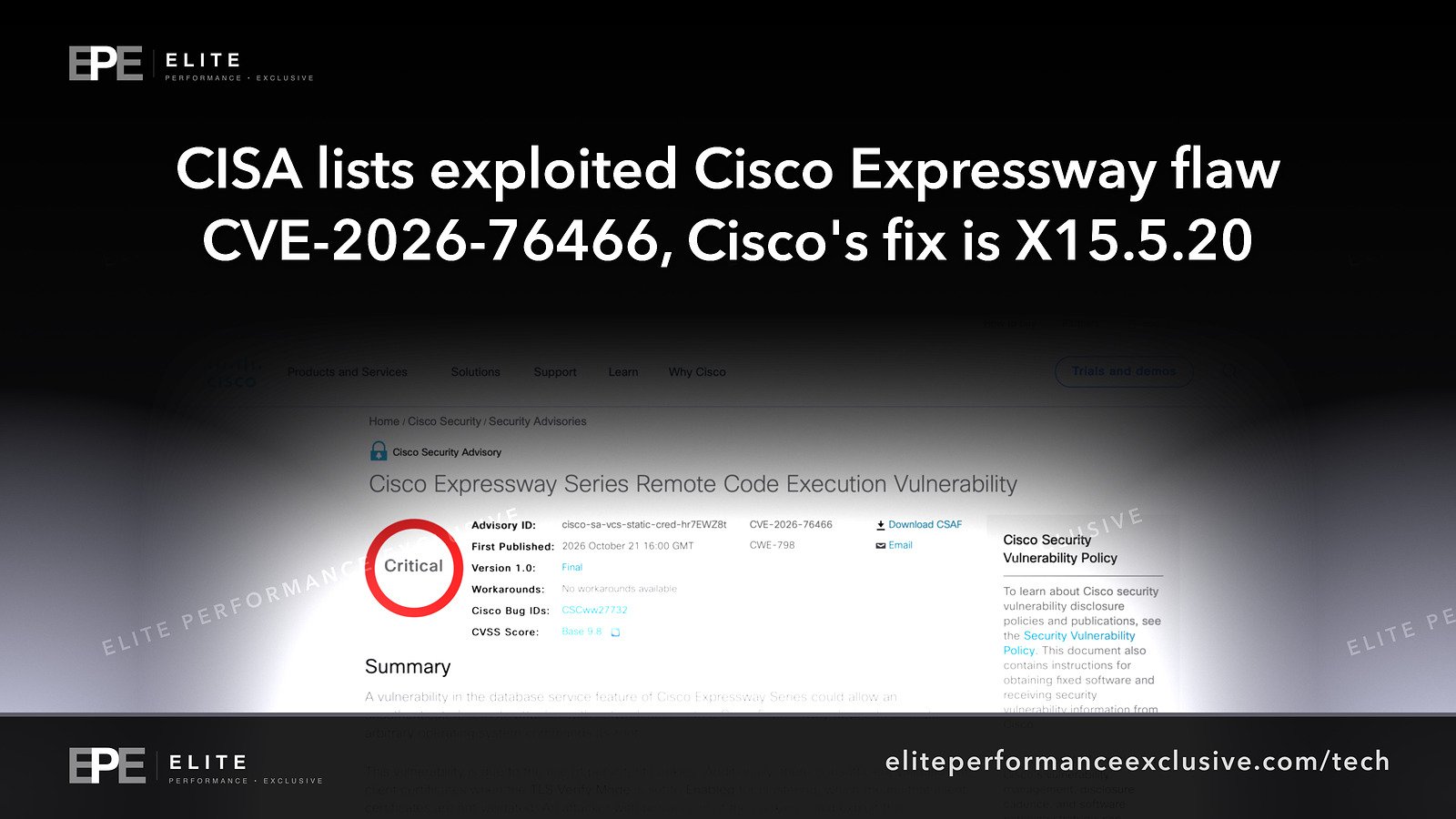
Cisco's security advisory for CVE-2026-76466 is dated 2026 October 21 16:00 GMT. It states: "This vulnerability affects Cisco Expressway-C and Cisco Expressway-E". The affected releases are X15.5.3 and earlier. The fixed release Cisco names is X15.5.20. Cisco scores the flaw Base 9.8.
Cisco explains the cause in one sentence: "This vulnerability is due to the use of persistent cookies." CISA's catalog gives it a different name: "Cisco Expressway Series Use of Hard-coded Credentials Vulnerability". In plain terms, hard-coded credentials are login secrets built into the software itself, not ones the owner sets. Good password habits on your side do not change something built into the product. The fix Cisco names is the upgrade to X15.5.20.
What is not known yet
The sources we checked do not say:
- what an attacker can do on an Expressway system after exploiting the flaw
- whether Cisco offers a workaround for systems that cannot be upgraded right away
- how many Expressway systems are exposed
- how releases between X15.5.3 and X15.5.20 are treated. The advisory text we have lists X15.5.3 and earlier as affected and X15.5.20 as the fix, and it says nothing about the releases in between
We are not filling those gaps with guesses. If Cisco or CISA publishes more, the answers will come from them.
Is CVE-2026-76466 being exploited?
| Statement | Where it comes from | Status |
|---|---|---|
| Listed as a known exploited vulnerability, added 2026-11-20, due 2026-11-23 | CISA Known Exploited Vulnerabilities Catalog | Confirmed by CISA |
| "The Cisco PSIRT is not aware of any public announcements or malicious use of the vulnerability" | Cisco's advisory dated 2026 October 21 | Cisco's statement in that advisory |
| "Hackers exploited a critical Cisco Expressway vulnerability to breach a Russian organization" | SecurityWeek | Reported. Neither Cisco nor CISA confirms it in the sources we checked |
The gap between Cisco and CISA is the part to watch. Cisco's statement is in an advisory dated October 21. CISA's listing came on 2026-11-20, a month later. We have not confirmed whether Cisco has changed that wording since. For planning, go by the CISA listing: the flaw is known to be exploited.
CISA's required action for the entry reads: "Apply mitigations in accordance with vendor instructions, ensuring compliance with CISA’s BOD 26-04". Whether or not that directive applies to your organization, the due date is a useful guide to how fast to move.
SecurityWeek's report also includes this line: "The source code contained characteristic comments and descriptions of fixes indicating the use of an AI assistant". We have not confirmed which code that refers to or who wrote it, so we are passing it on only as a reported detail.
How to check and patch Cisco Expressway this week
| Step | What to do | Done when |
|---|---|---|
| 1. Find every unit | List all Cisco Expressway-C and Expressway-E systems, including lab, backup and standby units | You have a complete list |
| 2. Check the version | Look up the software release running on each system | Each unit has a recorded version |
| 3. Flag affected units | Any unit on X15.5.3 or earlier is affected | Affected units are marked |
| 4. Upgrade | Move affected units to X15.5.20, the fixed release Cisco names | Every unit reports X15.5.20 |
| 5. Releases in between | If a unit runs a release after X15.5.3 but before X15.5.20, check Cisco's advisory for your exact release and plan to reach X15.5.20 | A decision is written down |
| 6. If you cannot upgrade today | Follow CISA's instruction to apply mitigations according to vendor instructions, using Cisco's advisory | There is a dated plan with an owner |
| 7. Look back | Because CISA lists the flaw as exploited, review admin sign-ins and configuration changes on any unit that ran an affected release | Anything unusual is escalated |
If an outside partner manages your Cisco equipment, send them this list and ask for the version of each unit in writing. A reply of we keep it updated does not answer the question. Our post Updated Is Not the Same as Patched explains why.
Why this matters for a company network
An exploited flaw on a system your network depends on is not a routine patch. The catalog's name says it plainly: these are known exploited vulnerabilities. Once a flaw is on that list, the question is no longer whether someone could use it, because someone already has.
The flaw's description matters too. Cisco blames persistent cookies and CISA calls it hard-coded credentials. Either way, it sits in the product, not in how you set it up, so careful setup on your side is no substitute for the upgrade.
The gap between the two sources also teaches something. A vendor advisory that says it is not aware of malicious use was accurate on the day it was written. It is not a guarantee a month later. That is why patch decisions should follow the latest signal from CISA or the vendor, not the first one you read.
If your company runs several Cisco products, one person should own the job of checking each new advisory against your list of equipment.
Cisco Expressway vulnerability questions people are asking
What is CVE-2026-76466?
It is a flaw in Cisco Expressway-C and Cisco Expressway-E. Cisco scores it Base 9.8, and CISA lists it as "Cisco Expressway Series Use of Hard-coded Credentials Vulnerability".
Which Cisco Expressway versions are affected?
Cisco's advisory lists X15.5.3 and earlier.
What version fixes the Expressway vulnerability?
X15.5.20, according to Cisco's advisory.
Is CVE-2026-76466 being exploited?
CISA added it to its Known Exploited Vulnerabilities catalog on 2026-11-20. Cisco's advisory dated October 21 says its PSIRT was not aware of malicious use at that time. SecurityWeek reports that a Russian organization was breached through the flaw.
What is the CISA deadline for CVE-2026-76466?
The catalog's due date is 2026-11-23.
Does the Expressway flaw allow remote code execution?
The sources we checked do not say what an attacker can do after exploiting it. Cisco gives the cause as persistent cookies. CISA names it hard-coded credentials.
Is there a workaround for the Cisco Expressway flaw?
We have not confirmed one. CISA's instruction is to apply mitigations according to Cisco's instructions, and the fixed release Cisco names is X15.5.20.
The bigger lesson
A security advisory describes the world on the day it is published. This one said no malicious use was known, and a month later CISA listed the flaw as exploited. Patching well means knowing what you run, checking it against each new advisory, and having one person responsible for the upgrade. Our post Who Is Patching the Software That Runs Your Business? covers how to settle who that person is.
Want the systems at the edge of your network reviewed and kept patched? See security hardening or request a quote.
Get security alerts like this one by email, with our free checklist, at security alerts.
Sources: Cisco Security Advisory cisco-sa-vcs-static-cred-hr7EWZ8t; CISA Known Exploited Vulnerabilities Catalog; SecurityWeek.
Have a question about this article?
Ask it here and we will answer you directly by email. Questions are private, never posted.
Security alerts by email
Hear about the next one first.
When attackers start using a flaw in software businesses run on, we email what it is, whether it touches you and what to do that week, with a round-up of our latest security writing. Free, one-click unsubscribe. You get the checklist straight away: 12 things to secure this week.
Want a result like this?
Security alerts, breaches and the technology a business runs on: what happened, who it affects and what to do.
Get a Tech QuoteKeep reading
Palo Alto Idira Vulnerability CVE-2026-114938: Critical Java Flaw in Privilege Threat Analytics, No Workaround, and the Version to Install
Palo Alto Networks rates CVE-2026-114938, a Java runtime flaw affecting Idira - Privilege Threat Analytics 15....
F5 BIG-IP CVE-2026-123637 and Five More Critical Flaws: BIG-IQ, CNF and Kubernetes Builds Are Affected Too, and How to Run a Hotfix-Only Patch
F5 lists six critical BIG-IP flaws, starting with CVE-2026-123637. Attackers with no login can crash TMM. The...
Danfoss AK-SM800A Vulnerability: Six Unpatched Flaws Could Allow Remote Takeover of Refrigeration Controllers, Firmware 5.4.0 Does Not Fix Them, and What to Do This Week
Researchers found six flaws in Danfoss AK-SM800A refrigeration controllers that could let a remote attacker ta...
