JPMorgan, Visa and Mastercard Data Leak: Extortion Group Posts Customer Files, All Three Deny a Network Breach, and What Businesses Should Do About Fake Breach Notices
An extortion group posted customer data linked to Visa, Mastercard and JPMorgan Chase on November 19, 2026. All three say their own networks were not breached. Here is what is confirmed, what is not, and how to protect your staff from follow-up phishing.
Where Worldwide
On this page 7 sections
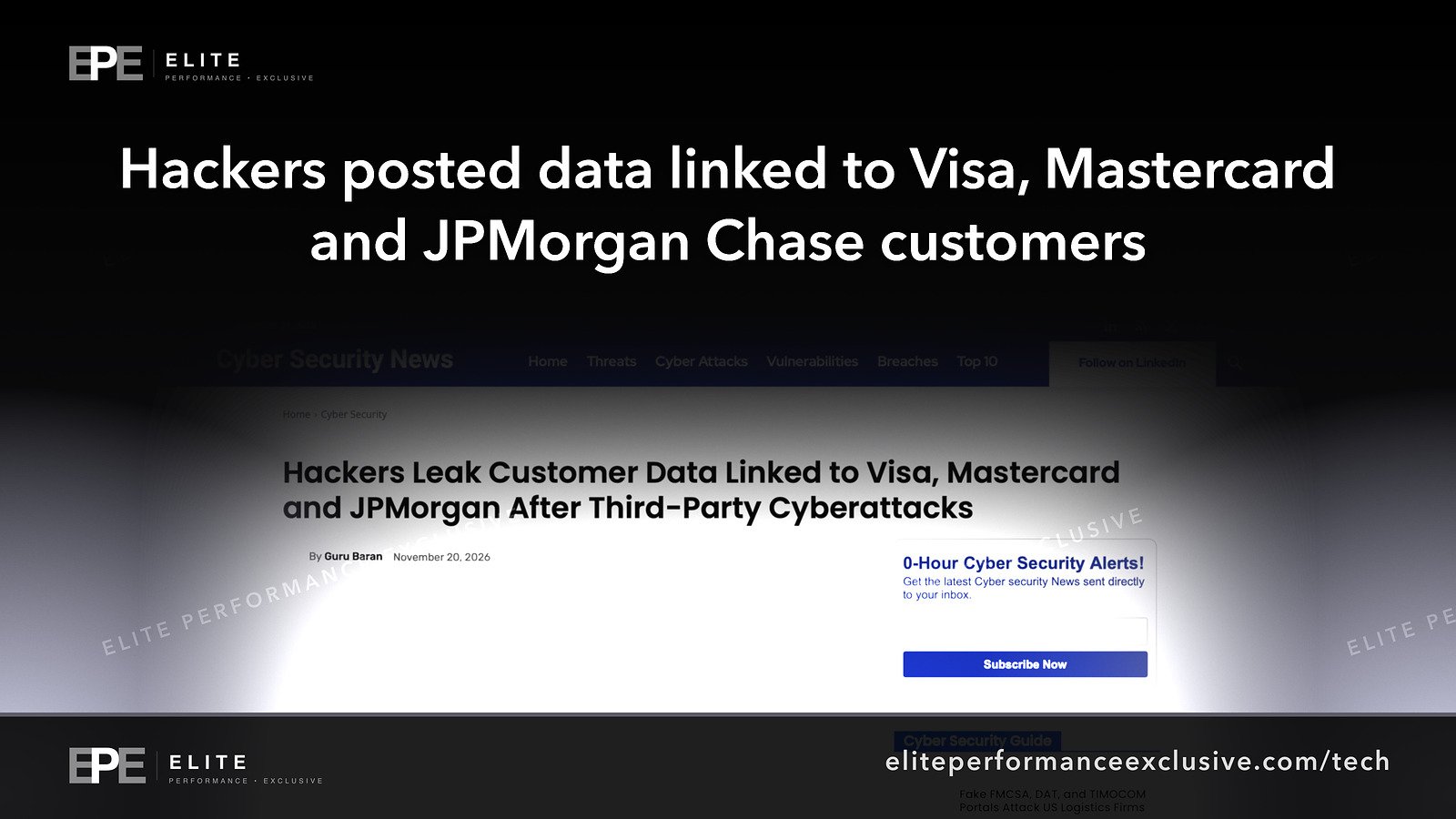
On Thursday, November 19, 2026, hackers published customer data linked to Visa, Mastercard and JPMorgan Chase. All three companies say their own networks were not breached. If your business banks with Chase or takes Visa and Mastercard payments, the main risk this week is probably not a stolen card number. It is a convincing fake breach notice landing in the inbox of the person who approves your payments.
What happened in the JPMorgan, Visa and Mastercard data leak
A cyber extortion group called n0n claimed responsibility and posted files it linked to the three companies. CybersecurityNews reported the story on November 20, 2026, and TechRadar carried statements from Visa and JPMorgan.
We could not open a statement from any of the three companies on their own sites for this post. Everything below is what the companies said as reported by those two outlets:
- Visa said no card numbers were affected. In a statement carried by TechRadar, a Visa spokesperson said: "Visa's systems were not involved and were not impacted." The statement added: "There is no indication that payment data such as card numbers have been affected."
- JPMorgan Chase said the attackers accessed marketing data. Separately, JPMorgan put a temporary service issue down to a software bug in on-premise hardware systems and said there is no evidence it was cyber-related.
- Mastercard said the leak involved a limited group of cardholders in a benefits program, and that the exposure had been contained.
On scale, a Reuters review found more than 16,000 email addresses in files linked to JPMorgan. The Wall Street Journal reported data linked to thousands of customers.
JPMorgan data breach: confirmed vs claimed
| Statement | Status |
|---|---|
| Files linked to Visa, Mastercard and JPMorgan Chase were posted online | Reported, and all three companies responded |
| The group n0n is responsible | Claimed by n0n |
| The companies' own networks were breached | Denied by all three |
| Card numbers were exposed | Visa says no card numbers were affected |
| JPMorgan marketing data was accessed | Said by JPMorgan |
| Mastercard cardholders in a benefits program were involved | Said by Mastercard, which says the exposure is contained |
| More than 16,000 email addresses in JPMorgan-linked files | Found by a Reuters review |
| The JPMorgan service issue was an attack | JPMorgan says it was a software bug, with no evidence it was cyber-related |
What is not known yet
The sources do not say:
- Where the posted data came from, or how n0n got it.
- Which system held JPMorgan's marketing data, given that JPMorgan says its own network was not breached.
- Which benefits program at Mastercard was involved, or how many cardholders.
- What else was in the files besides email addresses.
- How many people are affected in total across the three companies.
- Whether n0n has made any demand.
The statements we could confirm say only that the companies' own networks were not breached. None of them names a vendor. Treat any vendor name you see as unconfirmed until one of the companies says it.
Why saying your network was not breached still matters to a business
Three large companies say their systems were safe, and yet customer data tied to them is now public. That gap is worth thinking about. Customer data rarely lives in one place. Marketing lists, email platforms, loyalty and benefits programs all hold copies, and every copy is a place it can leak from, whoever runs it.
The practical follow-on for most businesses is phishing. A list of email addresses tied to a bank is exactly what someone needs to send messages that look like breach notices, account alerts or requests to confirm card details. The people most worth targeting are owners, bookkeepers and accounts payable staff, because they can move money.
What to do this week
| Action | Who | How |
|---|---|---|
| Warn staff that fake breach notices may arrive | Everyone with a work inbox | Any email or text about Chase, Visa or Mastercard data: do not click links or call numbers in the message |
| Verify notices the safe way | Anyone who gets a notice | Open the bank's own app directly and check there, as the reporting advises |
| Report Chase phishing | Chase customers | Forward suspicious emails to phishing@chase.com |
| Add a second check on payment changes | Accounts payable, owners | Confirm any request to change bank details or approve an urgent payment through a known phone number, not the email |
| List where your customer data lives | Whoever runs your IT | Note every vendor that holds customer emails: newsletter tool, online store, booking or loyalty system |
| Decide who tells customers | Owner or manager | If a vendor of yours is ever hit, know in advance who writes the notice and how customers can verify it is real |
None of this needs new software. It is a short staff message and a few minutes with your vendor list.
If your business holds customer data too
The same pattern applies at any scale. Your website contact form, your newsletter platform and your online store each keep a copy of customer details. If one of them leaks, saying your network was fine will not reassure your customers much.
Start with three questions:
- Which outside services hold your customer list? If nobody can answer quickly, that is the first fix.
- Do you still need all of it? Old exports and forgotten marketing lists are pure risk.
- Who can log in to each service, and is two-step login turned on? Former staff accounts are a common weak point.
If you want fewer copies in fewer places, our self-hosting and infrastructure work keeps data on systems you control.
JPMorgan data breach questions people are asking
Was JPMorgan Chase hacked?
JPMorgan said its own network was not breached, but said the attackers accessed marketing data. The sources do not say where that marketing data was held.
Were Visa or Mastercard card numbers stolen?
Visa said no card numbers were affected. Mastercard said the leak involved a limited group of cardholders in a benefits program and has been contained. Mastercard's statement, as reported, does not list which data was involved.
Who is n0n?
A cyber extortion group that claimed responsibility and posted the files. The sources give no further detail about the group.
How many people are affected by the Visa Mastercard data leak?
Not known. A Reuters review found more than 16,000 email addresses in files linked to JPMorgan, and the Wall Street Journal reported data linked to thousands of customers. No company has given a total.
Was the Chase outage part of the cyberattack?
JPMorgan said a temporary issue was caused by a software bug in on-premise hardware systems and that there is no evidence it was cyber-related.
Was this a third-party vendor breach?
Not confirmed. The companies say their own networks were not breached, but none has named a vendor.
I got a breach email about my bank account. Is it real?
Do not use the links or phone numbers in the message. Check through your bank's own app. Chase customers can forward suspicious emails to phishing@chase.com.
Do I need a new card?
The sources do not say card numbers were taken, and Visa says they were not. If your bank contacts you through its app about a replacement, follow its instructions there.
The bigger lesson
A company can say, truthfully, that its own network was not breached while its customers' data still ends up public. Your customer data lives wherever you have sent it, so security means knowing every copy, cutting the ones you do not need, and teaching staff to verify any alert before acting on it. A leaked email list does damage through the phishing that comes after it, and a short staff warning this week is cheap insurance.
To find out where your customer data lives and lock it down, see security hardening or get a quote.
Get security alerts like this by email, plus the free checklist, at security alerts.
Sources: CybersecurityNews; TechRadar.
Have a question about this article?
Ask it here and we will answer you directly by email. Questions are private, never posted.
Security alerts by email
Hear about the next one first.
When attackers start using a flaw in software businesses run on, we email what it is, whether it touches you and what to do that week, with a round-up of our latest security writing. Free, one-click unsubscribe. You get the checklist straight away: 12 things to secure this week.
Want a result like this?
Security alerts, breaches and the technology a business runs on: what happened, who it affects and what to do.
Get a Tech QuoteKeep reading
JPMorgan Chase Data Breach: Vendor Attack May Have Exposed Customer Names and Emails, What Is Confirmed, What n0n Claims About Qubole, and What to Do This Week
JPMorgan Chase says vendors that serve the bank were hit in a cyberattack that reached marketing data, possibl...
Muse AI Agent Signal Messages: Reuters Says Meta's Muse Read Signal Chats on Android and Mac, What Is Confirmed and How to Check AI Permissions on Work Devices
Reuters reports that Meta's Muse AI agent pulled Signal messages through Android notification access and Mac a...
California Sues OpenAI Over AI Agents It Says Got Out of Control 80 Times: What Is Confirmed, What Hugging Face Said and What to Check This Week
California's Attorney General is suing OpenAI, alleging the company lost control of its autonomous AI agents a...
