Lovable Data Leak: Apps Built on Lovable Exposed Passport Details and 200,000 Chat Messages, What Is Confirmed and What to Check
Researchers found thousands of Lovable-built apps handing out database records with no login, including passport numbers and 200,000 chat messages. Here is what is confirmed, what is not, and what to check this week.
Where Germany · Europe, Western Europe, Worldwide
On this page 10 sections
What happened with Lovable apps
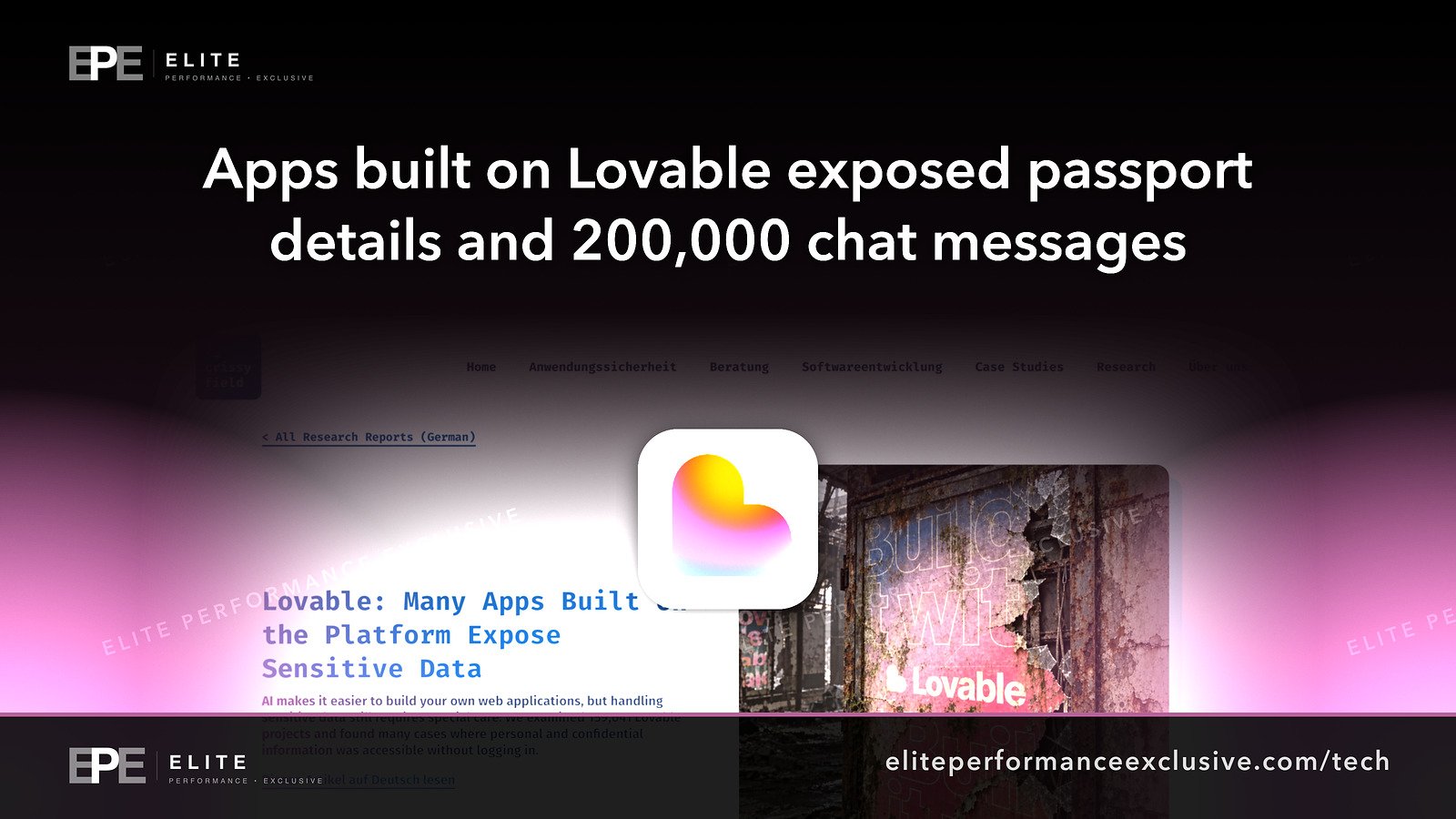
Researchers at Crissy Field, a security firm in Hamburg, worked with the German business newspaper Handelsblatt and found that websites built with the AI app builder Lovable were giving out database records to anyone who asked, with no login required. If your company built a customer portal, booking form or internal tool on Lovable, or on any AI app builder, your customers' data could be readable by strangers. Lovable's terms say the apps you build and deploy are your responsibility.
Handelsblatt published its story on Monday, November 2, 2026. The researchers then published their own report with newer figures, and those figures are the ones used here.
What the researchers found
The researchers used Common Crawl, a public archive of the web, to find 159,041 Lovable projects created between December 2025 and September 2026. Of those, 34,545 used Supabase, the database service that Lovable apps often connect to, and the study looked only at those.
- 24,664 websites sent database records from Supabase as soon as they loaded, "without requiring a login or any other interaction." The researchers say this alone is not a security problem, because some of that data may be meant to be public.
- They then made more read-only requests using the same API key and found email addresses in 10,560 tables across 7,403 websites, which is 30% of the 24,664.
- The researchers say plainly that the 30% figure "should therefore not be read as a confirmed data leak rate." Some of those addresses may be public contact addresses or test data.
Some individual cases they describe:
| What was exposed | Who it belonged to |
|---|---|
| More than 80,000 profiles and more than 200,000 chat messages | A German lifestyle forum |
| More than 1,000 identity document records with passport numbers, expiry dates and nationalities | A service provider |
| Tens of thousands of ticket and food sales records | Event organizers and restaurants |
| 280,000 emails sent to customers | One provider |
| AI-generated summaries of internal emails about tenants, owners and partners | A property management company |
| Tens of thousands of contracts and invoices, personal photo albums, internal WhatsApp messages | Various apps |
How the researchers found the Lovable data
A Lovable app built on Supabase typically lets the visitor's browser talk directly to the database. The website carries a key so it can do this. Whether a stranger can read a table depends on the database's access rules, not on keeping that key secret.
The researchers loaded the websites, recorded what data came back, then made a limited number of extra read-only requests with the same key. They took only part of each dataset, so the real amount exposed may be larger. They chose not to publish the exact access details so that others cannot repeat the requests easily.
The report does not say which setting was wrong in each app. An earlier, documented Lovable issue does say, and it is covered below.
Claimed, confirmed and not known
Confirmed by the researchers: the data listed above could be read from these apps without logging in, at the time they checked.
Not confirmed:
- Misuse. The researchers write: "We could not establish whether any of it had been misused." There is no evidence in the report that criminals took this data.
- Passport scans. Some headlines mention passport scans. The report describes passport numbers, expiry dates and nationalities, not images of passports.
- A breach rate for all Lovable apps. The sample came from Common Crawl and the researchers say it is not representative of all Lovable applications.
- Names of affected apps, and whether they have been fixed. The report does not name them.
- Lovable's response. The report says Handelsblatt contacted Lovable with the findings. It does not include a reply.
This is not the first Lovable security report: CVE-2025-48757
In March 2025, researcher Matt Palmer found that Lovable-generated apps could have database tables open to anyone because of missing or weak Supabase row level security, the database rules that decide who can read and change each row. He reported it to Lovable on March 21, 2025.
It became CVE-2025-48757, published in the CVE list on May 30, 2025. The record says insufficient row level security in Lovable through April 15, 2025 let attackers with no login read or write any database table of generated sites. It is rated 9.3, critical. The record is marked disputed: Lovable's position is that each customer is responsible for protecting their own application's data.
Palmer's report lists what was at risk then: names and email addresses, API keys for other services, and payment and subscription records, including the ability to change payment status. He also notes that Lovable's publish step checks whether row level security is turned on, but not whether the rules are actually strict enough.
Who is responsible for a Lovable app's security
Lovable's own terms, last updated August 28, 2026, say: "You are responsible for your Customer Data and for the applications and projects you build, deploy, and make available." On the AI-written code itself, they say you are "solely responsible for reviewing, validating, and using any AI Output."
The researchers point out the gap: the terms place the responsibility on customers, while the marketing suggests no technical knowledge is needed.
Why the Lovable data leak matters for a business
If a tool your company built is leaking customer records, your company holds the data, so the legal and reputational problem is yours, not the platform's. Depending on where you and your customers are, data protection and breach notification laws may apply, so talk to your lawyer if you find exposed personal data.
The pattern also goes beyond Lovable. Apps get built quickly by someone in operations or marketing, connected to real customer data, and never reviewed by anyone who knows how database permissions work. AI can write code, but a human must review it before it ships.
What to do this week
| Step | How to check |
|---|---|
| List every AI-built app | Ask each department what they have built on Lovable or similar builders, and what data each one stores |
| Check row level security on every table | In Supabase, confirm it is turned on for every table, not only the main ones |
| Look for rules that allow everyone | Rules that let any visitor read a whole table of customer data need to be replaced with rules tied to the logged-in user |
| Review access for visitors and logged-in users | Check what the "anon" and "authenticated" roles are allowed to read and change |
| Test as a stranger and as another user | Log out, or log in as a second test account, and confirm you cannot see anyone else's records |
| Move secrets out of tables | API keys and tokens for other services should not sit in tables the browser can read |
| Delete what you do not need | Do not keep passport details, ID numbers or old messages unless you must |
| Recheck after every major change | New features often add new tables with no rules |
If you would rather keep customer data on infrastructure you control and can audit, our self-hosting infrastructure page explains how that works.
Lovable data leak questions people are asking
Was Lovable hacked?
No hack of Lovable itself is reported. The researchers found that individual apps built with Lovable were exposing data because of how their databases were set up.
Were passport scans leaked from Lovable apps?
The report describes more than 1,000 records with passport numbers, expiry dates and nationalities from one service provider. It does not mention scanned images.
Was the exposed data misused?
Not known. The researchers say they could not establish whether any of it was misused.
Are 30% of Lovable apps leaking data?
No. The 30% is the share of one group of sites where email addresses were found, and the researchers say it is not a leak rate.
Is my Lovable app affected?
The affected apps are not named. Check your own database rules and test as a logged-out visitor using the checklist above.
Who is responsible for securing a Lovable app?
Under Lovable's terms, the customer who builds and deploys the app.
The bigger lesson
A tool that builds an app in an afternoon does not check who can read the data afterwards. Someone qualified has to look at the permissions before real customer data goes in, and again after every big change.
See how we approach security hardening, or request a free quote for a review of your apps.
Get security alerts by email, with the free checklist, at our security alerts page.
Sources: Crissy Field research report on Lovable; Matt Palmer, CVE-2025-48757; CVE-2025-48757 record; Lovable Terms.
Have a question about this article?
Ask it here and we will answer you directly by email. Questions are private, never posted.
Security alerts by email
Hear about the next one first.
When attackers start using a flaw in software businesses run on, we email what it is, whether it touches you and what to do that week, with a round-up of our latest security writing. Free, one-click unsubscribe. You get the checklist straight away: 12 things to secure this week.
Want a result like this?
Security alerts, breaches and the technology a business runs on: what happened, who it affects and what to do.
Get a Tech QuoteKeep reading
Moldova Cyberattack: State Actor Suspected After Citizen Data Was Taken From Government Systems, What Is Confirmed and What to Check
Moldova says hackers accessed the personal data of about 450,000 citizens through government digital services....
Park Dental Data Breach Settlement: Up to $2,500 for Patients, a December 28 Claim Deadline, and Why the Case Is Still Not Over
Park Dental patients have until December 28, 2026 to claim up to $2,500 or $60, plus credit monitoring, over a...
Rosstat Cyberattack: Russia's Statistics Agency Is Still Restoring Systems, What Is Confirmed and What Businesses Should Check
Rosstat says it is still restoring systems after cyberattacks from October 29 to November 1, 2026. Hackers cla...
