Medical Record Snooping: UK Regulator Logs More Than 300 Insider Access Reports in 2026 and Gives Health Chiefs Until 27 November to Prove Their Safeguards Work
The ICO received more than 300 reports of staff looking at medical records without a legitimate reason this year. Here is what is confirmed, what is not known, and how any business can check its own insider access this week.
Where United Kingdom · Europe, Northern Europe
On this page 7 sections
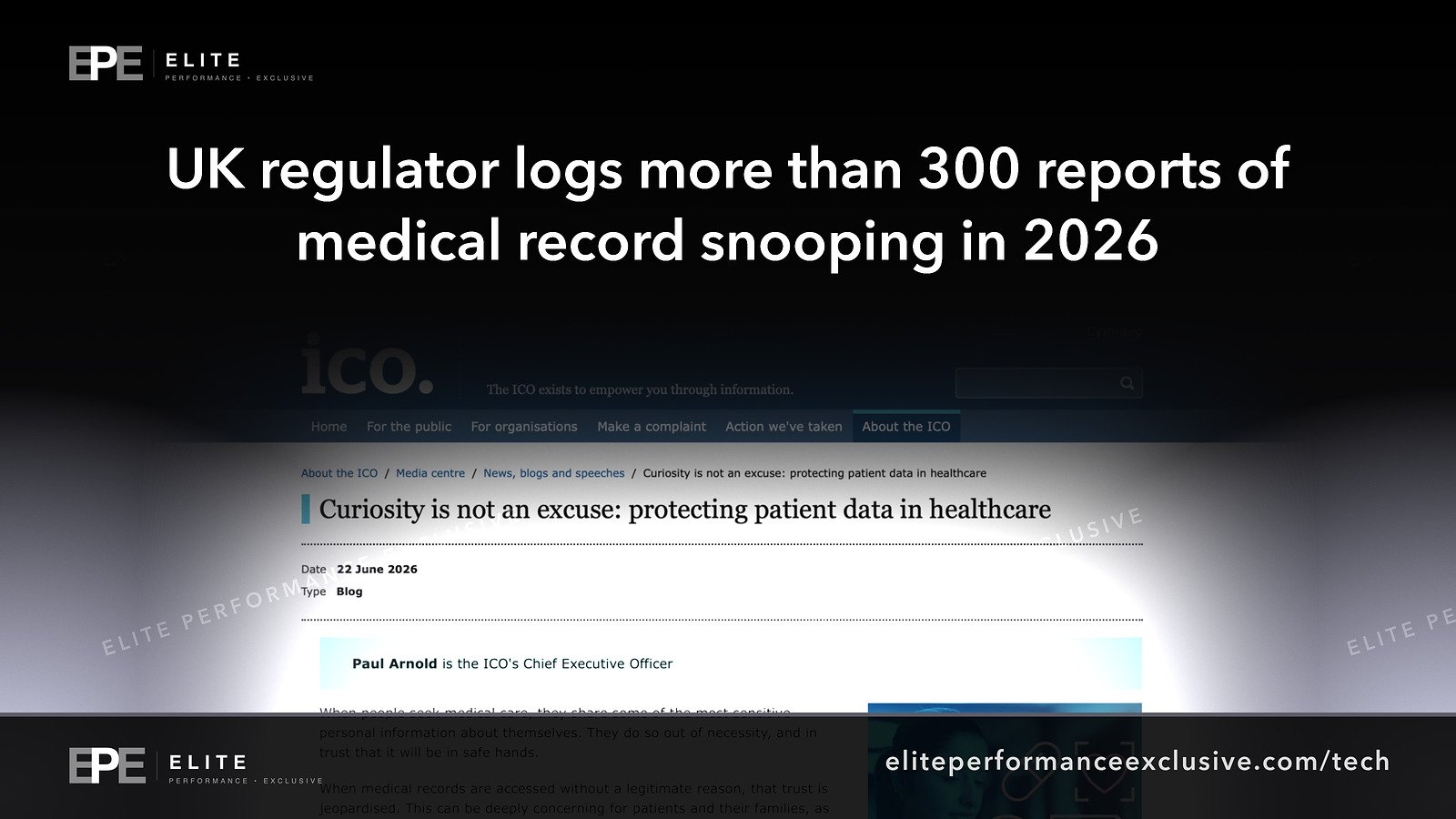
The UK's data protection regulator, the Information Commissioner's Office (ICO), received and assessed more than 300 reports of medical record snooping between January and mid-October 2026. In these cases staff looked at patient records without a legitimate reason. The threat here is not an outside hacker. It is people who already have a login, and any business that holds customer records has the same exposure.
The ICO has now written to more than 200 of the UK's most senior health service leaders and given them until 27 November to respond. Below we set out what the regulator has confirmed, what is still not known, and a checklist any business can use this week to answer the same question the ICO is asking: do your safeguards work in practice?
What happened with medical record snooping in the UK
The news was published on 13 November 2026 by The Register and by Local Government Lawyer, a UK legal news site. According to both, health sector organisations sent the ICO more than 300 reports of unauthorised access to records between 1 January and mid-October 2026.
The ICO's response is aimed at the top of each organisation, not at individual staff. In comments reported by The Register, the ICO said: "I've written to chief executives across the UK asking them to personally assure me that their safeguards work in practice."
Local Government Lawyer reports that the regulator describes the problem as "fundamentally a question of leadership and culture". In other words, the ICO is treating this as a management problem as well as a technical one.
What the ICO has confirmed
These points come from the ICO's own website and from the two news reports that quote it:
- The number of reports: more than 300, received and assessed between January and mid-October 2026.
- Who reported them: health sector organisations themselves.
- Who was contacted: more than 200 senior health service leaders across the UK.
- The deadline: executives have until 27 November to respond.
- Past enforcement: the ICO has prosecuted 16 healthcare workers for snooping through patient records over the past decade.
- The law: on its own site, the ICO states: "Knowingly or recklessly accessing personal data without authorisation for whatever reason is against the law."
- The regulator's view of the harm: "Accessing someone's health records without a legitimate reason isn't harmless curiosity." The ICO added that it "can cause enormous distress to patients and jeopardize the vital trust people place in our health service,"
- What it expects next: where safeguards do not work, "Where they don't, we expect organizations to put that right,"
The ICO is also careful about fairness to staff. Its earlier guidance says: "Inappropriate access is rare and does not represent the behaviour of the vast majority of healthcare staff".
What is not known yet
Our sources do not say:
- Which organisations made the reports, or how they are split across the UK's nations.
- How many patients or records were involved.
- Whether any of the 300-plus reports will lead to prosecution or other action.
- What the ICO will do with responses after 27 November, or what happens to leaders who do not reply.
- Whether the 2026 figure is higher or lower than earlier years. Some coverage describes a surge, but the primary material we checked gives no comparison, so we cannot confirm one.
If the ICO publishes results from this exercise, the picture may change.
Why insider access to records matters for a business
Most security spending goes on keeping outsiders out: firewalls, multi-factor login, patching. Snooping gets past all of that because the person doing it is supposed to be there. They have a valid account, they pass every login check, and the system lets them open the record because their role allows it.
That is true well beyond UK hospitals. A clinic, a law firm, an insurance agency, a payroll provider or an online store all hold records that staff can open. The questions the ICO is putting to health chiefs apply to any of them:
- Does each person only have access to the records their job needs?
- Is every view recorded, not just every change?
- Does anyone actually read those records of who looked at what?
- Would you know if someone looked at a record yesterday without a reason?
If your software cannot answer those questions, the gap is in how the system was built, not in your staff. Access by role and a reliable record of who viewed what are much easier to build in from the start than to add later. This is part of what we cover in security hardening, and if you run your own servers, the logs need somewhere safe to live, which is covered on our self-hosting and infrastructure page.
What to do this week: an insider access checklist
No software update fixes this. It is about settings, process and ownership. Here is a short list you can work through this week.
| Check | What to look for | Who owns it |
|---|---|---|
| List who can open customer or patient records | Every account with access, including shared and old accounts | IT lead |
| Match access to job roles | People who can see far more records than their work needs | Department heads |
| Remove leavers and movers | Accounts for former staff, or staff who changed roles but kept old access | IT lead and HR |
| Confirm views are logged | Your system records who opened a record, not only who edited it | IT lead or software vendor |
| Review the logs on a schedule | Someone is named to read them weekly or monthly, and does | Named manager |
| Look for unusual patterns | Staff opening records of coworkers, relatives or neighbours, large volumes, or out-of-hours access with no clear reason | Named manager |
| Tell staff plainly | Looking at records without a work reason is misuse, and it is checked | Leadership |
| Give a way to report concerns | Staff know who to tell if they see misuse | Leadership |
The last test is the one the ICO is asking UK health leaders to sign off personally: could you tell your regulator, your customers or your board that your safeguards work in practice, not just on paper?
Medical record snooping questions people are asking
What is medical record snooping?
It means a member of staff looking at a patient's health record without a legitimate work reason, for example out of curiosity about a coworker, a relative or a neighbour.
How many medical record snooping reports did the ICO get in 2026?
More than 300 between 1 January and mid-October 2026, sent in by health sector organisations.
Is looking at medical records without a reason illegal in the UK?
Yes. The ICO states that knowingly or recklessly accessing personal data without authorisation, for whatever reason, is against the law.
Has anyone been prosecuted for snooping on patient records?
Yes. The ICO has prosecuted 16 healthcare workers for snooping through patient records over the past decade.
What is the ICO deadline for health leaders?
More than 200 senior health service leaders have until 27 November to respond and give the ICO their assurance.
Is medical record snooping increasing?
The primary material we checked does not compare 2026 with earlier years, so it is not known whether this is a rise.
Does this matter for businesses outside the UK or outside healthcare?
The ICO's letters went to UK health leaders only. The lesson applies anywhere staff can open customer records: limit access by role, record every view, and review those records.
The bigger lesson
The most damaging access to your data may come from an account you created yourself. Strong passwords and firewalls cannot tell a legitimate look from a nosy one. Only the right access rules, a full record of who viewed what, and someone who actually reviews it can do that. The ICO has framed this as leadership and culture, and that is a fair test for any business: who in your company owns the answer?
To build those controls into your systems, see security hardening or request a quote.
Get security alerts by email, along with our free checklist, at /security-alerts.
Sources: The Register; Local Government Lawyer; Information Commissioner's Office.
Have a question about this article?
Ask it here and we will answer you directly by email. Questions are private, never posted.
Security alerts by email
Hear about the next one first.
When attackers start using a flaw in software businesses run on, we email what it is, whether it touches you and what to do that week, with a round-up of our latest security writing. Free, one-click unsubscribe. You get the checklist straight away: 12 things to secure this week.
Want a result like this?
Security alerts, breaches and the technology a business runs on: what happened, who it affects and what to do.
Get a Tech QuoteKeep reading
GitHub Accounts Hijacked: wfx-loot Malware Pushed Through 4,837 Stolen Accounts to 61,764 Repositories, What Is Confirmed and What to Check
Researchers say 4,837 hijacked GitHub accounts opened probe pull requests in 61,764 repositories to spread wfx...
Optimizely Malware Attack: Malicious JavaScript Reached 178 Organizations Including BBC, CNN and Zoom, What Is Confirmed and What to Check on Your Website
On 16 November 2026, an attacker used a flaw in Optimizely's Web Experimentation signup flow to inject malicio...
Cursor Security Breach: A Key Issued to Fireworks AI Led to a Malicious Claude Code Extension, What Is Confirmed and What to Check This Week
An attacker used an access key Cursor had issued to Fireworks AI, and a malicious Claude Code extension reache...
