NGINX Vulnerability CVE-2026-123007: NGINX2Root Exploit Code Is Public, Versions 1.9.5 Through 1.31.8 Affected, and the Fixed Versions to Install
Exploit code is public for nginx flaw CVE-2026-123007, a memory corruption bug in HTTP/2 flow control. Versions 1.9.5 through 1.31.8 are affected. Update to 1.30.7 or 1.31.9 this week.
Where Worldwide
On this page 9 sections
nginx has released fixes for ten security flaws, and proof-of-concept exploit code for one of them, CVE-2026-123007, is now public. If your website, web app or API runs on nginx 1.9.5 through 1.31.8, update to 1.30.7 (stable) or 1.31.9 (mainline) this week, before anyone turns that code into working attacks.
Xint Research disclosed the flaws under the name NGINX2Root. Below you will find what the primary sources confirm, what has only been reported, what nobody has said yet, and a checklist for your servers.
What happened with the NGINX vulnerability
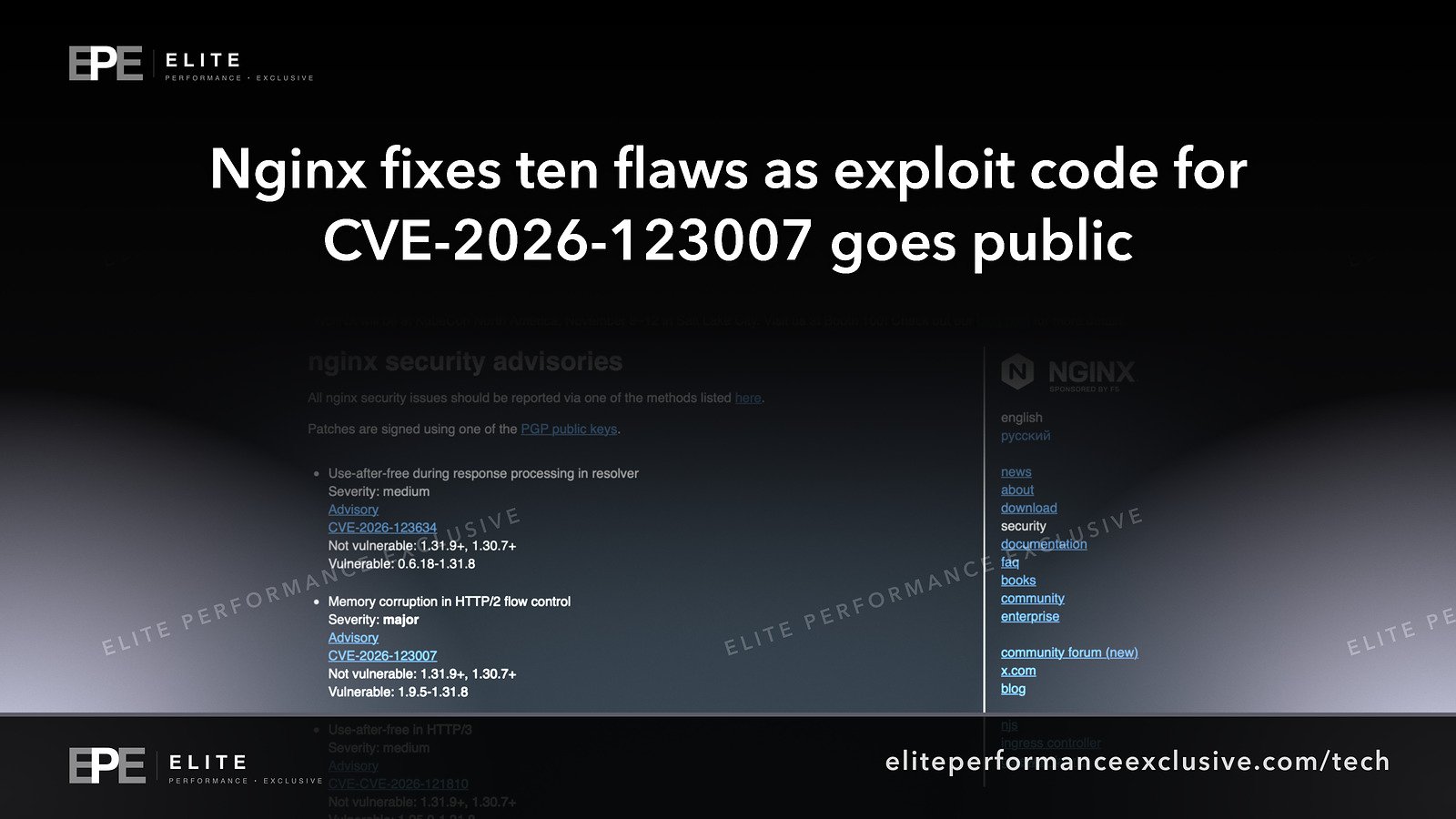
On 2026-11-18, nginx.org announced that nginx-1.30.7 stable and nginx-1.31.9 mainline had been released with vulnerability fixes. The announcement lists ten CVEs. CVE-2026-123007 is getting the most attention, and nginx describes it as "memory corruption in HTTP/2 flow control".
Two things make this urgent:
- Exploit code is public. SecurityWeek reports that proof-of-concept (PoC) code targeting CVE-2026-123007 has been published.
- The affected range is wide. nginx's own security advisories page lists the vulnerable versions as 1.9.5 through 1.31.8. Any server that has not been updated to one of the new releases is in scope.
What is confirmed and what is only reported
| Point | Status | Source |
|---|---|---|
| Fixed releases 1.30.7 (stable) and 1.31.9 (mainline) published on 2026-11-18 | Confirmed | nginx.org news |
| Vulnerable: 1.9.5 through 1.31.8. Not vulnerable: 1.31.9 and later, 1.30.7 and later | Confirmed | nginx security advisories |
| nginx rates the severity as major | Confirmed | nginx security advisories |
| All five NGINX2Root flaws have a CVSS 4.0 score of 9.2 out of 10 | Reported | Security Affairs |
| PoC code targeting CVE-2026-123007 has been published | Reported | SecurityWeek |
| CVE-2026-123007 was not on CISA's Known Exploited Vulnerabilities catalog at the time of writing | Reported | Security Affairs |
| Nearly 10 million internet services run nginx versions vulnerable to the NGINX2Root CVEs | Reported | Security Affairs |
| Attacks in the wild | Not reported | SecurityWeek |
On exploitation, SecurityWeek writes: "F5 makes no mention of any of these vulnerabilities being exploited in the wild."
What is not known yet
- The attack path. The name NGINX2Root suggests a route to root access, but the sources we checked do not describe the attack chain or what an attacker needs to reach it.
- Who published the PoC, and how reliable it is. SecurityWeek reports that the code exists. We have not seen an independent test of whether it works.
- Any workaround. None of the sources gives a setting that removes the risk. Upgrading is the only fix we can point to.
- How the 10 million figure was counted. Security Affairs reports the number without a method we could check, so treat it as a rough sense of scale.
Which nginx versions are affected by CVE-2026-123007
nginx's advisory lists the vulnerable range as 1.9.5 through 1.31.8 and the safe versions as 1.31.9+ and 1.30.7+. The advisory does not give separate cutoff versions for the stable and mainline branches. If you run the stable branch, move to 1.30.7. If you run mainline, move to 1.31.9.
All ten CVEs fixed in nginx 1.30.7 and 1.31.9
The nginx.org announcement lists these fixes, in nginx's own words:
| CVE | What nginx says it is |
|---|---|
| CVE-2026-123634 | Use-after-free in resolver |
| CVE-2026-123007 | Memory corruption in HTTP/2 flow control |
| CVE-2026-121810 | Use-after-free in HTTP/3 |
| CVE-2026-123633 | Use-after-free in HTTP/2 |
| CVE-2026-118899 | Infinite loop while reading client request body over TLS 1.3 |
| CVE-2026-113425 | Use-after-free in mail proxy module |
| CVE-2026-120993 | NULL pointer dereference when using PROXY protocol version 2 |
| CVE-2026-125283 | Buffer overflow when using alias with try_files |
| CVE-2026-120967 | SNI bypass in client certificate validation in stream module |
| CVE-2026-123640 | Insufficient validation in stream ssl_preread module |
The list covers HTTP/2, HTTP/3, the resolver, the mail proxy and the stream modules, so do not assume a server is safe because it does not use one particular feature. One upgrade fixes all ten.
Is NGINX2Root being exploited?
No source we checked reports attacks. Security Affairs says CVE-2026-123007 was not on CISA's Known Exploited Vulnerabilities catalog when it wrote, and SecurityWeek says F5 makes no mention of exploitation in the wild.
That could change quickly. Public PoC code means the hard part of the research is already written down. Plan to patch now, not after the first reports of attacks.
How to check your nginx version and patch it this week
- Find every copy of nginx. Check web servers, reverse proxies, load balancers, container images, and any hosting panel or appliance that bundles it.
- Check the version. Run
nginx -von each server. Anything from 1.9.5 through 1.31.8 needs updating. - Upgrade. Stable branch: 1.30.7. Mainline branch: 1.31.9.
- Confirm the running version. Make sure the process actually serving traffic is the new one, not just the package on disk.
- Ask your suppliers. If nginx came from your operating system's packages, a hosting company or a vendor appliance, ask which build contains these fixes and get the answer in writing.
- Rebuild containers. Images built on an old nginx base stay vulnerable until they are rebuilt and redeployed.
- Keep watching. Check the nginx advisory page and CISA's catalog this week in case exploitation is confirmed.
Why the NGINX flaw matters for a business website
nginx usually sits at the front door. It receives traffic from the internet and passes it to your website, online store, customer portal or API. A flaw at that point is exposed to anyone who can reach your site, without a login.
If Security Affairs' figure is close, a very large number of public servers are still on vulnerable versions. Many of them belong to businesses that never think about their web server because a hosting company, an agency or a long-gone contractor set it up. If you do not know who updates yours, now is the time to find out.
If you host your own servers, this is the kind of routine patching that has to happen on a schedule. Our self-hosting and infrastructure page explains how we approach it.
NGINX2Root questions people are asking
What is CVE-2026-123007?
nginx describes it as memory corruption in HTTP/2 flow control. It is one of ten flaws fixed in nginx 1.30.7 and 1.31.9.
Which nginx version fixes NGINX2Root?
nginx 1.30.7 (stable) and 1.31.9 (mainline), plus any later version. nginx lists 1.9.5 through 1.31.8 as vulnerable.
Should I install 1.30.7 or 1.31.9?
Stay on the branch you already use. nginx lists both as not vulnerable.
Is the nginx vulnerability being exploited?
No attacks have been reported in the sources we checked. Security Affairs reports PoC code is public and the flaw was not on CISA's catalog when it wrote.
How serious is CVE-2026-123007?
nginx rates it major. Security Affairs reports that all five NGINX2Root flaws score 9.2 out of 10 on CVSS 4.0, which counts as critical.
Is there a workaround if I cannot update today?
None of the sources we checked gives one. Plan the upgrade instead of relying on a config change.
Who found NGINX2Root?
Xint Research disclosed it, according to Security Affairs.
The bigger lesson
The software that quietly serves your website matters as much as the website itself. Fixes for this flaw were published on 2026-11-18, and exploit code followed. What protects a business is knowing where every copy of nginx runs, who owns updating it, and how fast that person can act once a fix ships.
See how we keep servers patched at security hardening, or ask for a quote to have your web servers checked.
Get security alerts like this by email, along with the free checklist, at security alerts.
Sources: nginx.org news 2026; nginx security advisories; SecurityWeek; Security Affairs.
Have a question about this article?
Ask it here and we will answer you directly by email. Questions are private, never posted.
Security alerts by email
Hear about the next one first.
When attackers start using a flaw in software businesses run on, we email what it is, whether it touches you and what to do that week, with a round-up of our latest security writing. Free, one-click unsubscribe. You get the checklist straight away: 12 things to secure this week.
Want a result like this?
Security alerts, breaches and the technology a business runs on: what happened, who it affects and what to do.
Get a Tech QuoteKeep reading
CISA KEV: Apache Axis, REDCap, Synology DSM and LiteLLM Flaws Exploited, No Patch Coming for Axis 1.x, and the Fixed Versions to Install
CISA has added exploited flaws in Apache Axis, REDCap, Synology DSM and LiteLLM to its KEV catalog. Apache wil...
Database RCE: PostgreSQL CVE-2026-116331, ClickHouse, MySQL and Oracle Flaws Show Locked-Down Database Accounts Can Still Reach the Server, and the Fixed Versions
Depthfirst researcher Zheng Yu showed that tight database permissions still leave room for attacks that run co...
Java4Shell Vulnerability CVE-2026-114938: Critical OpenJDK Base64 Flaw, Attack-Shaped Traffic Recorded, and What to Patch This Week
Java4Shell (CVE-2026-114938) is a critical memory-corruption flaw in OpenJDK's Base64 decoder. It affects unpa...
