Palo Alto CVE-2026-114938: Critical Java Vulnerability in Idira Privilege Threat Analytics and Remote Access Connector, No Workaround, and the Fixed Versions to Install
Palo Alto Networks says the critical Java flaw CVE-2026-114938 affects Idira Privilege Threat Analytics and the Remote Access Connector. Here are the fixed versions, what is confirmed and what is still not known.
Where Worldwide
On this page 7 sections
Palo Alto Networks says a critical Java vulnerability, CVE-2026-114938, affects several of its Idira products, including Privilege Threat Analytics and the Remote Access Connector. If your company runs any of them, there are fixed versions to install, no workaround to fall back on, and a severity rating of CVSS 9.2, Critical.
CISA says the underlying flaw is known as Java4Shell. It sits in Java's Base64 decoder, and according to CISA it can be triggered without a login. This post covers what is confirmed, what is not known yet, and what to do this week.
What happened with the Palo Alto Java vulnerability CVE-2026-114938
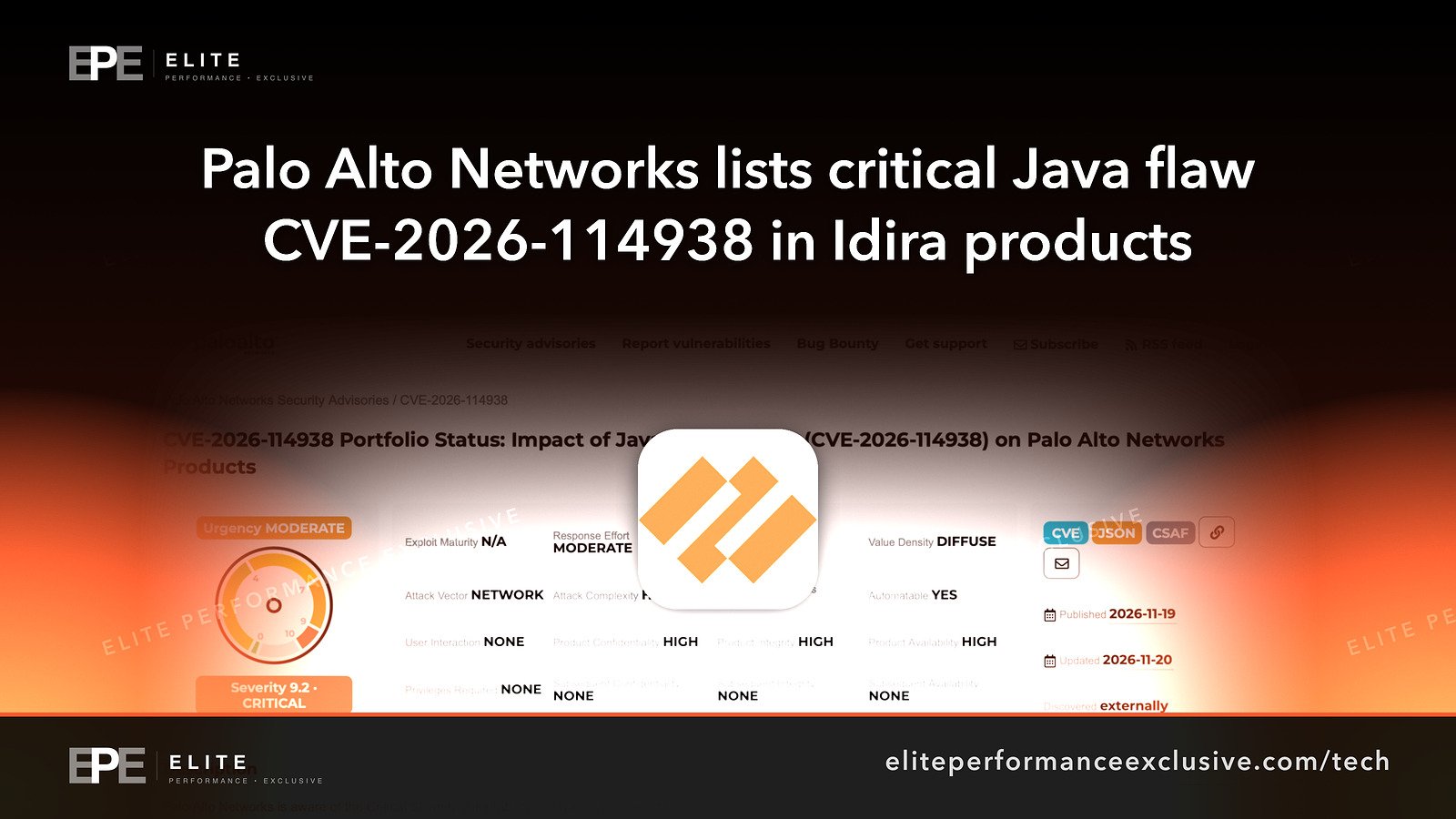
On Friday, November 20, 2026, Palo Alto Networks published an advisory titled "Portfolio Status: Impact of Java Vulnerability (CVE-2026-114938) on Palo Alto Networks Products". The title tells you how to read it. Palo Alto is checking its own products against a vulnerability in Java, so the bug appears to start in Java rather than in code Palo Alto wrote.
Palo Alto rates the issue CVSS 9.2, Critical.
Three days earlier, on Tuesday, November 17, 2026, the US Cybersecurity and Infrastructure Security Agency (CISA) published an alert about a critical Java vulnerability. CISA calls it a memory-corruption vulnerability in the Base64 decoder, known as Java4Shell, and warns: "Specially crafted Base64 input could crash the JVM and allow for unauthenticated remote code execution."
In plain English: Base64 is a routine way of packing data into ordinary text characters so it can travel through web requests, emails and APIs. The JVM (Java Virtual Machine) is the engine that runs Java programs. A booby-trapped piece of Base64 text could crash that engine. Worse, it could let an attacker run their own code on the server without logging in first.
Which Palo Alto Idira products are affected
These are the products and versions from Palo Alto's advisory, with the names written the way Palo Alto writes them:
| Product | Affected versions | Fixed version |
|---|---|---|
| Idira - Privilege Threat Analytics (15.2) | Earlier than 15.2.3 | 15.2.3 or later |
| Idira - Remote Access Connector / Remote Access Connector CLI | Earlier than 1.1.1002202 | 1.1.1002202 or later |
| Idira - Secure Access with an HTML5 Gateway (On-Prem) | Named in the advisory, version status not confirmed by us | Check the advisory |
The advisory also names the HTML5 Gateway, but the details we confirmed don't show which of its versions are affected or fixed. Open the advisory and read that product's row before you plan anything for it.
What is confirmed and what is not known
Confirmed, from Palo Alto's advisory and CISA's alert:
- The CVE is CVE-2026-114938, and Palo Alto rates it 9.2, Critical.
- Privilege Threat Analytics versions earlier than 15.2.3 are affected, and 15.2.3 or later fixes them.
- Remote Access Connector versions earlier than 1.1.1002202 are affected, and 1.1.1002202 or later fixes them.
- Palo Alto states: "No known workarounds exist for this issue."
- CISA says crafted Base64 input could crash the JVM and allow remote code execution without authentication.
Not known, or not in the sources we verified:
- Whether attackers are using it. Palo Alto says: "Palo Alto Networks is not aware of any malicious exploitation of this issue." That describes what the vendor knows today. It is not a guarantee that nobody is exploiting the flaw.
- Which Java versions contain the flaw, and which Java release fixes it. The facts we verified don't include this.
- How an attacker would get Base64 input into each Idira product, meaning which features, ports or pages are involved.
- The version status of the HTML5 Gateway.
- Whether other products are affected. That includes products beyond those listed above and other vendors' Java-based software. Check Palo Alto's full advisory for Palo Alto, and each vendor's own advisory for everything else.
How to check and patch Idira this week
- Find every installation. List every server running Idira - Privilege Threat Analytics, the Remote Access Connector (including the CLI) or Secure Access with an HTML5 Gateway (On-Prem). Include test and backup systems.
- Record the version on each one. Privilege Threat Analytics below 15.2.3 and Remote Access Connector below 1.1.1002202 are affected.
- Upgrade Privilege Threat Analytics to 15.2.3 or later.
- Upgrade the Remote Access Connector to 1.1.1002202 or later.
- Check the HTML5 Gateway's row in the advisory and follow what it says for your version.
- Don't wait for a workaround. Palo Alto says none is known, so upgrading is the only fix it names.
- Confirm the fix landed. Check the version number again after the upgrade. A finished install screen is not proof. We explain why in Updated Is Not the Same as Patched.
- Look into unexplained crashes. CISA says crafted input could crash the JVM. If Java processes on these servers have crashed or restarted for no clear reason, look into it rather than just restarting them.
- Ask your other vendors. If you run other business software built on Java, ask the vendor in writing whether CVE-2026-114938 affects it and when a fix is due.
Why the Idira vulnerability matters for a company network
Go by the product names: Privilege Threat Analytics, Remote Access Connector, Secure Access with an HTML5 Gateway. These tools sit close to a company's most sensitive accounts and connections. A flaw that allows code execution without a login is serious anywhere. On tools in that position it is worse, because an attacker who takes one over starts out close to the systems that matter most.
The lack of a workaround matters too. With many vendor bugs, IT can switch off a feature or block a port until the patch is scheduled. Here, Palo Alto offers no such option, so the upgrade has to happen.
There is also a lesson that reaches past Palo Alto. This advisory is a vendor checking its products against a flaw in Java. Any business software built on Java may face the same question, and each vendor will answer on its own schedule. If you're unsure who is responsible for tracking those answers, read Who Is Patching the Software That Runs Your Business?.
Palo Alto Java vulnerability questions people are asking
Is CVE-2026-114938 being exploited?
Palo Alto says it is not aware of any malicious exploitation. That is the vendor's current knowledge, not a promise. Patch anyway.
What is Java4Shell?
Java4Shell is the name CISA gives to a critical memory-corruption vulnerability in Java's Base64 decoder. CISA says crafted Base64 input could crash the JVM and allow remote code execution without a login.
Which version fixes Palo Alto Idira Privilege Threat Analytics?
Version 15.2.3 or later. Versions earlier than 15.2.3 are affected.
Which version fixes the Palo Alto Remote Access Connector?
Version 1.1.1002202 or later, for the Remote Access Connector and its CLI. Versions earlier than 1.1.1002202 are affected.
Is there a workaround for CVE-2026-114938?
No. Palo Alto says no known workarounds exist. Upgrading is the fix.
How serious is a CVSS 9.2 rating?
Palo Alto rates it Critical, with a CVSS score of 9.2. Combined with no login required and no workaround, it belongs at the top of this week's patch list.
Does this affect Palo Alto firewalls?
The products we confirmed in the advisory are the Idira products listed above. For any other Palo Alto product, check its entry in Palo Alto's advisory directly. Don't assume either way.
The bigger lesson
The software you buy is built on other software. When a shared building block like Java has a critical flaw, each vendor has to find out whether its products are affected and ship its own fix. Your job is to know which of your systems depend on it and to confirm each fix actually lands. Keep a current list of what runs where, who supplies it and who is responsible for patching it, so that an advisory like this one takes an afternoon, not a week of searching.
For help mapping and hardening the systems your business depends on, see security hardening or request a quote.
Get security alerts like this by email, with our free checklist, at security alerts.
Sources: Palo Alto Networks advisory CVE-2026-114938; CISA alert, November 17, 2026.
Have a question about this article?
Ask it here and we will answer you directly by email. Questions are private, never posted.
Security alerts by email
Hear about the next one first.
When attackers start using a flaw in software businesses run on, we email what it is, whether it touches you and what to do that week, with a round-up of our latest security writing. Free, one-click unsubscribe. You get the checklist straight away: 12 things to secure this week.
Want a result like this?
Security alerts, breaches and the technology a business runs on: what happened, who it affects and what to do.
Get a Tech QuoteKeep reading
Linux KVM Vulnerability CVE-2026-99312: AMD Hosts With Nested Virtualization Affected, What Is Confirmed and How to Check Yours
A Linux kernel flaw in the KVM hypervisor, CVE-2026-99312, affects hosts with AMD processors and nested virtua...
PHP Critical Vulnerability: Seven RCE Flaws Fixed in PHP 8.5.13 and 8.6.0, Which Version to Install for Your Branch and Who Is Exposed
PHP's 19 November 2026 security releases fix seven critical remote code execution flaws. Here is which version...
PHP Session Vulnerability: CVE-2026-126714 and CVE-2026-115560 Can Lead to Remote Code Execution, Fixed in PHP 8.5.13, and What to Check This Week
PHP has fixed two session flaws, CVE-2026-126714 and CVE-2026-115560, that can lead to remote code execution....
