PAN-OS Vulnerability CVE-2026-123633: Critical NGINX HTTP/2 Flaws in Palo Alto Firewalls, No Known Attacks Yet, and the Fixed Versions to Install
Palo Alto Networks rates two NGINX HTTP/2 flaws in PAN-OS 12.2, 12.1.5 and 11.2.8 Critical. Researchers say they allow remote code execution without a login. Here is what is confirmed and what to install.
Where Worldwide
On this page 8 sections
Palo Alto Networks has published a security advisory for two flaws in the NGINX code that handles HTTP/2 traffic inside PAN-OS, and it rates them Critical. If your business runs a Palo Alto firewall on PAN-OS 12.2, 12.1.5 or 11.2.8, fixed versions are out now, and Palo Alto says it is not aware of anyone exploiting the flaws so far.
Wiz Research, the team that found the bugs, says they can be exploited for remote code execution without a login. No known attacks is good news. It means you can patch calmly this week, but it is not a reason to wait.
What happened with PAN-OS CVE-2026-123633
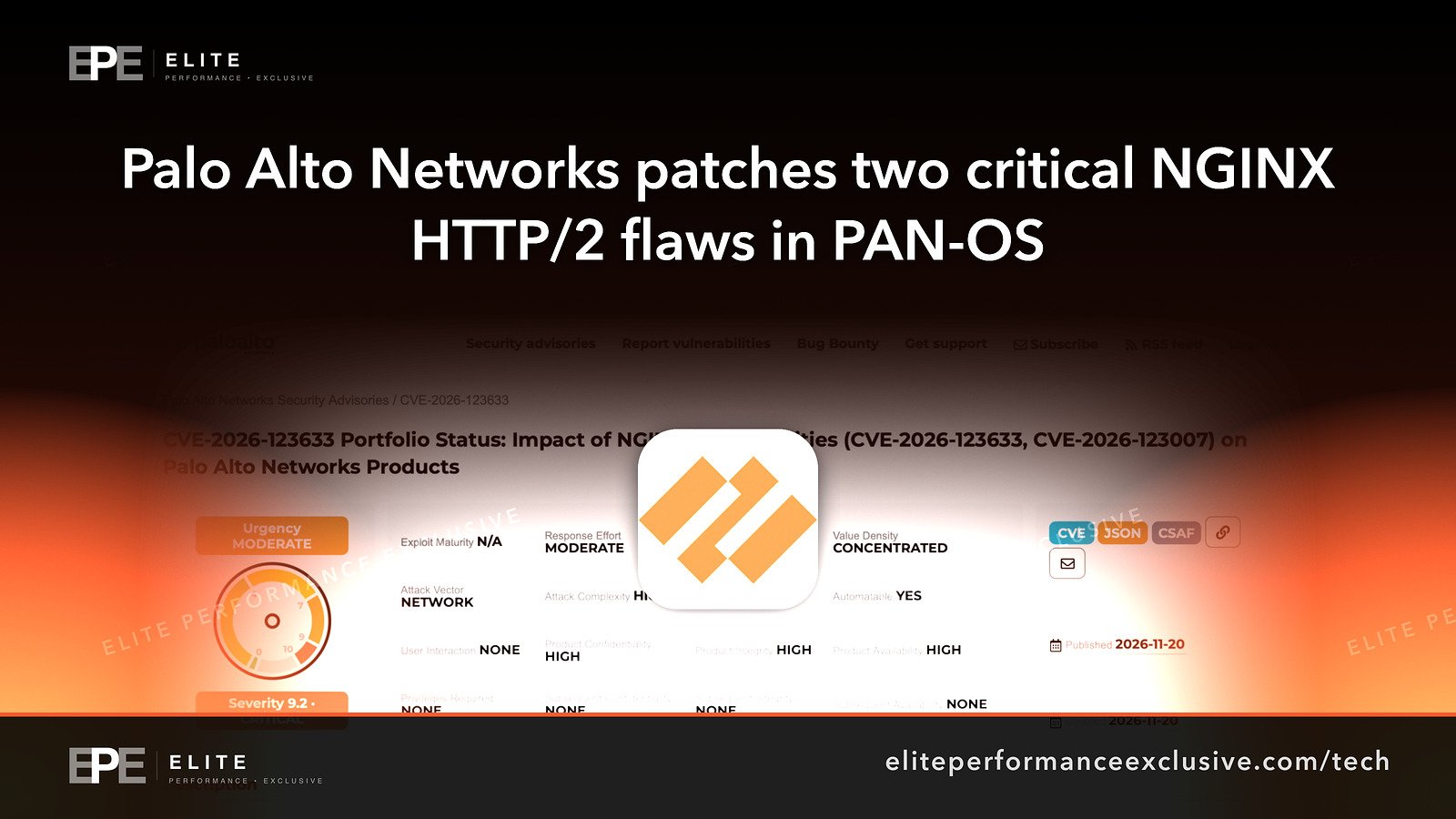
Palo Alto Networks first published its advisory on November 20, 2026. It covers two separate bugs in NGINX, the web server software used inside PAN-OS:
- CVE-2026-123633: in Palo Alto's words, "a use-after-free vulnerability in NGINX HTTP/2 proxy handling".
- CVE-2026-123007: "an integer underflow vulnerability in NGINX HTTP/2 flow control".
Wiz Research describes both as memory-safety issues in how NGINX handles HTTP/2 traffic. Put simply, the software mishandles memory while it processes a certain kind of web traffic, and Wiz found that an attacker can turn that mistake into running their own code.
The flaws come from NGINX itself, not from code Palo Alto wrote. The NGINX project's own security advisories page rates the issue "Severity: major" and lists versions 1.31.9 and later and 1.30.7 and later as not vulnerable. That matters if your company runs NGINX on its own web servers, which we cover below.
Wiz's disclosure timeline includes an "F5 security release and coordinated public disclosure". We did not verify the date of that step, so we are not giving one.
PAN-OS NGINX vulnerability: confirmed vs claimed
| Statement | Who says it | How solid |
|---|---|---|
| Fixed versions exist for PAN-OS 12.2, 12.1.5 and 11.2.8 | Palo Alto Networks advisory | Confirmed by the vendor |
| Severity Critical, suggested urgency Moderate | Palo Alto Networks advisory | Vendor rating |
| Both CVEs rated Critical, CVSS 4.0 score 9.2 | Wiz Research | Researcher rating |
| The flaws can be exploited for remote code execution without a login | Wiz Research | Researcher finding, exploit code not released |
| No known malicious exploitation | Palo Alto Networks advisory | Vendor statement as of the advisory |
| NGINX 1.31.9+ and 1.30.7+ are not vulnerable | nginx.org | Confirmed by the NGINX project |
You will see three different labels for the same problem. Palo Alto pairs Critical severity with a Moderate suggested urgency, Wiz gives a CVSS 4.0 score of 9.2, and the NGINX project calls it major. Each organisation scores in its own way, and the advisory text we verified does not explain why Palo Alto set the urgency to Moderate. For planning, treat this as a Critical flaw on the device that guards your network.
The remote code execution claim comes from Wiz. We did not confirm the same wording in the Palo Alto advisory text we checked. Wiz has also said: "In the interest of customer protection, we will not be releasing these exploits at this time."
Which PAN-OS versions are affected and fixed
| PAN-OS branch | Advisory table entry | Upgrade to |
|---|---|---|
| PAN-OS 12.2 | < 12.2.4-h3 | 12.2.4-h3 or later |
| PAN-OS 12.1.5 | >= 12.1.5 | 12.1.10-h6 or later |
| PAN-OS 11.2.8 | >= 11.2.8 | 11.2.16-h3 or later |
The 12.2 row is simple: anything below 12.2.4-h3 is affected. For 12.1.5 and 11.2.8, the advisory table entries we verified read ">= 12.1.5" and ">= 11.2.8". From the text we checked, we could not tell for certain whether those mark the first affected builds or something else. Do not treat them as a reason to skip the update. Go by the upgrade targets, which are clear.
What is not known yet
- Whether attacks will start. Palo Alto says it is not aware of malicious exploitation. Wiz is holding back its exploits. Neither tells you what will happen next.
- Which settings expose a firewall. We could not confirm from the advisory text we verified which features or settings have to be on for a firewall to be exposed.
- Whether a workaround exists. We did not verify one. If you cannot upgrade right away, read the advisory itself for any mitigation Palo Alto lists.
- Other Palo Alto products. The sources we verified name PAN-OS. We are not making claims about any other product.
What to do this week
| Step | What to check | Done when |
|---|---|---|
| 1 | List every Palo Alto firewall, including spares, lab units and backup sites | You have a full list with the PAN-OS version for each |
| 2 | Compare each version against the table above | You know which units need an upgrade |
| 3 | Read the Palo Alto advisory for configuration details and any workaround | You know whether your setup changes the risk |
| 4 | Back up the configuration and book a maintenance window | You have a rollback plan |
| 5 | Upgrade to 12.2.4-h3, 12.1.10-h6 or 11.2.16-h3 or later | Every unit runs a fixed version or later |
| 6 | Check NGINX on your own web servers and reverse proxies | Each runs 1.31.9+ or 1.30.7+ |
| 7 | Ask vendors of appliances and apps that include NGINX for their fix status | You have an answer from each vendor in writing |
On step 7: a vendor saying a product is up to date is not the same as having this fix. We wrote about that gap in Updated Is Not the Same as Patched.
Why this matters for a business network and website
Your firewall sits between the internet and everything else: staff laptops, file servers, payment systems, cameras. According to Wiz, these NGINX flaws can be exploited without authentication. A device at the edge of the network, facing the internet, is the worst place to have a flaw like that.
The second risk is less obvious. NGINX is not only inside firewalls. Many company websites, online stores, APIs and internal apps run behind NGINX. If yours do, the firewall upgrade does not fix them, and someone has to check those servers separately. If nobody can tell you who owns that job, read Who Is Patching the Software That Runs Your Business?. For servers you host yourself, our self-hosting and infrastructure work covers this kind of upkeep.
PAN-OS NGINX vulnerability questions people are asking
Is CVE-2026-123633 being exploited?
Palo Alto Networks says it "is not aware of any malicious exploitation of this issue." Wiz says it is not releasing its exploits for now.
What is the CVSS score for CVE-2026-123633 and CVE-2026-123007?
Wiz Research rates both Critical with a CVSS 4.0 score of 9.2. Palo Alto lists the severity as Critical and the suggested urgency as Moderate.
Which PAN-OS version fixes the NGINX vulnerability?
12.2.4-h3 or later, 12.1.10-h6 or later, or 11.2.16-h3 or later, depending on your branch.
Is CVE-2026-123007 the same bug as CVE-2026-123633?
No. CVE-2026-123633 is a use-after-free in HTTP/2 proxy handling. CVE-2026-123007 is an integer underflow in HTTP/2 flow control. Both are covered by the same Palo Alto advisory.
Does the NGINX HTTP/2 flaw affect servers that are not Palo Alto firewalls?
The bugs are in NGINX. The NGINX project lists 1.31.9+ and 1.30.7+ as not vulnerable, so check any server or product that runs NGINX.
Is there a PAN-OS workaround?
We could not confirm one. Upgrading to a fixed version is the action the advisory names.
Do I need to log in to the firewall to be at risk?
No login is needed, according to Wiz's finding. That is why the upgrade should not wait for a routine window weeks away.
The bigger lesson
A firewall is software too, and it is built partly from shared open-source parts like NGINX. When one of those parts has a flaw, it can turn up in a firewall, a website and a vendor appliance in the same week. The businesses that recover fastest know what runs inside their systems and who is responsible for patching each part.
If you want help with that, see security hardening or get a quote.
Get security alerts like this by email, along with the free checklist, at security alerts.
Sources: Palo Alto Networks advisory CVE-2026-123633; Wiz Research; nginx security advisories.
Have a question about this article?
Ask it here and we will answer you directly by email. Questions are private, never posted.
Security alerts by email
Hear about the next one first.
When attackers start using a flaw in software businesses run on, we email what it is, whether it touches you and what to do that week, with a round-up of our latest security writing. Free, one-click unsubscribe. You get the checklist straight away: 12 things to secure this week.
Want a result like this?
Security alerts, breaches and the technology a business runs on: what happened, who it affects and what to do.
Get a Tech QuoteKeep reading
LiteLLM Vulnerability CVE-2026-42271: Reported Exploited MCP Test Endpoint Flaw Chains With Starlette CVE-2026-48710 for No-Login Code Execution, and the Versions to Install
LiteLLM flaw CVE-2026-42271 is reported exploited, and chained with Starlette flaw CVE-2026-48710 it allows co...
TSMC Data Breach: Employee Data Leaked Through a Cloud Provider, What Is Confirmed and What Businesses Should Check This Week
TSMC says data on some current and former employees appeared on an external website. It also says the data mat...
N-able MailAssure Vulnerability CVE-2026-134624: CISA Lists the Exploited SSRF Flaw, Mail Assure Dashboards Restored After the November 16 Incident, and What to Ask Your Provider This Week
CISA lists N-able Mail Assure flaw CVE-2026-134624 (CVSS 9.3) as exploited, with a November 26, 2026 due date....
