Perforce Puppet Vulnerability CVE-2026-115731: Exploited Flaw Could Expose the Certificate-Signing Key, and the Fixed Versions to Install
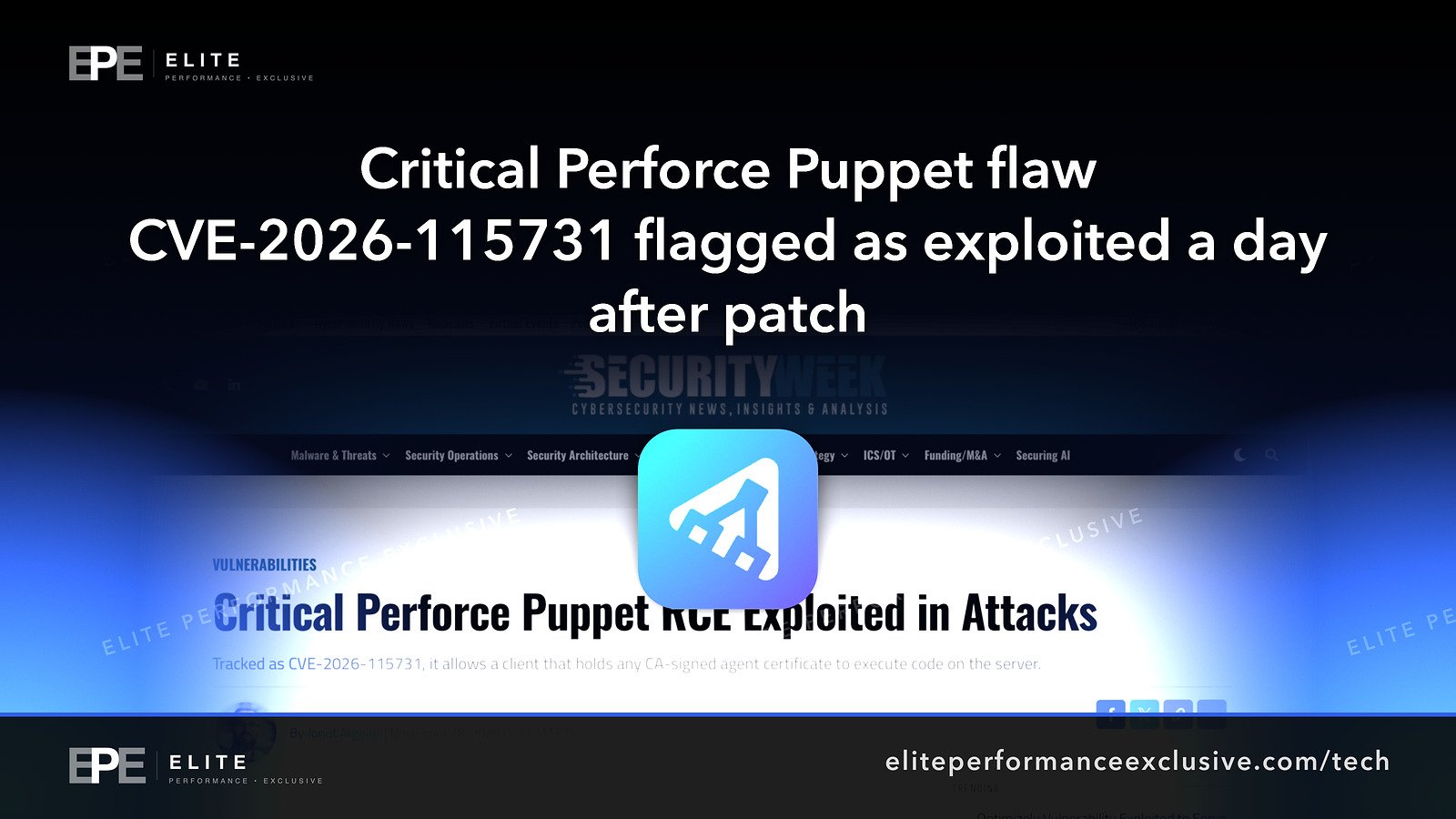
A critical Perforce Puppet flaw, CVE-2026-115731 (CVSS 9.4), was flagged as exploited one day after it was patched. Here are the fixed Puppet Enterprise and Puppet Core versions and what to check this week.
Where Worldwide
On this page 8 sections
A critical flaw in Perforce Puppet, tracked as CVE-2026-115731, has been flagged as exploited in attacks, one day after it was patched. If your company or your IT provider runs Puppet Enterprise, Puppet Enterprise Advanced or Puppet Core, upgrade to a fixed version this week.
The reason to move quickly is in Perforce's own warning, as quoted by SecurityWeek: "A successful attack could expose the server's certificate-signing key, allow an attacker to issue trusted certificates". Certificates are how machines prove who they are. If an attacker can issue certificates your systems trust, the damage can go well beyond one server.
What happened with CVE-2026-115731
Here is the timeline from the sources we checked:
- November 3: the security hole was patched, according to SecurityWeek.
- November 4: SecurityWeek reports that CVE-2026-115731 was flagged as exploited.
- CISA listing: the US Cybersecurity and Infrastructure Security Agency (CISA) lists "Perforce Puppet Enterprise Deserialization of Untrusted Data Vulnerability" in its Known Exploited Vulnerabilities catalog.
The flaw is rated critical, with a CVSS score of 9.4.
SecurityWeek also reports a second critical issue fixed in the same releases, one where an attacker could use a certificate with a name that extends an approved name. In plain terms, a certificate whose name merely begins with a trusted name could be accepted when it should not be. The sources we checked do not give a CVE number for this second flaw, and they do not say whether it has been exploited.
Claimed vs confirmed: the Puppet flaw at a glance
| Statement | Status | Where it comes from |
|---|---|---|
| CVE-2026-115731 is critical, CVSS 9.4 | Reported | SecurityWeek |
| The flaw was patched on November 3 | Reported | SecurityWeek |
| It was flagged as exploited on November 4 | Reported | SecurityWeek |
| A Perforce Puppet Enterprise deserialization flaw is being exploited | Confirmed listing | CISA KEV catalog |
| An attack could expose the certificate-signing key | Perforce's warning, as quoted | SecurityWeek quoting the Perforce advisory |
| Fixed versions are available for Puppet Enterprise and Puppet Core | Reported | SecurityWeek |
A note on sourcing: the Perforce advisory text above is as SecurityWeek quotes it. CISA's catalog gives the exploited status and the instruction to follow the vendor's guidance.
What is not known yet
The sources leave several important questions open, so do not assume the answers:
- Who is attacking, and how many organizations are affected. Neither source names an attacker or gives a count of victims.
- The full list of affected versions. The sources list the fixed releases, not every vulnerable release.
- How the attack works in detail. CISA's catalog describes it as a deserialization of untrusted data vulnerability. The sources we checked give no further technical detail.
- Whether a workaround exists. Neither source describes one short of upgrading.
- What to do about certificates already issued. The sources do not say what Perforce recommends if a signing key may have been exposed before you patched.
- The second flaw's status. Its CVE number and whether it has been exploited are not given in the sources we checked.
Why the Puppet vulnerability matters for a company network
Most business owners have never logged in to Puppet, which is why it slips off patch lists. Tools like this usually run in the background, managed by an internal IT team, a contractor or a hosting provider. That is exactly why you need to ask.
Perforce's warning is about the certificate-signing key. Think of that key as the stamp that makes a certificate official. Anyone holding the stamp can make passes your systems accept as genuine. If an attacker gets it, they could issue trusted certificates, and patching the software afterward does not undo that on its own.
The timing matters too. One day passed between the patch on November 3 and the exploitation report on November 4. Waiting for the next monthly maintenance window leaves a gap of weeks for a flaw that attackers picked up within a day. If nobody owns patching for your back-end tools, start with the question of who is patching the software that runs your business.
Which Puppet versions fix CVE-2026-115731
According to SecurityWeek, these releases contain patches for both flaws:
| Product | Fixed versions |
|---|---|
| Puppet Enterprise | 2026.0.1, 2025.12.1, 2023.8.13 |
| Puppet Enterprise Advanced | 2026.0.1, 2025.12.1, 2023.8.13 |
| Puppet Core | 9.1.3, 8.22.2 |
The sources do not say which fixed release lines up with which older version. Before you upgrade, check Perforce's advisory to confirm the right fixed release for the version you run.
What to do this week
Use this checklist with whoever runs your servers:
- Find out whether Puppet is running anywhere. Ask your IT team, your managed service provider and any contractor who set up your servers. Include test and staging systems.
- Write down the version on each one. Note whether it is Puppet Enterprise, Puppet Enterprise Advanced or Puppet Core, and the exact version number.
- Upgrade to a fixed version. Puppet Enterprise and Puppet Enterprise Advanced: 2026.0.1, 2025.12.1 or 2023.8.13. Puppet Core: 9.1.3 or 8.22.2.
- Follow the vendor's instructions. CISA's guidance for this entry is: "Apply mitigations in accordance with vendor instructions." Read Perforce's advisory in full for any steps beyond the upgrade.
- Ask about certificates. Because Perforce warns that the signing key could be exposed, ask whoever runs Puppet what Perforce advises about certificates issued before the patch, and whether they have checked. The sources we checked do not spell out these steps, so get the answer from the advisory or from Perforce.
- Get the result in writing. Ask for the version number installed after the upgrade, not just a note saying it was updated. Remember that updated is not the same as patched, so confirm the exact version number.
If Puppet runs on servers you host yourselves, our page on self-hosting infrastructure covers how we approach keeping that kind of setup maintained.
Perforce Puppet vulnerability questions people are asking
Is CVE-2026-115731 being exploited?
Yes, according to the sources. SecurityWeek reports it was flagged as exploited on November 4. CISA's Known Exploited Vulnerabilities catalog also lists a Perforce Puppet Enterprise deserialization of untrusted data vulnerability.
How serious is the Puppet vulnerability?
It is rated critical, with a CVSS score of 9.4. Perforce warns that a successful attack could expose the server's certificate-signing key and allow an attacker to issue trusted certificates.
Which Puppet versions fix CVE-2026-115731?
Puppet Enterprise and Puppet Enterprise Advanced 2026.0.1, 2025.12.1 and 2023.8.13, and Puppet Core 9.1.3 and 8.22.2.
Does it affect Puppet Core or only Puppet Enterprise?
CISA's entry names Puppet Enterprise, but Perforce also released patched Puppet Core versions, 9.1.3 and 8.22.2. If you run Puppet Core, treat it as in scope and upgrade.
What is the second Puppet flaw?
SecurityWeek describes it as a critical issue where an attacker could use a certificate with a name that extends an approved name. The same fixed versions patch it. The sources we checked do not give its CVE number or say whether it has been exploited.
Is there a workaround if we cannot upgrade yet?
The sources we checked do not describe one. CISA says to apply mitigations according to the vendor's instructions, so check Perforce's advisory.
Who is behind the Puppet attacks?
That is not known from the sources. No attacker or victim count has been named.
The bigger lesson
The software that runs your infrastructure needs the same patching attention as your firewall or your website. In this case, attackers were reported to be using the flaw one day after the fix came out. If the patch window is that short, someone has to know the tool exists, know its version and be able to upgrade it this week.
See how we approach security hardening, or get a quote to have your server tools reviewed and kept patched.
Get security alerts like this by email, with our free checklist, at /security-alerts.
Sources: SecurityWeek: Critical Perforce Puppet RCE Exploited in Attacks; CISA Known Exploited Vulnerabilities Catalog.
Have a question about this article?
Ask it here and we will answer you directly by email. Questions are private, never posted.
Security alerts by email
Hear about the next one first.
When attackers start using a flaw in software businesses run on, we email what it is, whether it touches you and what to do that week, with a round-up of our latest security writing. Free, one-click unsubscribe. You get the checklist straight away: 12 things to secure this week.
Want a result like this?
Security alerts, breaches and the technology a business runs on: what happened, who it affects and what to do.
Get a Tech QuoteKeep reading
Cursor Security Incident: Malicious Claude Code Extension Versions 2.1.312 and 2.1.313 Tried to Plant an SSH Backdoor, Credentials Exposed, and What to Check This Week
Cursor confirms an attacker obtained an access key, malicious Claude Code extension versions 2.1.312 and 2.1.3...
Puppet Enterprise Vulnerability CVE-2026-115731: CISA Lists the Exploited Flaw, the Certificate Key Risk, and the Fixed Versions to Install
CISA added Puppet Enterprise flaw CVE-2026-115731 (CVSS 9.4) to its exploited list on November 17. Here is wha...
Agent Framework PyPI Malware
Attackers published malicious releases of Microsoft's official Agent Framework package on PyPI on November 17,...
