Project Zero 30-Day Deadline: Google Plans to Cut Its Bug Disclosure Clock From 90 Days to 60, Then 30, and What It Means for Your Patch Schedule
Google Project Zero plans to cut its disclosure deadline from 90 days to 60 in February 2027 and to 30 in January 2028. Here is what is confirmed, what is claimed, and how to check how fast your business patches.
Where Worldwide
On this page 7 sections
Google Project Zero plans to shorten its bug disclosure deadline, which is how long a vendor gets before details of a flaw are made public. It is 90 days today, drops to 60 days on February 2, 2027 and to 30 days on January 3, 2028. For a business, that means less time between a flaw being reported in software you rely on and its details going public, so how fast you and your vendors patch matters more each year.
This is a policy change, not a new vulnerability, and nothing needs an emergency update today. It is still a good reason to look at how quickly your business really applies security fixes, because the window is shrinking on a published schedule.
What is confirmed: the Project Zero disclosure policy timeline
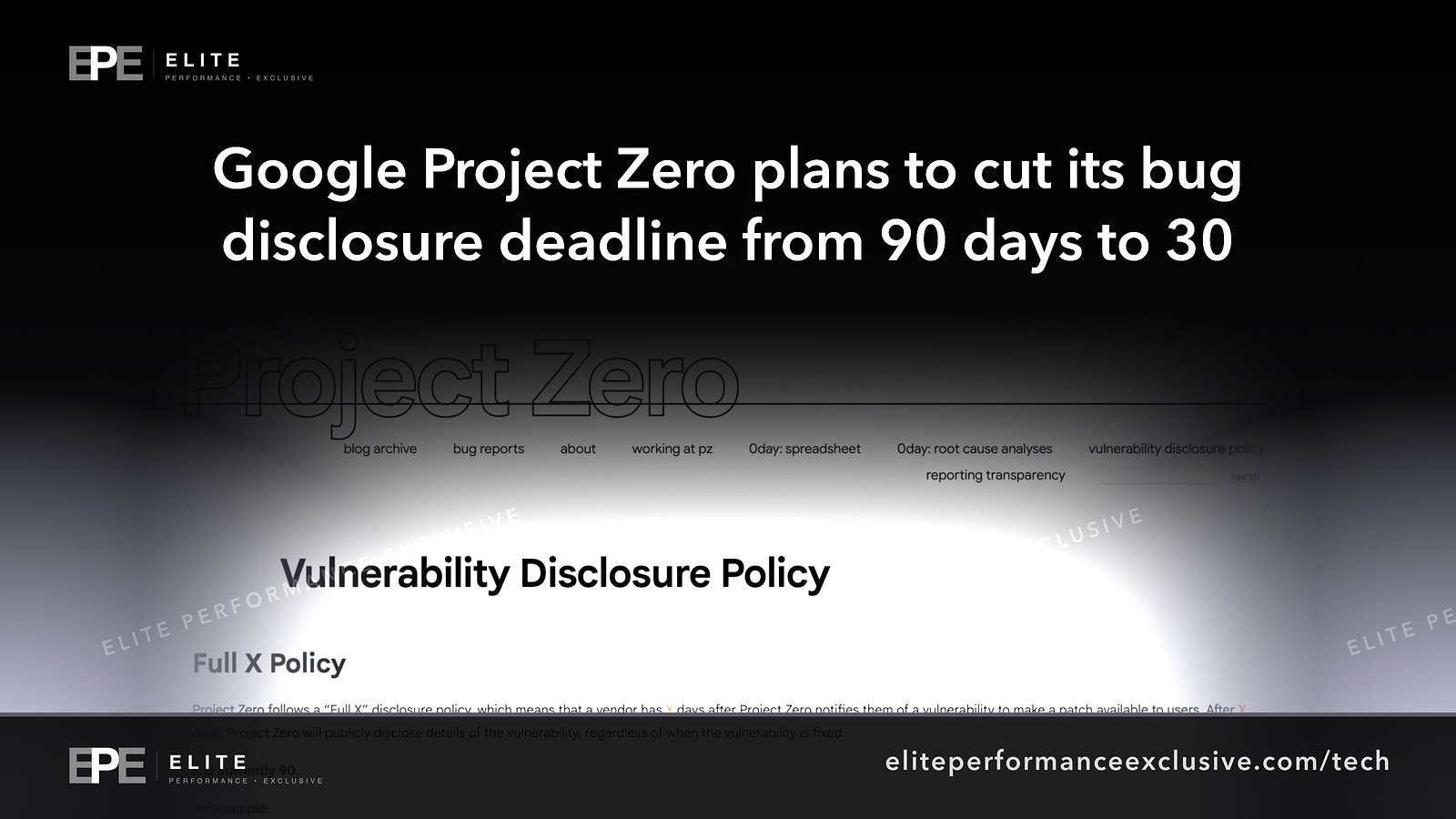
Project Zero's own policy page describes what it calls a “Full X” disclosure policy, where X is the number of days. The page states: "X is currently 90."
The same page sets out two planned steps:
On February 2, 2027, we plan to move to a “Full 60” policy where vulnerabilities are disclosed after 60 days.
On January 3, 2028, we plan to move to a “Full 30” policy where vulnerabilities are disclosed after 30 days.
For flaws that are being actively exploited in the wild, the policy page says details are disclosed after 7 days.
The page also says Project Zero may grant exceptions to the policy in some situations. We confirmed the opening of that sentence but not the full list of conditions, so we are not going to guess at them.
| Period | Disclosure deadline | Status on the policy page |
|---|---|---|
| Today | 90 days | Current policy |
| From February 2, 2027 | 60 days | Planned |
| From January 3, 2028 | 30 days | Planned |
| Actively exploited flaws | 7 days | Current policy |
Note the word plan. The page describes both dates as plans, and plans can move.
What is claimed: why Google is shortening the deadline
BleepingComputer's report, headlined "Google Project Zero cuts bug disclosures to 30 days amid AI threats", says Project Zero's reason is that AI has sped up both finding and exploiting vulnerabilities. That is the team's stated reason as reported. Our sources contain no figures on how much faster discovery or exploitation has become, so treat it as Project Zero's explanation, not a measured fact.
One note on that headline: 30 days is the last step of a phased schedule. The policy page still puts the deadline at 90 days today and plans the 30-day step for January 3, 2028.
What is not known yet
- How vendors will respond. Our sources do not say whether any software makers have changed their release schedules because of this.
- The full exception rules. We confirmed only the opening of the sentence on exceptions.
- Whether the 7-day rule for exploited flaws changes too. Our verified sources do not say it does.
- Whether other research teams will follow. Nothing in our sources says so.
- Exactly what is published at the deadline, and whether an early fix changes the timing. The parts of the policy we verified do not cover this.
Why a shorter disclosure deadline matters for a business network or website
Your firewall, VPN, email gateway, website platform, servers, phones and browsers all come from vendors. When a flaw is reported, the vendor works on a fix, and at some point the technical details become public. Once they are public, anyone can read them.
A shorter deadline squeezes both ends. Vendors have less time to ship a fix, and you have less quiet time to install it before the details are out.
This is where many businesses get caught. An update can be downloaded but never applied, a device can need a restart that never happens, or nobody is sure who looks after the box in the server closet. We covered those gaps in Updated Is Not the Same as Patched and Who Is Patching the Software That Runs Your Business?. A shorter clock makes each of those gaps more costly.
It matters for websites and custom apps too. If your site runs on a platform, plugins or a server you do not control, your patch speed is someone else's patch speed. If you own the code and the server, you can move as fast as your own process allows.
What to do this week: check your patch speed
Nothing needs to change overnight. The first planned step is February 2, 2027, so use the time before then to test your process.
| Task | How to check |
|---|---|
| List every system that needs security updates | Firewall, VPN, email, servers, website, laptops, phones, browsers, business apps |
| Name an owner for each one | One person or provider responsible for patching it, written down |
| Find each vendor's security advisory page | Bookmark it and sign up for email notices where the vendor offers them |
| Time your last critical fix | Note when the vendor released it and when it was installed and running on every device |
| Set a target | Decide how many days a critical fix may take, and treat anything marked as exploited as a same-week job |
| Confirm restarts happen | Check that updated devices and browsers actually restarted onto the fixed version |
| Plan testing and rollback | Have a quick test step and a way to undo an update, so moving fast does not mean guessing |
| Review contracts | Ask managed providers and software vendors how quickly they commit to applying security fixes |
If your measured time from vendor release to installed everywhere is longer than 60 days, fix that first. If it is longer than 30 days, start planning for 2028 now.
Project Zero disclosure deadline questions people are asking
What is the Project Zero 90-day disclosure policy?
It is Google Project Zero's rule for how long a vendor gets before details of a flaw are made public. The policy page says the number is currently 90 days.
When does Project Zero move to a 30-day deadline?
The policy page says Project Zero plans to move to 30 days on January 3, 2028. Before that, it plans to move to 60 days on February 2, 2027.
Is the Project Zero deadline 30 days now?
No. The policy page puts it at 90 days today. The 30-day step is planned for January 3, 2028.
Why is Google Project Zero shortening the deadline?
BleepingComputer reports that Project Zero says AI has accelerated vulnerability discovery and exploitation.
What happens to bugs that are already being exploited?
The policy page says flaws that are actively exploited in the wild are disclosed after 7 days.
Can Project Zero make exceptions?
Yes. The policy page says it may grant exceptions in some situations. We have not confirmed the full list of conditions.
Does this mean my vendors must patch within 30 days?
It is a disclosure policy, not a law. It sets when Project Zero publishes details, not when a vendor has to ship a fix. Either way, the window before the details of those flaws go public is getting shorter.
The bigger lesson
A disclosure deadline is a clock you do not control. What you do control is how long it takes a fix to go from the vendor's release to running on every device, server and website you own. Measure that number while the deadline is still 90 days, and get it down before it has to be.
For help with patching and hardening your systems, see security hardening or request a quote.
Get security alerts by email, with our free checklist, at security alerts.
Sources: Google Project Zero vulnerability disclosure policy; BleepingComputer.
Have a question about this article?
Ask it here and we will answer you directly by email. Questions are private, never posted.
Security alerts by email
Hear about the next one first.
When attackers start using a flaw in software businesses run on, we email what it is, whether it touches you and what to do that week, with a round-up of our latest security writing. Free, one-click unsubscribe. You get the checklist straight away: 12 things to secure this week.
Want a result like this?
Security alerts, breaches and the technology a business runs on: what happened, who it affects and what to do.
Get a Tech QuoteKeep reading
LiteLLM Vulnerability CVE-2026-42271: Reported Exploited MCP Test Endpoint Flaw Chains With Starlette CVE-2026-48710 for No-Login Code Execution, and the Versions to Install
LiteLLM flaw CVE-2026-42271 is reported exploited, and chained with Starlette flaw CVE-2026-48710 it allows co...
Cursor Security Breach: A Key Issued to Fireworks AI Led to a Malicious Claude Code Extension, What Is Confirmed and What to Check This Week
An attacker used an access key Cursor had issued to Fireworks AI, and a malicious Claude Code extension reache...
TSMC Data Breach: Employee Data Leaked Through a Cloud Provider, What Is Confirmed and What Businesses Should Check This Week
TSMC says data on some current and former employees appeared on an external website. It also says the data mat...
