SYS01 Infostealer Facebook Ads
Bitdefender Labs says the SYS01 infostealer spreads through Facebook ads and goes after Facebook Business accounts, then uses the hijacked accounts to run more malicious ads. What is confirmed, what is not, and what to do.
Where Worldwide
On this page 7 sections
Bitdefender Labs reports that criminals are running Facebook ads that lead people to download the SYS01 infostealer, malware built to steal Facebook logins, with Facebook Business accounts as a main target. If it gets onto a computer someone uses to manage your company's page or ad account, the attackers can take that account and use it to run the same malicious ads under your business's name.
This post covers what the researchers actually confirmed, what some coverage has added that is not confirmed, and the short list of things to do this week.
What happened with the SYS01 infostealer
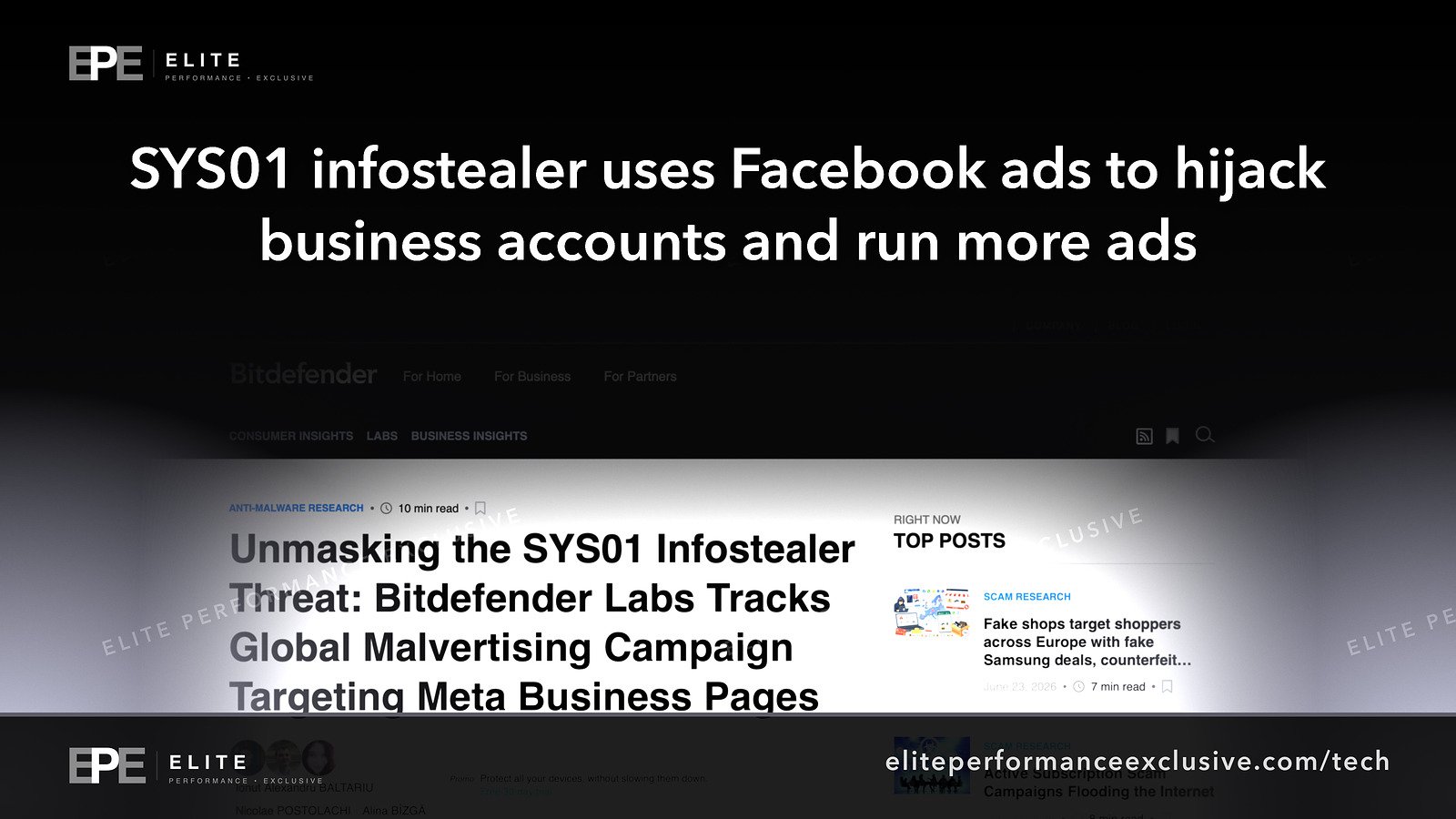
Bitdefender Labs, the research team at the security company Bitdefender, has been tracking a malvertising campaign: malware spread through paid ads. Their report says: "A key goal of SYS01InfoStealer is to harvest Facebook credentials, specifically Facebook Business accounts."
The researchers describe how the operation feeds itself. Once the attackers have a business account, "they use the hijacked accounts to launch more malicious ads." Every stolen account gives them a new place to advertise from, and a new set of people to reach.
According to Bitdefender, the ads typically point to a MediaFire link, or refer to one, that allows the direct download of the malicious software. The people clicking think they are getting something useful. What they get is a program that collects their data.
Bitdefender says the stolen personal information, including login data, financial info and security tokens, can be sold on underground markets. The researchers also found nearly a hundred malicious domains used to host the malware and to control it.
On timing, Bitdefender writes that among the activity it tracked, "a campaign that started in September stood out." The part of the report we checked does not give the year, and it does not say whether the campaign is still running.
What is confirmed and what is not
| Claim | Status |
|---|---|
| SYS01 aims to steal Facebook logins, especially Facebook Business accounts | Confirmed by Bitdefender Labs |
| Hijacked accounts are used to launch more malicious ads | Confirmed by Bitdefender Labs |
| Ads typically point to a MediaFire download | Confirmed by Bitdefender Labs |
| Stolen login data, financial info and security tokens can be sold | Confirmed by Bitdefender Labs |
| Nearly a hundred malicious domains involved | Confirmed by Bitdefender Labs |
| The campaign abused browser management policies | Not established: Cyberpress, the news site that covered it, says its reporting does not establish this |
| Number of victims, countries hit, who is behind it | Not stated in the sources we checked |
| Whether the campaign is still active today | Not stated in the sources we checked |
Some headlines about this story say the malware abuses browser management policies to steal cookies. Treat that as unproven. Cyberpress itself notes that it does not establish that this campaign abused browser management policies. We are not going to tell you to rebuild your browser policies over a claim the source does not support.
Why the attackers want cookies and security tokens
Cyberpress explains the basic idea: browser session cookies let websites recognize users who have already signed in. Bitdefender lists security tokens among the data SYS01 steals. Put those together and the risk is easy to see: stolen session data is about being treated as someone who is already logged in, not only about knowing their password.
That is why a single infected laptop matters. If the person who runs your company's Facebook page or ad account downloads the wrong file, the problem is not limited to that laptop. It reaches every account that browser was signed in to.
The common pattern is clear: ads and downloads are now a main way in.
Why it matters for a business Facebook page
For many businesses, the Facebook Business account holds the page customers know, a payment method for ads, and access shared among several staff or an outside agency. Losing control of it causes three problems at once:
- Your name on someone else's scam. Bitdefender says hijacked accounts are used to launch more malicious ads. Your customers may see malware ads that appear to come from you.
- Money and data exposure. Bitdefender lists financial info among the stolen data, and says it can be sold.
- More than one device at risk. Anyone with access to the account is a possible way in, including contractors and part-time staff.
Bitdefender also explains why the attackers keep at it. Facebook's user base is huge, and in the researchers' words, "such a large potential victim pool virtually guarantees success."
What to do this week
| Step | How to check |
|---|---|
| Turn on two-factor authentication (2FA) for every Facebook account that manages your business | Bitdefender's advice: "Make sure 2FA is enabled on your Facebook account, particularly if you use it for business purposes." Check each admin, not only the owner. |
| List everyone with access to your business page and ad account | Remove people who no longer need it, including former staff and old agencies. |
| Review recent ad activity | Look for ads, campaigns or charges nobody on your team created. |
| Tell staff not to install software from ads | Be especially wary of ads that lead to a MediaFire download. Software should come from the vendor's own site or an approved app store. |
| Treat a suspicious download as a security incident | If someone installed something from an ad, have that computer checked before it is used to sign in to business accounts again. |
| Do not rely on antivirus alone | See the next section. |
Why not rely on antivirus alone? Bitdefender says: "Once antivirus companies detect and block a version of the malware dropper, hackers enhance obfuscation methods and re-launch new ads with updated versions." Antivirus helps, but the attackers are deliberately working to stay a step ahead of it. Fewer admins, 2FA everywhere and careful download habits all help no matter which version of the malware is going around.
SYS01 infostealer questions people are asking
What is the SYS01 infostealer?
It is malware that Bitdefender Labs calls SYS01InfoStealer. Its key goal is stealing Facebook logins, especially Facebook Business accounts.
How does the SYS01 malware spread?
Through Facebook ads. Bitdefender says the ads typically point to a MediaFire link that downloads the malware directly.
Does SYS01 abuse browser management policies?
That is not established. Cyberpress, which reported the claim, says its reporting does not establish that this campaign abused browser management policies.
What does SYS01 steal?
Bitdefender lists login data, financial info and security tokens, which can be sold on underground markets.
Why are Facebook Business accounts targeted?
Because attackers can use hijacked business accounts to launch more malicious ads, which spreads the malware further.
Is the SYS01 campaign still active?
The sources we checked do not say. Bitdefender describes a campaign that started in September but does not give the year in the passage we checked.
How do I protect a Facebook Business account from SYS01?
Turn on 2FA for every admin, cut access down to the people who need it, check for ads you did not create, and do not install software from ad links.
The bigger lesson
The accounts that run your marketing are business systems, just like your website and email, and they deserve the same care: few admins, two-factor login for everyone, and a clear rule that work software never comes from an ad. Attackers chose Facebook Business accounts because each one gives them the reach to find the next victim. Locking down yours makes it a dead end for them.
If you want help locking down the accounts and systems your business runs on, see security hardening or request a quote.
Get security alerts like this one by email, plus our free checklist, at security alerts.
Sources: Bitdefender Labs; Cyberpress.
Have a question about this article?
Ask it here and we will answer you directly by email. Questions are private, never posted.
Security alerts by email
Hear about the next one first.
When attackers start using a flaw in software businesses run on, we email what it is, whether it touches you and what to do that week, with a round-up of our latest security writing. Free, one-click unsubscribe. You get the checklist straight away: 12 things to secure this week.
Want a result like this?
Security alerts, breaches and the technology a business runs on: what happened, who it affects and what to do.
Get a Tech QuoteKeep reading
Vishing Attacks: Unit 42 Tracks CL-CRI-1264 and Waves of Scam Calls Against Financial, Healthcare and Legal Firms, What Is Confirmed and What to Do This Week
Unit 42 says it has tracked numerous waves of vishing attacks, mainly against financial services, healthcare a...
pCloud Pass breach
pCloud confirmed a cyberattack on its pCloud Pass password manager that exposed some user email addresses and...
GoodGuys Phishing Campaign: Fake Paid Expert Interviews Impersonate Eight Brands to Steal Work Google Logins and Relay MFA Codes, and What to Tell Staff This Week
Push Security has tracked a phishing kit it calls GoodGuys since October 13. It offers up to $600 for fake exp...
