AI Agent Cyberattacks: Switzerland Confirms Break-Ins Using AI Agents, Three Critical Infrastructure Operators Hit, and What to Patch This Week
Switzerland's NCSC says attackers used AI agents that search for weaknesses and pick attack tools on their own. Here is what is confirmed, what is not known, and what a business should do this week.
Where Switzerland · Europe, Western Europe
On this page 8 sections
Switzerland's cyber security agency, the NCSC, says attackers have used AI agents to break into organizations' IT systems. These are programs that can search for weaknesses and choose attack tools on their own. If you run a company network or a website, this means the hunt for unpatched flaws is now automated, and the NCSC says those tools are spreading.
This post separates what the NCSC confirmed from what was reported later. It also lists what the sources leave out, and what you can do this week.
What happened: AI agent cyberattacks in Switzerland
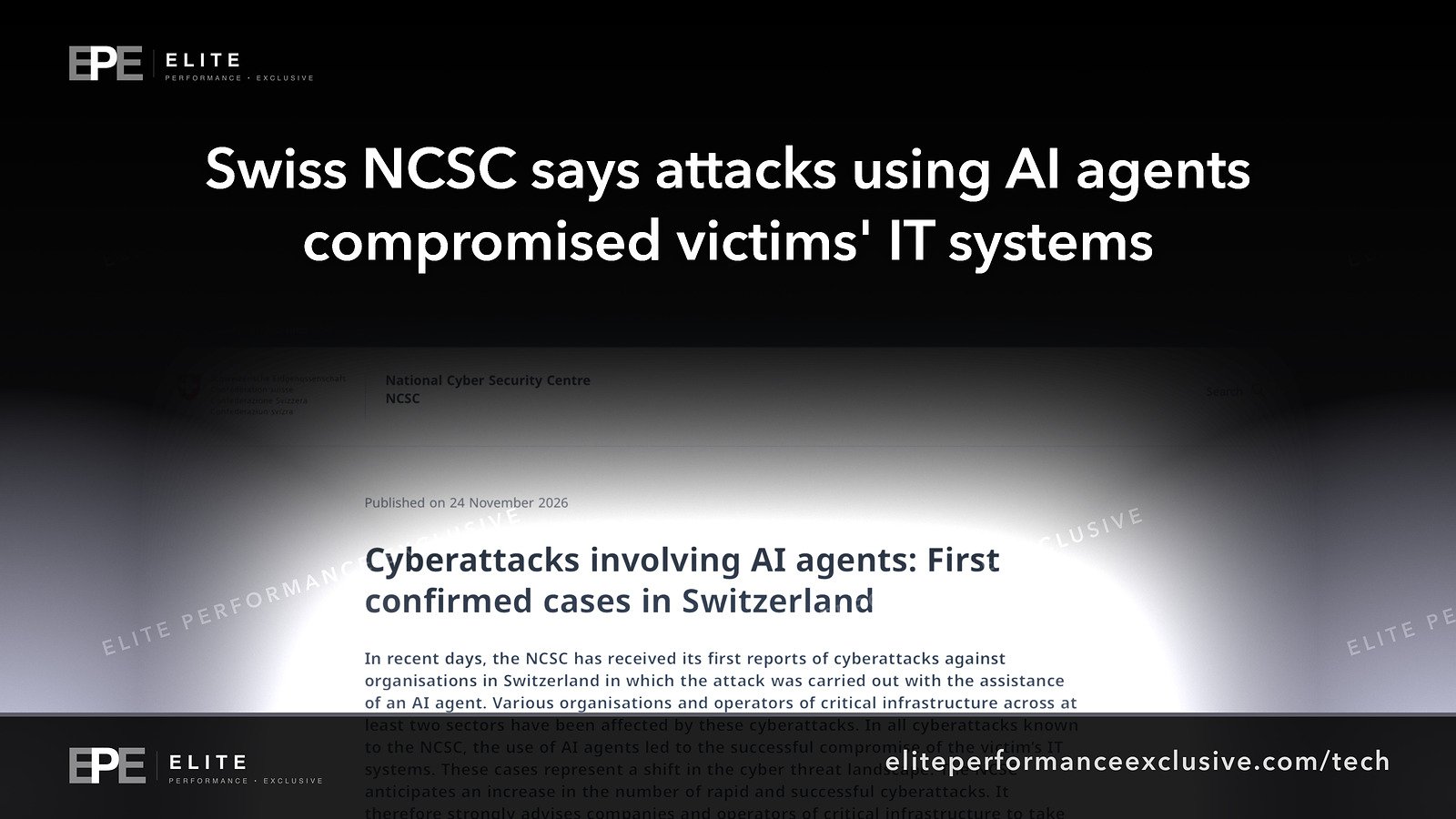
The NCSC published its notice on 24 November 2026. Its central statement is direct: "In all cyberattacks known to the NCSC, the use of AI agents led to the successful compromise of the victim's IT systems."
The NCSC describes the threat as AI agents which, in its words, "independently search for vulnerabilities, select suitable attack tools," and it names two that can be reached over the internet, "ARTEX" and "CyberStrikeAI". The agency also says the number of internet-accessible AI attack agents "has almost doubled since October 2026".
SRF also published a report on the cases. It quotes an interviewee saying: "Wir haben aktuell fünf bestätigte Fälle von Angriffen mit KI-Agenten." In English, that means there are currently five confirmed cases of attacks using AI agents. The report also says three of the targets operate critical infrastructure: "Betroffen von den neuen Cyberangriffen sind drei Betreiberinnen kritischer Infrastrukturen."
AI cyberattacks: what is confirmed and what is reported
| Point | Where it comes from | Status |
|---|---|---|
| AI agents led to successful compromise in every attack known to the NCSC | NCSC notice, 24 November 2026 | Confirmed by the agency |
| Internet-accessible AI attack agents have almost doubled since October 2026 | NCSC notice | Confirmed by the agency |
| ARTEX and CyberStrikeAI are examples of internet-accessible AI agents | NCSC notice | Confirmed by the agency |
| Five confirmed cases | SRF report | Quoted in the report |
| Three of the targets are critical infrastructure operators | SRF report | Reported |
| Systems were successfully hacked in four of the five cases | SRF report | Reported |
The two sources do not fully agree. The NCSC says every attack it knows of ended in a compromise. SRF reports that systems were successfully hacked in four of five cases ("In vier von fünf Fällen seien Systeme erfolgreich gehackt worden."). Neither source explains the difference, so we will not guess at it.
One more point to keep straight: the NCSC gives ARTEX and CyberStrikeAI as examples of AI agents available online. The sources we used do not say these tools were the ones used in the Swiss attacks.
What an AI attack agent actually does
An attacker usually has to do several jobs by hand: find a target, look for a weak spot, pick a tool that fits and use it. The NCSC describes AI agents that do parts of this work on their own, searching for vulnerabilities and selecting tools to attack them.
For a business, the key point is one SRF quotes directly: "Wenn es keine Schwachstelle gibt, kann auch ein KI-Agent nicht in ein System eindringen". Put simply, if there is no vulnerability, an AI agent cannot get into a system either. The agent finds and uses flaws. It does not create them.
What is not known about the AI agent attacks
The sources do not say:
- Which organizations were attacked, or which industries apart from the three critical infrastructure operators.
- Who was behind the attacks.
- Which vulnerabilities or products were used to get in.
- Whether data was stolen, or whether any service was disrupted.
- Which AI agent or agents were used in each case.
If any of these details come out later, treat them as new information. Do not assume them now.
Why AI cyberattacks matter for a business network or website
The confirmed cases are in Switzerland, but the tools are not tied to one country. The NCSC's point is that AI attack agents are available over the internet and that their number has almost doubled in a short time. Anything your company exposes to the internet can be reached by the same kind of tool: a website, a customer portal, a VPN, a firewall admin page, a self-hosted server.
SRF's report also quotes two warnings worth taking seriously. The first: "Das Problem wird von den Unternehmen nicht ausreichend ernst genommen." This means companies are not taking the problem seriously enough. The second: "Ich rechne mit einer grösseren Angriffswelle". This means the speaker expects a larger wave of attacks. Those are predictions, not confirmed events, but they point the same way as the NCSC's numbers.
The practical result is that the gap between a security update coming out and someone trying the flaw is no longer something you can leave for the next maintenance window. If nobody clearly owns patching for each system, fix that first. We covered why in Who Is Patching the Software That Runs Your Business? and Updated Is Not the Same as Patched.
What to do this week: AI attack readiness checklist
The NCSC's advice includes a time limit of "no later than 24 hours after release." We read this as a deadline for installing security updates. Check the NCSC page for the full wording. Here is how to act on it:
| Step | What to do | How to check it is done |
|---|---|---|
| 1 | List every system reachable from the internet: website, apps, VPN, firewall, mail, remote access, servers | You have one written list with an owner's name next to each item |
| 2 | Check each system for security updates that are waiting to be installed | The admin page or update tool for each system shows nothing pending |
| 3 | Set a rule to install security updates no later than 24 hours after release | The rule is written down, and someone is responsible for alerts on weekends and holidays |
| 4 | For anything you cannot patch within 24 hours, cut down who can reach it | Admin pages and remote access are not open to the whole internet |
| 5 | Remove systems you no longer use from the internet | Old test sites, retired servers and unused portals are switched off |
| 6 | Ask your vendors and hosting provider how fast they patch | You have their answer in writing |
If you are not sure what your company has exposed, start with Your Website Is Live. Can Anyone Find It, and Is It Locked?.
AI cyberattack questions people are asking
What is an AI agent cyberattack?
It is an attack where software driven by AI does parts of the hacking itself. The NCSC describes agents that independently search for vulnerabilities and select attack tools.
How many AI-assisted attacks were confirmed in Switzerland?
SRF quotes an interviewee saying there are currently five confirmed cases. According to SRF, three of the targets are critical infrastructure operators.
Did the AI agents actually get in?
The NCSC says every attack it knows of ended in a successful compromise. SRF reports successful hacks in four of five cases. The sources do not explain the difference.
Which AI hacking tools were named?
The NCSC names ARTEX and CyberStrikeAI as examples of AI agents reachable over the internet. It is not confirmed that these were used in the Swiss attacks.
Were businesses in the US affected?
The cases described are in Switzerland. The sources say nothing about attacks elsewhere, but the tools are reachable over the internet.
Can an AI agent hack a fully patched system?
According to the statement SRF quotes, no: if there is no vulnerability, an AI agent cannot get in either. Patching closes the doors these tools look for.
How fast should we install security updates?
The NCSC's advice includes the phrase "no later than 24 hours after release." Treat 24 hours as your maximum for security updates on internet-facing systems.
The bigger lesson
AI does not change what lets attackers in. It changes how quickly and how widely they can look for it. Software that is patched fast, has a named owner and is not left open to the internet is what keeps an AI agent outside, just as it does with a human attacker. If building AI tools is on your list too, the same rule about who maintains them applies, as we wrote in AI Can Build Your App. Who Is Going to Keep It Running?.
See how we lock down systems at security hardening, or get a quote to have your internet-facing systems reviewed.
Get security alerts like this by email, with our free checklist, at security alerts.
Sources: NCSC: AI agents; SRF: Fünf bestätigte Fälle.
Have a question about this article?
Ask it here and we will answer you directly by email. Questions are private, never posted.
Security alerts by email
Hear about the next one first.
When attackers start using a flaw in software businesses run on, we email what it is, whether it touches you and what to do that week, with a round-up of our latest security writing. Free, one-click unsubscribe. You get the checklist straight away: 12 things to secure this week.
Want a result like this?
Security alerts, breaches and the technology a business runs on: what happened, who it affects and what to do.
Get a Tech QuoteKeep reading
SAP GitHub Breach: Stolen Employee Tokens Reportedly Used to Copy and Change Source Code, What Is Confirmed and What Businesses Should Check
An insider told Der Spiegel that attackers used SAP employees' authentication tokens to copy and change SAP so...
PolinRider GitHub Malware: North Korea-Linked Campaign Planted a Loader in 7,609 Repositories, What Is Confirmed and What to Check This Week
Reports say the PolinRider campaign planted a loader in at least 7,609 GitHub repositories owned by 2,330 real...
1Password Breach: An Employee's GitHub Account Was Used to Push Malicious Code and Download Account Records, What Is Confirmed and What to Do This Week
1Password says an attacker used an employee's corporate GitHub account to access source code, push malicious c...
