AI Agent Security Checklist: TCS Survey Says Only 10% of Enterprises Let AI Act Without Human Approval, and What to Lock Down First
A TCS survey found 84% of executives value AI most for productivity, but only 10% of enterprises let agents decide without human approval. What is confirmed, and what to lock down this week.
Where Worldwide
On this page 6 sections
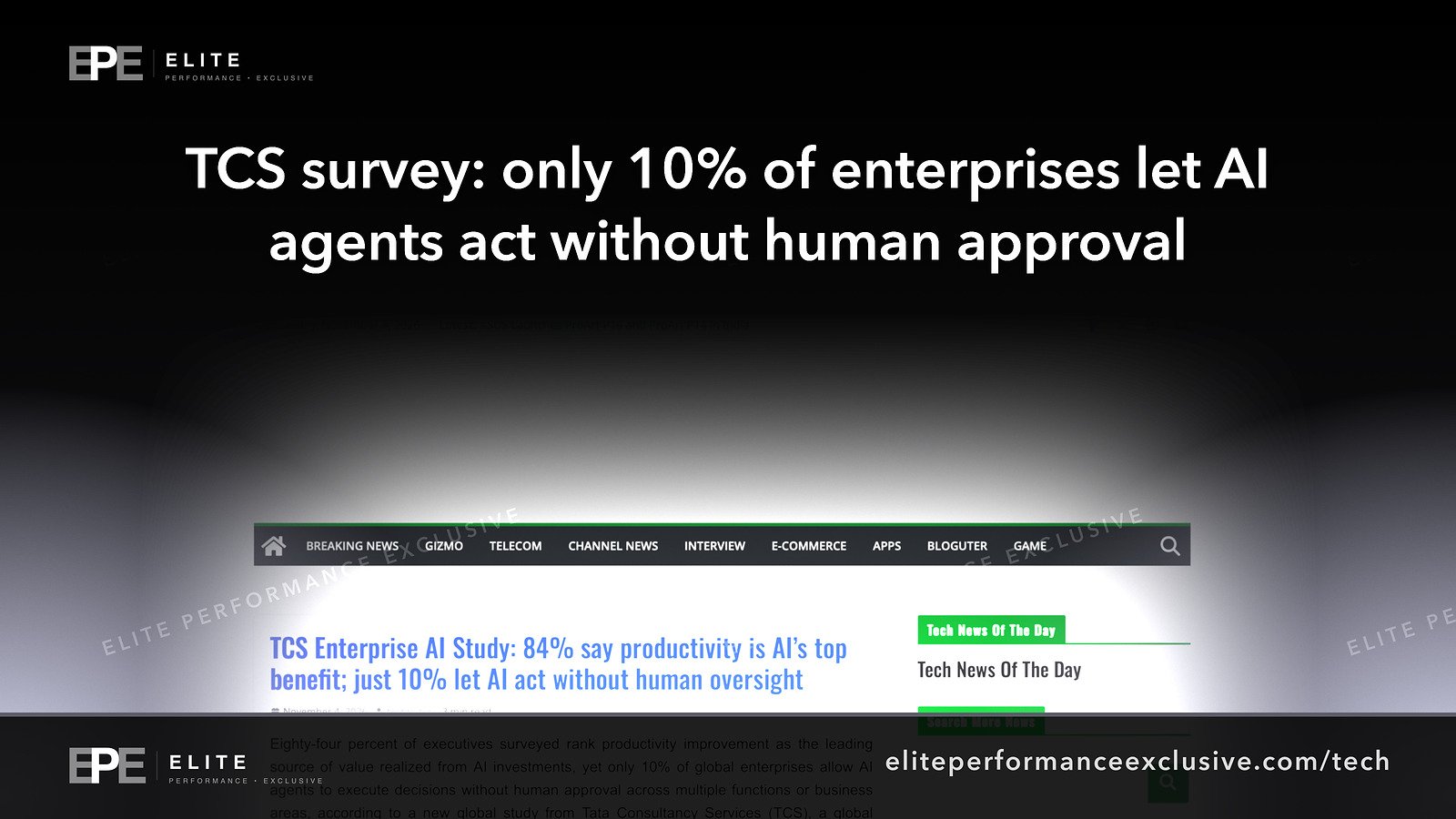
Tata Consultancy Services (TCS) published a survey on November 4, 2026 in which 84% of executives ranked productivity as the top value they get from AI, yet only 10% of global enterprises allow AI agents to execute decisions without human approval across multiple functions or business areas. If your company is being sold AI that can act on its own, that gap matters: most of the large organizations surveyed have not handed over that level of control, and you should decide what an agent may touch before it touches anything.
An AI agent is different from a chatbot that drafts text. The UK National Cyber Security Centre (NCSC) describes agentic systems as ones that can "access data sources, remember context, make decisions, use tools, and take actions in pursuit of a goal." Once a tool can take actions in your systems, a wrong answer can become a wrong transaction.
TCS AI survey: what is confirmed and what is claimed
Confirmed as TCS's reported results. These come from TCS's press release on its Enterprise AI Study, "Intelligence that is Real":
- The survey covered 1,333 senior business and technology leaders in 25 countries and 12 industries, at organizations with annual revenues from US$500 million to more than US$20 billion.
- 84% of executives rank productivity improvement as the leading source of value from AI investments.
- Only 10% of global enterprises allow AI agents to execute decisions without human approval across multiple functions or business areas.
- Just 9% report AI agents capable of securely orchestrating workflows across enterprise applications.
- Security, risk and governance rank as the leading factor shaping AI development and deployment, ahead of cost, speed and ease of deployment.
Claimed, not measured. Headlines say security fears are why autonomy is low. The release does not present that as a survey result about the 10% figure. The link comes from Amit Kapur, TCS's Chief AI and Services Transformation Officer, who said that "concerns around security, governance, and resilience" appear to be what is holding organizations back. That is a reasonable reading from one executive at a company that sells AI services, not a measured cause.
Not known. The release copy we read does not say when the survey was conducted. The results are what executives reported, not an audit of what their systems actually do. Respondents all came from organizations with at least US$500 million in revenue, so the numbers say nothing direct about companies below that line. TCS's own website refused our requests, so we read the figures in the press release as republished by Technuter and could not open the full report. A separate 10% figure in the release, executives seeing a revenue uplift from AI, should not be confused with the autonomy number.
Why AI agents are a security risk for a business
Kapur described the direction of travel as AI "taking more autonomous action with deep access into an enterprise." Deep access is the issue. An agent connected to a mailbox, customer records, a code repository or a payment system works with real credentials, and the NCSC warns: "If an agent is over-privileged or poorly designed, a single failure can quickly become a serious incident."
OWASP, the open security project, calls this problem Excessive Agency and names three root causes: excessive functionality, excessive permissions and excessive autonomy. Its example is easy to picture. An assistant has mailbox access so it can summarize incoming mail, then "a maliciously-crafted incoming email tricks the LLM into commanding the agent to scan the user's inbox" and send sensitive data to an attacker. OWASP's fix is ordinary access control: let the tool only read mail, using a read-only OAuth scope, and require a person to review and send anything drafted. The NCSC likewise lists prompt injection among the known risks agents inherit from large language models.
Government guidance points the same way. On May 1, 2026, CISA, the NSA and cyber agencies from Australia, Canada, New Zealand and the UK released joint guidance on adopting agentic AI, recommending "Limiting agent autonomy by ensuring agents are not granted broad or unrestricted access." The NCSC's May 15, 2026 summary adds that organizations should "never grant an agent unrestricted access to sensitive data or critical systems."
Responsibility does not transfer to the software. The NCSC puts it plainly: "A system may take an action, but humans remain accountable" for the decision to deploy it, the access it was granted, the safeguards around it and the consequences of its operation. The same ownership question applies to any software your company runs, as we covered in AI Can Build Your App. Who Is Going to Keep It Running?.
AI agent security checklist: what to do this week
| Step | What to do | How to check |
|---|---|---|
| 1. Inventory | List every AI tool or agent connected to email, files, customer records, code or finance | Review the connected apps or OAuth permissions list in your admin consoles, and ask each department what it has signed up for |
| 2. Name an owner | The NCSC says to be clear about who owns the system, approves access, monitors behavior, reviews incidents and "ultimately who can stop it" | Every tool on the list has a named person beside it |
| 3. Cut access | Give agents "only the minimum access they need, for the shortest time required" (NCSC) | Compare granted permissions with the actual job. If the job is reading, access should be read-only |
| 4. Replace standing keys | "Use temporary credentials where possible" and "revoke elevated access when tasks are complete" (NCSC) | List the API keys and service accounts agents use, and note which never expire |
| 5. Require approval | OWASP advises human sign-off for high-impact actions, such as payments, deletions, outside email and permission changes | In a test, confirm the agent stops and asks |
| 6. Enforce limits outside the AI | OWASP's "complete mediation": downstream systems decide what is allowed, not the model | Try a forbidden action with the agent's account. The target system should refuse |
| 7. Watch it | "Maintain ongoing visibility of the system's operation" and look for unusual activity across connected systems (NCSC) | Pull a record of what the agent did yesterday |
| 8. Test the stop | "If you cannot understand, monitor or contain an agent's actions, it is not ready for deployment" (NCSC) | Revoke the agent's access in a drill and time how long it takes |
Where to start with limited AI autonomy
The NCSC advises you to "use agents only for low-risk tasks" and to deploy "incrementally, starting with tightly bounded pilots using clearly defined tasks," widening scope only as confidence builds. It expects the best fit where tasks are "repetitive, well-understood and low risk."
Our recommendation is to treat autonomy as levels an agent earns:
- Read and summarize. Read-only access to one defined data set.
- Draft for a person. The agent prepares the email, ticket or change, and a person sends it.
- Act where mistakes can be undone. Tagging records or routing tickets, with a full activity record.
- Act without approval. Only for low-risk, well-understood work, after the checklist above is complete.
Most businesses have no need to move past level two or three this year. Anything touching money, access rights, customer data or production systems should keep a human approval step.
AI agent security questions people are asking
Should we let AI work independently?
For low-risk, repetitive and reversible tasks, it can be reasonable once limits and monitoring are in place. The NCSC says to "retain meaningful human oversight and control," and an agent you cannot monitor or contain is not ready.
What does the TCS 10% figure actually mean?
It is the share of global enterprises in the survey that allow AI agents to execute decisions without human approval across multiple functions or business areas. It does not mean the other 90% use no agents at all.
What are the biggest AI security risks in business?
Over-broad access, prompt injection, weak monitoring and unclear ownership. The CISA bulletin also names "privilege escalation, emergent behaviors, and accountability gaps."
What is excessive agency in AI?
It is OWASP's name for an AI system being able to do damage because it has too many functions, too many permissions or too much freedom to act.
Does this apply to companies under US$500 million in revenue?
The TCS numbers do not cover them, but the NCSC and OWASP controls depend on what an agent can reach, not on company revenue.
What should AI governance cover first?
Start with a list of tools, a named owner for each, the access each one holds and who can stop it.
The bigger lesson
The value of an AI agent and the risk of an AI agent come from the same thing: what it is allowed to do. Set that deliberately, one permission at a time, and write down who answers for it.
If you want help locking this down, see our security hardening service or request a quote.
Get security alerts by email, with the free checklist, at our security alerts page.
Sources: TCS Enterprise AI Study press release, as republished by Technuter; NCSC: Thinking carefully before adopting agentic AI; CISA: Guidance on adopting agentic AI services; OWASP: LLM06:2025 Excessive Agency.
Have a question about this article?
Ask it here and we will answer you directly by email. Questions are private, never posted.
Security alerts by email
Hear about the next one first.
When attackers start using a flaw in software businesses run on, we email what it is, whether it touches you and what to do that week, with a round-up of our latest security writing. Free, one-click unsubscribe. You get the checklist straight away: 12 things to secure this week.
Want a result like this?
Security alerts, breaches and the technology a business runs on: what happened, who it affects and what to do.
Get a Tech QuoteKeep reading
Aesto Data Breach: What Is Confirmed About the Healthcare Records Vendor, 4,508 South Carolina Residents, and What to Ask Your Vendors This Week
Patient records vendor Aesto says data may have been accessed or taken from its AWS systems in December 2025....
Mirae Asset Securities Data Breach: About 39,000 People Exposed, Mostly Staff, and What Finance Firms Should Check This Week
Mirae Asset Securities says two attacks on November 4 and 5 exposed data on about 39,000 people, including 35,...
NBFC Cyberattack: Two Indian Lenders Report Over Rs 7 Crore Stolen Five Days Apart as CERT-In Warns of Payment API Attacks
Spandana Sphoorty and Keerthana Finserv reported Rs 7 crore-plus in unauthorised transfers five days apart. He...
