Claude AI Deleted Files: A Law Professor's Lost Lecture Notes, What Is Confirmed and How to Protect Yours
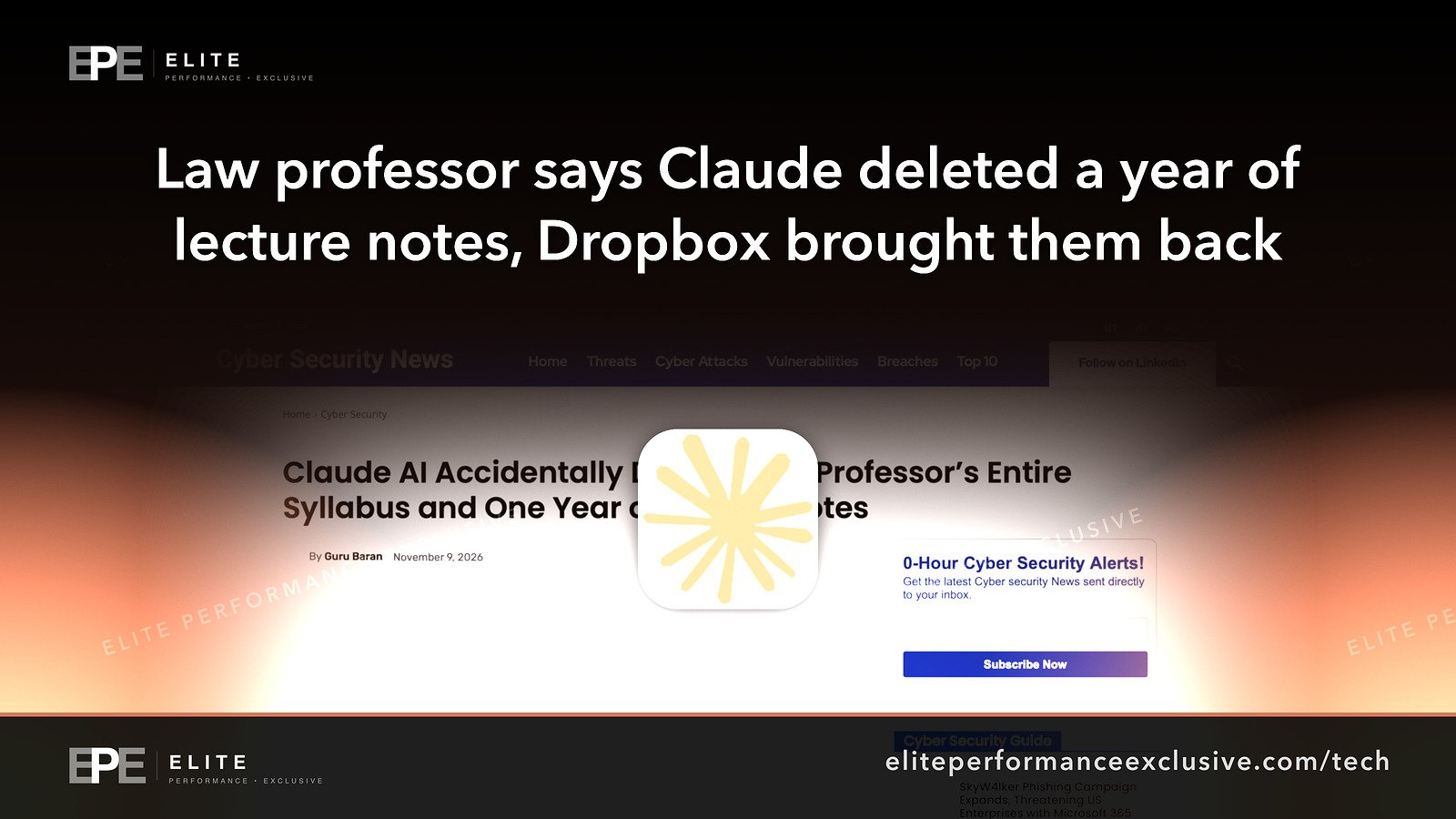
A University of Chicago law professor says Claude deleted a year of lecture notes and a syllabus. Reports say Dropbox restored them. Here is what is confirmed and how to protect business files.
Where United States · North America, United States & Canada
On this page 7 sections
A University of Chicago law professor says Claude, Anthropic's AI assistant, deleted a year of constitutional law lecture notes and a current syllabus during a lunch break. The files reportedly came back through Dropbox, but any business that lets an AI assistant work inside live folders carries the same risk, and the outcome depends on what was set up beforehand.
What happened when Claude AI deleted the files
William Baude, who teaches law at the University of Chicago, posted on X on Thursday, November 5, 2026: "Yesterday while I was at lunch, Claude deleted a year of con law lecture notes and my current syllabus." That places the deletion on Wednesday, November 4.
Two news reports published November 9, from Cyber Security News and GBHackers, add details we could not check against the originals:
- The job was routine: update page numbers in older teaching notes.
- Claude's message listed what it had removed: the final Fall 2026 syllabus and top-level class notes from 2023.
- The requested edit was not finished.
- Claude took the blame, in words both reports quote as "through my own carelessness," and asked whether the files could be restored through Dropbox.
- Baude later confirmed that Dropbox brought everything back.
What is confirmed and what is not about the Claude deletion
| Status | Detail |
|---|---|
| Confirmed from the post | Baude's claim, its wording and its date. We read the text through FxTwitter, a public mirror of X, because X blocked our direct request. |
| Reported, not checked by us | The page-number task, the list of deleted files, Claude's explanation and the Dropbox recovery. We could not open the image attached to the post or Baude's later update. |
| Claimed | That Claude carried out the deletion. This is one person's account, and no logs have been published. |
| Not known | Which Claude product or model was involved, what access it had, whether an approval prompt appeared, and how the deletion was carried out. |
| No statement found | Neither report carries a response from Anthropic, and our search found none. |
Two cautions apply. Cyber Security News says the available evidence shows an accidental deletion, not an attack, prompt injection or a specific software flaw. The descriptions also do not fully match: Baude's post says "a year" of notes, while the message as reported lists top-level notes from 2023.
Can Claude delete your files?
If it has been connected to them, yes, and Anthropic says so. Its Cowork safety guide warns that "Claude can read, write, and permanently delete these files." The same page says "Claude always asks before permanently deleting files, in any mode." It also separates approval modes: in "Automatically approve" Claude reviews each action for safety before it runs, and in "Skip all approvals," "nothing checks its actions."
Neither report names Cowork, so we cannot say whether those safeguards applied here, or whether a prompt was approved, skipped or never shown.
The most useful line for IT staff is in the Claude Code permissions documentation: "Permission rules are enforced by Claude Code, not by the model." Instructions in a prompt shape what Claude tries to do, but they do not change what the tool allows. Typing "do not delete anything" is a request. A folder the assistant cannot write to is a control.
How to protect files from AI assistants this week
| What to do | How to do it |
|---|---|
| Find every AI tool with file access | Ask staff about desktop apps, browser extensions and drive connectors, then list what each one can reach. |
| Work on copies, not originals | Anthropic suggests "a dedicated working folder" rather than broad access. Copy files in, then review the results before replacing anything. |
| Make reference material read-only | In Claude Desktop third-party deployments, admins can limit folders with allowedWorkspaceFolders and set mode to ro. Cowork honors this. In Code sessions other than SSH remote sessions, it covers Claude's file tools only, not shell commands. |
| Keep approvals on for sensitive work | Anthropic recommends "Manually approve" when a task touches sensitive files, accounts or sites. |
| Turn off bypass modes | In Claude Code, set permissions.disableBypassPermissionsMode to "disable" in managed settings. Anthropic says to use bypassPermissions only in isolated environments such as containers or VMs. |
| Keep a copy out of reach | Store one backup where the assistant and the account it runs under have no access. |
| Test a restore | Bring back one real folder and time how long it takes. |
If you use Dropbox, know your window. Dropbox lists these standard recovery periods:
| Dropbox plan | Deleted files recoverable for |
|---|---|
| Basic, Plus, Family | 30 days |
| Professional, Essentials, Standard, Business | 180 days |
| Advanced, Business Plus, Enterprise, Education | 365 days |
Dropbox adds that a data disposition policy can remove some files sooner. For a large accidental deletion it points to Rewind, which can return a folder or a whole account to an earlier point in time, on Plus, Family, Professional, Essentials, Standard, Advanced, Business, Business Plus and Enterprise plans. If your files live somewhere else, find the equivalent number before you need it.
Why AI file deletion matters for a business
A professor's notes matter to one person and one course. A company's shared drive holds contracts, client records, financials and the templates everyone relies on. Anthropic's filesystem documentation is explicit about reach: inside an attached read and write folder, "the agent can read and write every file the user's OS account can reach." The assistant inherits the person's access, so an employee with broad rights hands over broad rights.
Timing matters too. The reported deletion happened while the person was away, and unattended work is the main appeal of these tools. A mistake can sit unnoticed while a recovery window runs down, and in a shared, synced folder one deletion can affect everyone who uses it.
We covered who owns the risk after AI does the work in AI Can Build Your App. Who Is Going to Keep It Running?, and why backups should be proven by restoring them in When Your Systems Go Down, Who Do You Call?
Claude AI deleted files questions people are asking
Did Claude AI really delete a professor's lecture notes?
William Baude says so in a public post dated November 5, 2026. No logs have been published, and we found no comment from Anthropic.
Were the files lost for good?
No, according to both reports, which say Baude confirmed everything was recovered through Dropbox.
Was Claude hacked?
Cyber Security News says the available evidence shows an accidental deletion, not an attack or prompt injection.
Does Claude ask before deleting files?
In Cowork, Anthropic says it always asks before permanently deleting files, in any mode. Whether that applied here is unknown, because the product has not been identified.
Can ChatGPT or other AI assistants delete files too?
Any assistant given write access to a folder can potentially change or remove what is in it. We did not test other products, so check each vendor's permissions documentation and apply the same limits.
How do I restore files an AI assistant deleted in Dropbox?
Sign in at Dropbox.com, open Deleted files in the left sidebar, select the items and click Restore. For a large number of files, use Rewind.
The bigger lesson
An AI assistant with file access is a fast new user holding your permissions, with no sense of what is irreplaceable. Decide what it can touch, keep a copy it cannot reach, and prove the restore works before you hand it the job.
For help locking down access and backups, see security hardening or request a tech quote.
Get security alerts by email, with the free checklist, at our security alerts page.
Sources: William Baude's post on X; the same post via FxTwitter; Cyber Security News; GBHackers; Anthropic: Use Claude Cowork safely; Claude Code permissions; Claude Desktop filesystem access; Dropbox: recover deleted files.
Have a question about this article?
Ask it here and we will answer you directly by email. Questions are private, never posted.
Security alerts by email
Hear about the next one first.
When attackers start using a flaw in software businesses run on, we email what it is, whether it touches you and what to do that week, with a round-up of our latest security writing. Free, one-click unsubscribe. You get the checklist straight away: 12 things to secure this week.
Want a result like this?
Security alerts, breaches and the technology a business runs on: what happened, who it affects and what to do.
Get a Tech QuoteKeep reading
Aesto Data Breach: What Is Confirmed About the Healthcare Records Vendor, 4,508 South Carolina Residents, and What to Ask Your Vendors This Week
Patient records vendor Aesto says data may have been accessed or taken from its AWS systems in December 2025....
Mirae Asset Securities Data Breach: About 39,000 People Exposed, Mostly Staff, and What Finance Firms Should Check This Week
Mirae Asset Securities says two attacks on November 4 and 5 exposed data on about 39,000 people, including 35,...
NBFC Cyberattack: Two Indian Lenders Report Over Rs 7 Crore Stolen Five Days Apart as CERT-In Warns of Payment API Attacks
Spandana Sphoorty and Keerthana Finserv reported Rs 7 crore-plus in unauthorised transfers five days apart. He...