GL.iNet GoodCloud Malware: Attackers Used a Flaw in the Cloud Management Service to Infect Routers and KVMs, What Is Confirmed and What to Do This Week
GL.iNet says an unauthorized party exploited a vulnerability in GoodCloud, its cloud management service, and installed malware on some connected routers and KVM devices. What is confirmed, what is not, and what to do this week.
Where Worldwide
On this page 7 sections
GL.iNet says an unauthorized party exploited a vulnerability in GoodCloud, its cloud remote management service, and installed malware on some of the routers and KVM devices connected to it. If your business has a GL.iNet router or KVM linked to GoodCloud, find it, check it and update it this week. The attack came through the management service itself.
What happened with GL.iNet GoodCloud
GoodCloud is GL.iNet's service for managing its routers and KVM devices remotely. People search for the company as GL.iNet, GLiNet and GL inet, and all three mean the same vendor. The convenience is what makes the service matter here: one service holds a path to many devices at once.
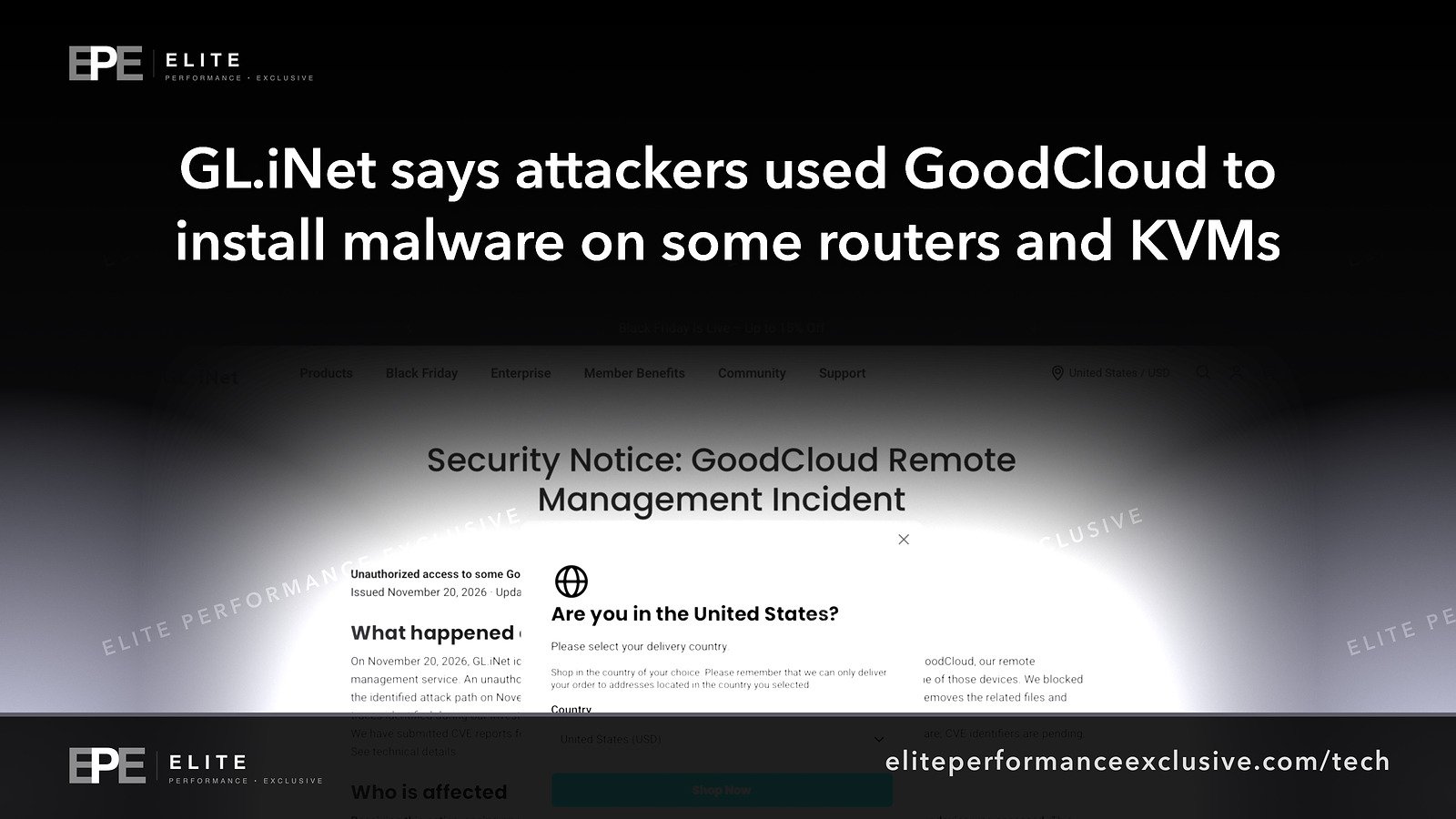
In its security notice, GL.iNet writes: "On November 20, 2026, GL.iNet identified unauthorized access to some routers and KVM devices connected to GoodCloud". The notice continues: "An unauthorized party exploited a vulnerability in the service and installed malware on some of those devices."
Two points matter for anyone running a company network. First, the weak point was the vendor's cloud service. Second, the result was malware on devices that sit inside customers' networks. You can keep your own equipment patched and still be exposed if the service that manages it has a hole.
What is confirmed and what is only reported
| Point | Status | Source |
|---|---|---|
| Unauthorized access to some routers and KVM devices connected to GoodCloud, identified November 20, 2026 | Confirmed by GL.iNet | GL.iNet security notice |
| A vulnerability in GoodCloud was exploited and malware was installed on some devices | Confirmed by GL.iNet | GL.iNet security notice |
| CVE identifiers | Pending, none published yet | GL.iNet security notice |
| Number of affected devices and timeline | Still being determined | GL.iNet security notice |
| 199 reached by 22 November, 166 showing the 20 November attack, an older backdoor, or both | Reported in a technical breakdown, not a GL.iNet figure | RemoteToHome-io on GitHub |
Two values, virtualIp and ip, are not checked or quoted |
Reported in the technical breakdown | RemoteToHome-io on GitHub |
The most detailed numbers come from a technical breakdown in the RemoteToHome-io repository on GitHub. In its words: "199 reached by 22 November, 166 of them showing the attack of 20 November, the older backdoor, or both". Those figures belong to that write-up. GL.iNet has not published a total of its own. It says: "We are continuing to determine the number of affected devices, the timeline of unauthorized activity..."
On the flaw itself, the breakdown says: "Neither virtualIp nor ip is checked or quoted." Put simply, two values the service handles were used without being checked first. Unchecked input is a common cause of serious flaws, but the sources we read do not show exactly how it was used in this attack, so we will not guess.
What is not known yet
- How many devices were affected in total. GL.iNet is still counting.
- The full timeline, including when the unauthorized activity began.
- What the malware does once it is on a device. The sources we checked do not describe it.
- What "the older backdoor" is, who placed it, or when. The breakdown treats it as separate from the 20 November attack, and the sources say nothing more.
- CVE numbers and severity scores. GL.iNet's notice says: "CVE identifiers are pending."
- Who was behind the attack.
If you read a claim elsewhere that fills one of these gaps, check whether it comes from GL.iNet or from the breakdown's authors before you act on it.
Why a GL.iNet router or KVM compromise matters for a business network
A router decides what traffic enters and leaves a site. A KVM device can give someone the keyboard, screen and mouse of the machine it is plugged into, often a server, and it is often there for the moments when other remote access fails. That makes both attractive to an attacker. Malware on either one deserves more attention than malware on a single laptop.
We have written before about how a remote access network is only as safe as its weakest device, and about how few IT leaders could get in right away when the primary network fails. GoodCloud adds a third point: when a vendor's cloud service manages your equipment, that service is part of your security, and you rarely get to see inside it. Our post on who is patching the software that runs your business covers the ownership question. This incident is a live example of it.
What to do this week about GoodCloud
| Step | What to do | How to check |
|---|---|---|
| 1. Find the devices | List every GL.iNet router and KVM the business owns, including any that staff take on the road and any in a server closet | Purchase records, your network's device list, and the GoodCloud account used to manage them |
| 2. Note GoodCloud connections | Mark which devices are connected to GoodCloud | The GoodCloud account and whoever set the devices up |
| 3. Confirm the exact model | Record the exact model of each device | The label on the device or its admin page |
| 4. Update the firmware | Install the latest stable security firmware for that exact model | Use only the official links in GL.iNet's security notice |
| 5. Know what sits behind each device | Write down which servers and systems each router or KVM can reach | Ask whoever manages the network |
| 6. Follow the notice | Recheck GL.iNet's notice for affected device counts, the timeline and CVE identifiers | GL.iNet's security notice page |
GL.iNet's own instruction is short: "Install the latest stable security firmware for your exact model, using the official links below." We have not listed version numbers here because GL.iNet ties the fix to your exact model, and its official links are the place to get it. Do not download firmware from third-party mirrors.
If a GoodCloud-connected device handles anything important, such as a KVM attached to a server, do not assume an update tells you what happened before it. GL.iNet has not yet published the timeline, so plan to review that device again once it does.
GL.iNet GoodCloud questions people are asking
Was GL.iNet GoodCloud hacked?
Yes. GL.iNet says an unauthorized party exploited a vulnerability in GoodCloud and installed malware on some connected routers and KVM devices. It identified the access on November 20, 2026.
Is my GL.iNet router affected?
It could be if it is connected to GoodCloud. GL.iNet says it is still working out how many devices were affected, so there is no official list yet. Install the latest stable security firmware for your exact model.
How many GL.iNet devices were infected?
GL.iNet has not published a total. A technical breakdown on GitHub reports "199 reached by 22 November, 166 of them showing the attack of 20 November, the older backdoor, or both".
Are GL.iNet KVM devices affected too?
Yes. GL.iNet's notice names both routers and KVM devices connected to GoodCloud.
What is the CVE for the GoodCloud vulnerability?
There is none yet. GL.iNet says: "CVE identifiers are pending."
Which GL.iNet firmware version fixes it?
GL.iNet advises installing the latest stable security firmware for your exact model from its official links. The sources we checked do not give one version number that covers every device.
What is the older backdoor on GL.iNet devices?
The technical breakdown mentions "the older backdoor" alongside the 20 November attack. The sources we checked do not say what it is, who installed it or when.
The bigger lesson
Remote management is a door into every device it manages. When that door is a vendor's cloud service, its security becomes part of yours, whether or not anyone on your team can see how it works. Know which of your devices are managed from the cloud, know who updates them, and have a plan for the day the vendor posts a notice like this one.
If you want help checking what manages your network and who keeps it patched, see security hardening or get a quote.
Get security alerts like this by email, with the free checklist, at /security-alerts.
Sources: GL.iNet security notice; RemoteToHome-io technical breakdown.
Have a question about this article?
Ask it here and we will answer you directly by email. Questions are private, never posted.
Security alerts by email
Hear about the next one first.
When attackers start using a flaw in software businesses run on, we email what it is, whether it touches you and what to do that week, with a round-up of our latest security writing. Free, one-click unsubscribe. You get the checklist straight away: 12 things to secure this week.
Want a result like this?
Security alerts, breaches and the technology a business runs on: what happened, who it affects and what to do.
Get a Tech QuoteKeep reading
Windows NTLM Signing and CVE-2026-118737: Critical RPC Runtime Flaw Fixed in November Updates, Third-Party App Compatibility Issues and the Temporary Workaround
Microsoft fixed a critical Windows RPC Runtime flaw, CVE-2026-118737, in updates released on and after Novembe...
Infoblox Data Breach: Customer Network Snapshots and Employee Records Reportedly Exposed Through a SharePoint Migration Vendor, What Is Confirmed and What to Do
Infoblox confirmed unauthorized access to certain company information, reportedly through a compromised ShareP...
Samsung Securities Breach: Complaint Portal Exposed Personal Data of 8,241 Customers, What Is Confirmed and How to Check Your Own Upload Forms
Samsung Securities says an intruder got into its Voice of Customer complaint portal and exposed personal data...
