Out-of-Band Management Access: Opengear Survey Finds Only 15% of IT Leaders Could Get In Right Away if the Primary Network Failed
An Opengear survey of 514 CIOs and CISOs found only 15% could get secure management access right away if the primary network failed. Here is what is confirmed, what is not, and how to test your own backup way in this week.
Where United States, United Kingdom, Germany, India, Australia · Asia, South Asia, Europe, Northern Europe, Western Europe, North America, United States & Canada, Oceania, Australia & New Zealand
On this page 7 sections
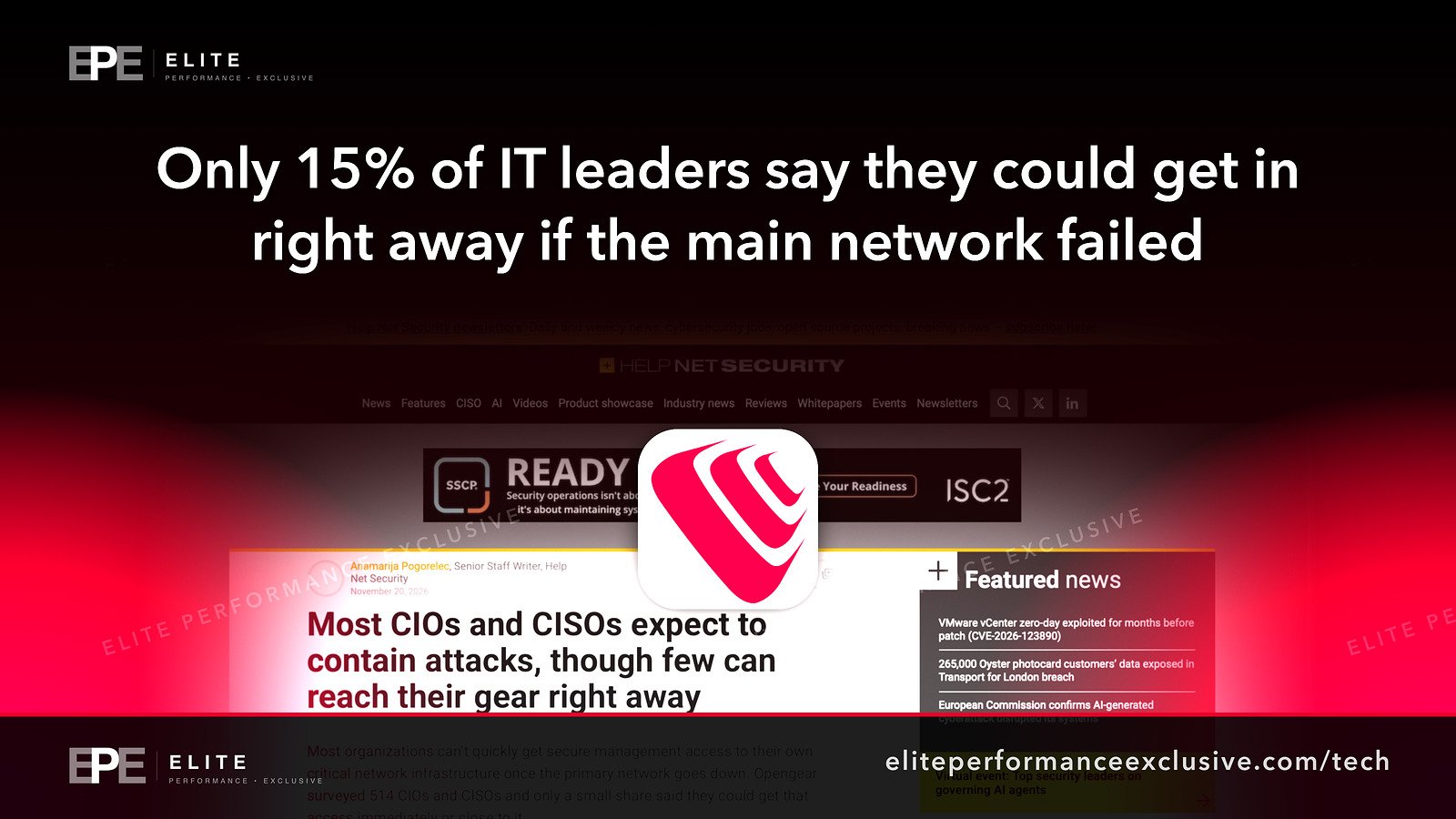
Opengear, a Digi International company, surveyed 514 CIOs and CISOs about what happens when the main network fails, and only 15% said they could get secure management access to their systems right away. For a business, this gap is what turns an outage, a bad update or a ransomware attack into a long one: if the only way into your firewall, switches and servers runs over the network that just went down, nobody can log in to fix it.
What the Opengear survey found
The survey ran in July and August 2026 and covered CIOs and CISOs in the US, the UK, Germany, India and Australia. These are the main numbers as published:
- 15% said they could get secure management access right away if the primary network failed, according to Help Net Security's report on the survey. Only a minority said they could get that access immediately or close to it.
- 72%, nearly three in four, said their organization had delayed, scaled back or paused at least one AI, edge or distributed infrastructure project in the past 12 months over concerns about resilience, remote access or recovery.
- $12.4 million versus $18.8 million: organizations with what Opengear calls embedded resilience reported estimated average outage costs over the past 12 months that were $6 million lower than organizations with less developed resilience capabilities.
- 93% of those embedded organizations said they are confident they could isolate affected systems during a cyber incident.
"This research shows it is also a source of performance," said Patrick Quirk, President, Opengear.
What is confirmed and what is not
Confirmed: Opengear published these figures in its own announcement, and Help Net Security reported on the same survey, including the 15% figure. The survey size, the dates and the five countries come from Opengear's announcement.
Claimed, not tested: every number is what respondents said about their own organizations. A CIO who says they could isolate systems during an incident has not shown it in a test. The outage cost figures are estimates the respondents gave, and a gap between two groups does not prove that resilience caused the lower costs.
Not known from the sources we reviewed: how Opengear defines "embedded" resilience, how respondents estimated outage costs, the exact wording of the questions, and how the results break down by country, industry or company size. If any of that matters to a decision you are making, ask for the full report before you rely on the numbers.
What out-of-band management access means
Most companies manage their network gear over the network itself. The IT person logs in to the firewall from a laptop in the office, or over the VPN from home. That works until the network is the thing that broke.
Out-of-band management is a second, separate way in: a path to your firewalls, switches, routers and servers that does not depend on the main network. In practice that can mean a console server with its own connection, a cellular backup line, or a direct serial or management port. The 15% figure is about exactly this: whether secure management access still works right away when the primary network fails. Most respondents did not say yes.
Why this matters for a business network
Think about the two worst days your IT person could have.
The first is a bad update. A firewall or switch takes a firmware or configuration change, comes back up wrong and drops off the network. Everything behind it goes too, including the VPN your IT provider would use to fix it. Without another way in, someone has to drive to the building.
The second is ransomware. The first job in an incident is to isolate: cut off infected machines, block traffic between parts of the network and stop the spread. That means logging in to network gear while the network is under attack or has been deliberately shut down. If your management access runs over that same network, you are either locked out or working on a network you can no longer trust.
The survey also points at a cost beyond outages. Nearly three in four organizations said they held back AI, edge or distributed projects because of resilience, remote access or recovery worries. A company that cannot reach and recover its own equipment slows down its new projects as well as its recovery.
How to check your out-of-band access this week
You do not need to buy anything to start. These steps show you where you stand.
| Step | What to do | How to check |
|---|---|---|
| 1. List critical devices | Write down every firewall, core switch, router, server and storage box the business cannot run without | One page, with the location of each device and who manages it |
| 2. Map the way in | For each device, note how your IT person or provider logs in today | If every answer is over the network or over the VPN, you have no second path |
| 3. Test with the network down | In a planned window, disconnect the main internet line or core switch and try to reach each device | Time how long it takes, and note any device you cannot reach |
| 4. Store access details offline | Keep admin credentials and device addresses somewhere that works without the network, such as a password manager with offline access or a sealed printed copy | Ask: could we read this if email and file shares were down? |
| 5. Secure the backup path | Any second way in is also a way in for attackers: require strong passwords and multi-factor login, and limit who has it | Review who can use the backup path and remove anyone who should not |
| 6. Practice isolation | Walk through how you would cut off one infected computer or one office network segment | Write the steps down and name the person who does each one |
| 7. Fix the worst gap first | Start with the device whose failure would stop the business, usually the main firewall | Set a date by which it has a tested second path |
If you run your own servers, ask the same question about them: can you reach the console when the operating system or the network is down? Our self-hosting and infrastructure page covers running your own systems.
Out-of-band management questions people are asking
What is out-of-band management access?
It is a separate way to log in to network equipment and servers that does not use the main network, such as a cellular line, a console server or a direct serial connection.
What did the Opengear survey find?
Of the 514 CIOs and CISOs surveyed, only 15% said they could get secure management access right away if the primary network failed, according to Help Net Security's report.
Who was surveyed, and when?
CIOs and CISOs in the US, UK, Germany, India and Australia, surveyed in July and August 2026.
Why can't my IT provider just use the VPN?
The VPN usually runs through the same firewall and internet connection that has failed. If those are down, the VPN is down too.
Does better resilience really save $6 million?
Organizations with embedded resilience reported estimated average outage costs of $12.4 million, against $18.8 million for the rest. These are estimates the respondents gave, and they do not prove cause and effect.
Does this matter for a single office?
Yes. One firewall that will not come back after an update can take a whole office offline, and the question of how someone gets in to fix it is the same.
Is a backup access path a security risk?
It can be if it is left open. Protect it like any admin login: strong passwords, multi-factor login and a short list of people who can use it.
The bigger lesson
Build a second way into your network before the day you need it. Every business that depends on its own network gear should know how it would log in and isolate systems with the main network down, and should test that answer instead of assuming it.
Need help hardening your network and setting up a tested backup path? See security hardening or get a quote.
Get security alerts like this by email, along with our free checklist, at /security-alerts.
Sources: Opengear survey announcement (Business Wire India via UNI); Help Net Security.
Have a question about this article?
Ask it here and we will answer you directly by email. Questions are private, never posted.
Security alerts by email
Hear about the next one first.
When attackers start using a flaw in software businesses run on, we email what it is, whether it touches you and what to do that week, with a round-up of our latest security writing. Free, one-click unsubscribe. You get the checklist straight away: 12 things to secure this week.
Want a result like this?
Security alerts, breaches and the technology a business runs on: what happened, who it affects and what to do.
Get a Tech QuoteKeep reading
Linux KVM Vulnerability CVE-2026-99312: AMD Hosts With Nested Virtualization Affected, What Is Confirmed and How to Check Yours
A Linux kernel flaw in the KVM hypervisor, CVE-2026-99312, affects hosts with AMD processors and nested virtua...
PHP Critical Vulnerability: Seven RCE Flaws Fixed in PHP 8.5.13 and 8.6.0, Which Version to Install for Your Branch and Who Is Exposed
PHP's 19 November 2026 security releases fix seven critical remote code execution flaws. Here is which version...
PHP Session Vulnerability: CVE-2026-126714 and CVE-2026-115560 Can Lead to Remote Code Execution, Fixed in PHP 8.5.13, and What to Check This Week
PHP has fixed two session flaws, CVE-2026-126714 and CVE-2026-115560, that can lead to remote code execution....