MONAI Label Vulnerability: AI Agents Running Cairn Found a Critical Zero-Day, No Fixed Version Yet, and What to Do This Week
Attackers used AI agents running Cairn to find a critical flaw in MONAI Label and write files to a server in about 11 minutes. Versions 0.8.5 and earlier are affected, and no fixed release is out yet.
Where Worldwide
On this page 8 sections
A critical security flaw in MONAI Label, an open-source medical imaging application, was found and used by attackers running AI agents before any fix existed. If your organization runs MONAI Label 0.8.5 or earlier, treat it as affected. The project says the fix will come in its next release, so this week the job is to find every install and limit who can reach it.
What happened with MONAI Label
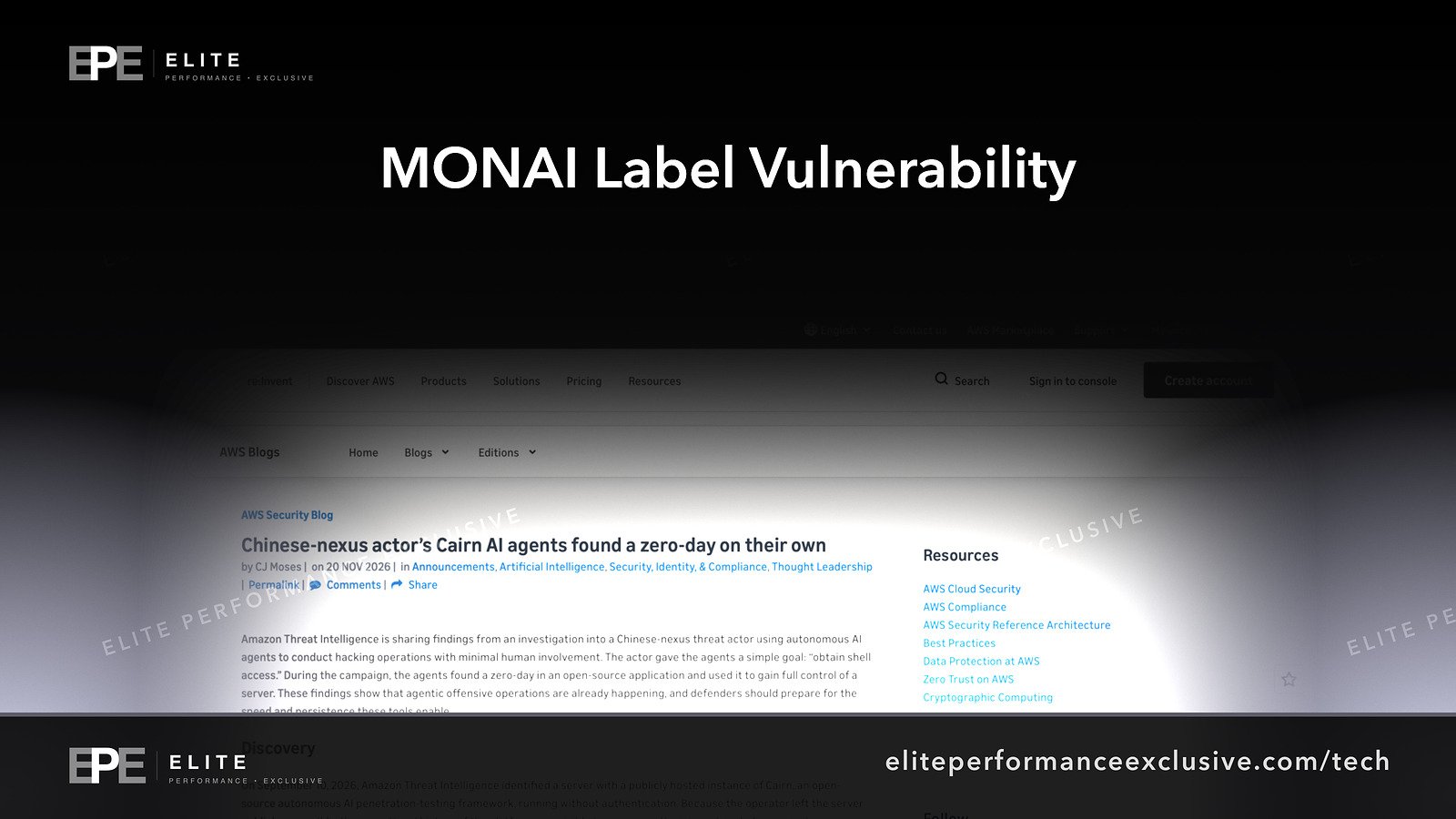
Amazon Threat Intelligence published an account of an attack that ran over an approximately 48-hour period beginning September 8, 2026. According to Amazon, the attacker pointed a set of AI agents at a MONAI Label server and gave them a simple goal: "obtain shell access."
Amazon's write-up shows how fast it went: "In about 11 minutes, the agents went from mapping the application's API to arbitrarily writing files on the server."
The agents ran through Cairn, which BleepingComputer describes as a legitimate pentesting tool. Put another way, software built to help security teams test their own systems was used to find and abuse a flaw nobody had reported yet.
The MONAI Label project has since published a GitHub security advisory dated November 18, 2026. It rates the flaw Critical, lists the affected versions as 0.8.5 and earlier, and shows no known CVE.
What is confirmed and what is only assessed
It helps to keep these kinds of statements apart.
Confirmed by the MONAI Label project's own advisory:
- Severity is rated Critical.
- Affected versions are 0.8.5 and earlier.
- There is no known CVE for the flaw.
- No fixed version is out yet. The advisory says: "The fix will be included in the next MONAI Label release."
Reported by Amazon Threat Intelligence:
- The timeline: roughly 48 hours starting September 8, 2026, and about 11 minutes from mapping the API to writing files on the server.
- The goal the attacker gave the agents: "obtain shell access."
- Amazon credits Gambit Security as one of the first organizations to document a threat group using Cairn.
Assessments, not proof:
- Amazon assesses with high confidence that the flaw was a zero-day, meaning the project did not know about it when it was used. Amazon bases this on the absence of any matching fix, issue, advisory or earlier mention in vulnerability databases.
- Amazon assesses with moderate confidence that the attacker is a Chinese-nexus threat actor. That is a judgment, not an established fact.
Not known from the sources we checked:
- Which organizations were targeted, or how many MONAI Label servers were attacked.
- Whether the attacker got the shell access they were after. The account describes file writes on the server and does not tell us what followed.
- The full technical details of the flaw.
- When the next MONAI Label release will ship, or whether there is an official workaround until then.
What is Cairn, the AI pentesting tool?
Cairn is a penetration testing tool that uses AI agents. BleepingComputer calls it a legitimate pentesting tool, and that matters: this is not custom malware. It is the kind of tool a security team might run against its own network to find weak spots before someone else does.
What changed here is who ran it and how little they had to do. The attacker gave the agents a goal and let them work. In Amazon's account, the agents went from learning the application's API to writing files on the server in about 11 minutes. For anyone responsible for a server, that is the number to remember. The gap between a flaw nobody knows about and a flaw someone is using can now be measured in minutes.
Is there a patch for MONAI Label?
Not yet. The advisory dated November 18, 2026 says the fix will be included in the next MONAI Label release. The advisory does not give a fixed version number, so we will not guess one. Watch the advisory page for the release and install it as soon as it is published.
What to do this week
| Step | What to do | How to check |
|---|---|---|
| 1. Find it | List every server, workstation and cloud instance running MONAI Label, including test and research setups | Ask the teams who work with medical imaging, and check your servers for the application |
| 2. Check the version | Treat 0.8.5 and earlier as affected | Confirm the installed version on each machine |
| 3. Limit access | Keep MONAI Label off the open internet, and allow access only from your internal network or a VPN | Test from outside your network that the service cannot be reached |
| 4. Look for changes | The reported attack wrote files to the server, so review it for files you cannot explain | Compare against a known good backup or a recent baseline |
| 5. Watch for the fix | Follow the advisory for the next release | Install the next release as soon as it is published |
| 6. Speed up response | Amazon advises prioritizing high-confidence detections that trigger an automated response, with humans still part of the process | Check which of your alerts act on their own and which wait for a person |
Steps 3 and 4 are general good practice for any exposed application without a patch. They are not instructions from the advisory.
Why this matters for a business network
Most companies will never run MONAI Label. The lesson still applies to every business that runs software on its own servers.
First, open-source tools often get installed for one project and then forgotten. A research team, a contractor or a developer sets something up, it works, and nobody adds it to a patch list. Those are the servers left exposed when a flaw like this appears. We wrote about that ownership gap in Who Is Patching the Software That Runs Your Business?
Second, speed. If an attacker's AI agents can go from mapping an application to writing files on it in about 11 minutes, a monthly check of what is exposed is too slow. You need to know what can be reached from the internet before something like this happens.
Third, waiting for a patch is a normal state, not a rare one. Here, the fixed release has not shipped, and that is when limiting access matters most. If you host your own applications, our self-hosting and infrastructure work is built around keeping services behind the right controls. As we covered in AI Can Build Your App. Who Is Going to Keep It Running?, AI tools cut both ways, and someone has to own the upkeep.
MONAI Label vulnerability questions people are asking
Which MONAI Label versions are affected?
The project's advisory lists 0.8.5 and earlier.
Is there a fixed version of MONAI Label?
Not yet. The advisory says the fix will be included in the next MONAI Label release.
Does the MONAI Label flaw have a CVE?
No. The advisory shows no known CVE.
Was the MONAI Label zero-day exploited?
Amazon Threat Intelligence describes an attacker's AI agents using it to write files on a server. Amazon assesses with high confidence that it was a zero-day at the time.
Who was behind the Cairn attack?
Amazon assesses with moderate confidence that it was a Chinese-nexus threat actor. That is an assessment, not a confirmed identity.
What is Cairn AI?
Cairn is a penetration testing tool that runs AI agents. BleepingComputer describes it as a legitimate pentesting tool. In this case attackers used it.
Can AI agents find zero-days on their own?
In this case, Amazon reports that the attacker gave the agents a goal and they went from mapping the API to writing files in about 11 minutes. The sources we checked do not say how much human help was involved beyond setting the goal.
The bigger lesson
Attackers can now use the same automated testing tools as defenders, and they point them at software nobody is watching. The fix is not exotic: know what you run, know what is exposed, and have someone responsible for installing the fix the day it is released.
Want your servers and applications reviewed before the next one? See security hardening or get a quote.
Get security alerts like this by email, with our free checklist, at security alerts.
Sources: Amazon Threat Intelligence; MONAI Label GitHub advisory; BleepingComputer.
Have a question about this article?
Ask it here and we will answer you directly by email. Questions are private, never posted.
Security alerts by email
Hear about the next one first.
When attackers start using a flaw in software businesses run on, we email what it is, whether it touches you and what to do that week, with a round-up of our latest security writing. Free, one-click unsubscribe. You get the checklist straight away: 12 things to secure this week.
Want a result like this?
Security alerts, breaches and the technology a business runs on: what happened, who it affects and what to do.
Get a Tech QuoteKeep reading
Linux KVM Vulnerability CVE-2026-99312: AMD Hosts With Nested Virtualization Affected, What Is Confirmed and How to Check Yours
A Linux kernel flaw in the KVM hypervisor, CVE-2026-99312, affects hosts with AMD processors and nested virtua...
PHP Critical Vulnerability: Seven RCE Flaws Fixed in PHP 8.5.13 and 8.6.0, Which Version to Install for Your Branch and Who Is Exposed
PHP's 19 November 2026 security releases fix seven critical remote code execution flaws. Here is which version...
PHP Session Vulnerability: CVE-2026-126714 and CVE-2026-115560 Can Lead to Remote Code Execution, Fixed in PHP 8.5.13, and What to Check This Week
PHP has fixed two session flaws, CVE-2026-126714 and CVE-2026-115560, that can lead to remote code execution....
