Java 17 Vulnerability CVE-2026-114938: Critical No-Login Flaw Reported in OpenJDK 17.0.6 and Later, No Fix or Details Yet, and What to Do This Week
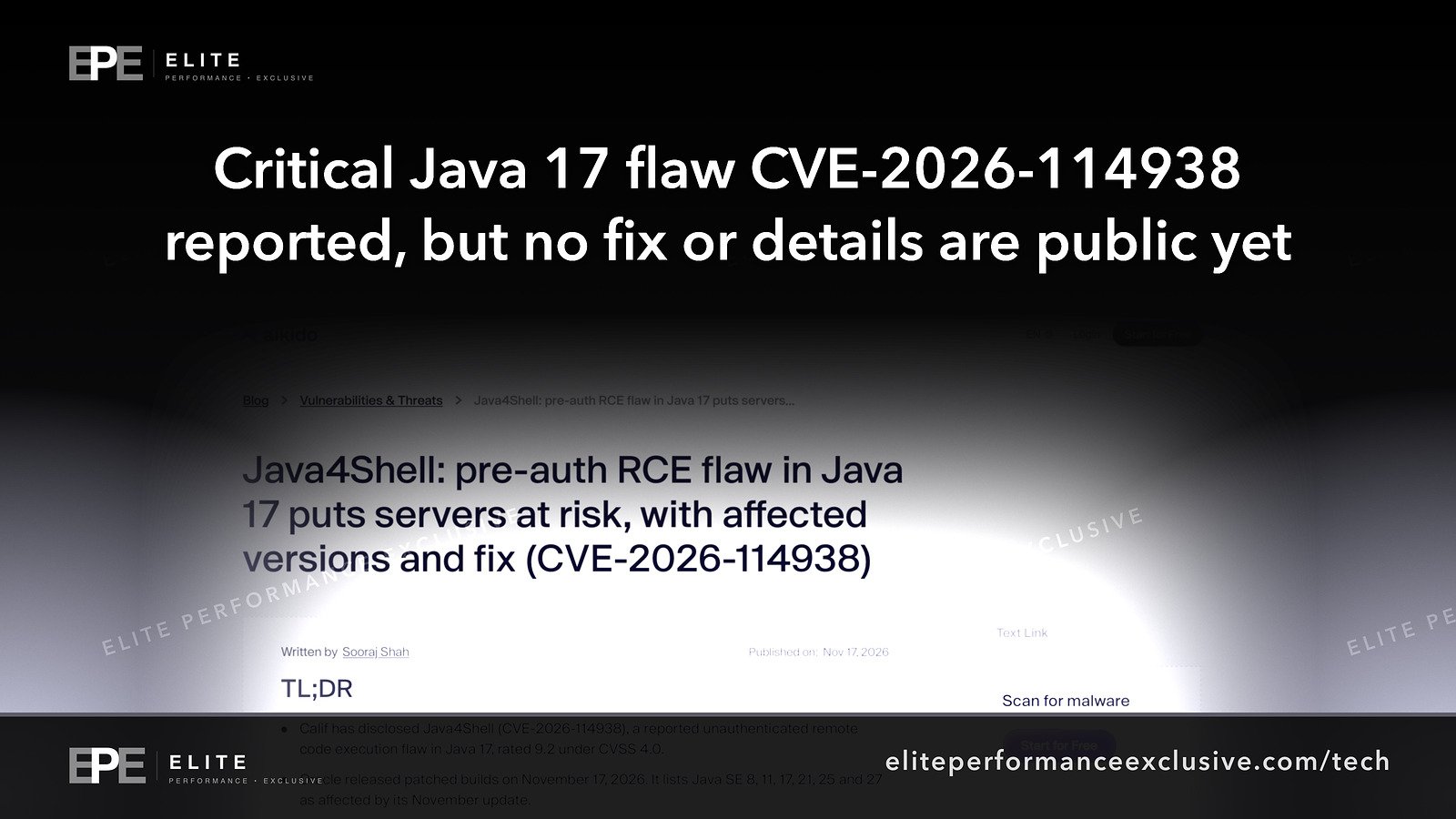
Reports say CVE-2026-114938 affects OpenJDK 17.0.6 and later, needs no login and is rated 9.2, Critical. No fix, exploit code or CVE details are public yet. Here is what is confirmed and what to do this week.
Where Worldwide
On this page 8 sections
A security news report says a flaw tracked as CVE-2026-114938 affects OpenJDK 17.0.6 and later, needs no login, and has a Critical rating. If your business runs Java 17 on a server, inside a vendor product or behind a website, you should pay attention. No fix has been published and very little about the flaw is confirmed, so this week is about getting ready, not panicking.
What happened with the Java 17 vulnerability
Public reports describe a new flaw in Java 17, the OpenJDK runtime that many business applications are built on. Here is what those reports say:
- The bug is tracked as CVE-2026-114938.
- It reportedly needs no login and affects OpenJDK 17.0.6 and later.
- Reports rate it 9.2 out of 10 under CVSS 4.0, which is Critical.
That is everything the public reports claim. The rest of the picture is missing, and the gaps matter as much as the headline.
What is claimed and what is confirmed
| Point | Status |
|---|---|
| Needs no login | Claimed in public reports |
| Affects OpenJDK 17.0.6 and later | Claimed in public reports |
| Severity 9.2, Critical (CVSS 4.0) | Rating given in reports |
| A fixed build | Not published |
| Proof-of-concept code | Not published |
| Attacks in the wild | None reported as of November 17 |
| Official CVE description | None: the record is still reserved |
| Link to a released fix | None of the 11 fixes in the coverage has been tied to this CVE |
Cyber Security News puts it plainly: "No fixed build, proof-of-concept code or sign of real-world exploitation has been published." A separate write-up on Aikido's blog says that as of November 17, it had seen no reports of exploitation in the wild.
The CVE record for CVE-2026-114938 is still reserved with no public description. In practice the official entry is a placeholder. Nobody has published what the flaw is, where it sits in Java, or how it would be attacked.
The coverage also mentions 11 fixes, and none of them has been tied to CVE-2026-114938. If you have seen a headline saying this Java flaw is already patched, the sources do not show that. A fix has not been published.
What is not known yet
- What the flaw actually does. There is no public description, so it is not confirmed what an attacker could do or which part of Java is involved.
- How it would be reached. The only published detail about attack conditions is that it needs no login. Whether it needs network access to a particular service is not stated.
- Other Java releases. The reports name OpenJDK 17.0.6 and later. Whether earlier 17 builds or other Java versions are affected is not stated.
- Different Java builds. Java is often supplied in builds packaged by different providers. Whether each of them is affected in the same way is not stated.
- When a fix will arrive. No date has been published.
How to check if you run Java 17
On any server or computer, open a terminal or command prompt and run:
java -version
If the output shows OpenJDK 17.0.6 or later, that system is in the range the reports describe.
There are two catches:
- The command only shows the first Java it finds on the system path. Servers often have more than one copy of Java installed, so check application folders too.
- Many vendor products bundle their own private copy of Java, and the command above will not always find it. Ask the vendor directly whether their product ships OpenJDK 17.0.6 or later.
What to do this week
| Step | What to do | Why now |
|---|---|---|
| 1. Inventory | List every server, internal tool, web backend and vendor product that runs Java | You cannot patch what you have not found |
| 2. Check versions | Run java -version and note any system on OpenJDK 17.0.6 or later | Those are the builds the reports name |
| 3. Ask vendors | Ask each vendor whose product bundles Java which version it ships and how they will handle this CVE | The vendor updates bundled Java, not you |
| 4. Review exposure | Find out which Java services can be reached from the internet, and close off any that do not need to be | The flaw reportedly needs no login. Limiting access is not confirmed to block it, but it means less is exposed |
| 5. Plan the update | Book a maintenance window and a test system so you can apply a fix quickly once one is released | Updating Java can affect the apps that run on it |
| 6. Watch the sources | Check the CVE record and your Java provider's release notes for a published fix | Both the fix and the details are still missing |
| 7. Ignore unofficial fixes | Do not install a patch that arrives by email, from a forum or from an unknown site | No fixed build has been published, so anything that claims to be one needs checking |
Why this matters for a business network or website
Java tends to run quietly. It sits under web application backends, internal business tools and software you bought from a vendor years ago, and it is easy to forget it is there. A flaw that reportedly needs no login matters most for anything that can be reached from outside your network, because an attacker would not need a stolen password first.
The other business lesson is timing. When a fix does appear, it helps to already know where Java runs and who is responsible for updating each copy.
Java 17 vulnerability questions people are asking
Is there a patch for CVE-2026-114938?
No. No fixed build has been published, and none of the 11 fixes mentioned in the coverage has been tied to this CVE.
Is CVE-2026-114938 being exploited?
There are no reports of it. Aikido wrote that as of November 17 it had seen no reports of exploitation in the wild, and no proof-of-concept code has been published.
Which Java versions are affected by CVE-2026-114938?
Public reports say OpenJDK 17.0.6 and later. Whether other versions or other Java builds are affected is not stated.
Is the Java 17 flaw a remote code execution (RCE) bug?
That is not confirmed. The CVE record is still reserved with no public description, so nobody has published what an attacker could actually do with it.
How serious is the Java 17 vulnerability?
Reports rate it 9.2 out of 10 under CVSS 4.0, which is Critical, and say it needs no login. Until the details are public, take it as a reason to prepare, not as proof that your systems are under attack.
Should I uninstall Java 17?
Not because of these reports alone. Removing Java breaks the software that depends on it. If a system has Java installed and nothing uses it, removing it is reasonable. Otherwise, find where it runs, limit what is exposed to the internet, and be ready to update when a fix comes out.
Where will the OpenJDK 17 fix come from?
It will come from whoever supplies your Java build. That means your OpenJDK provider, or for bundled copies, the vendor of the product that includes it.
The bigger lesson
A critical rating with no fix and no details is uncomfortable, but it also gives you a head start. You can do the work that makes patch day easy today, before anything is released: know every place Java runs and who updates it.
Want help finding and hardening the Java behind your business? See security hardening or get a quote.
Get security alerts like this by email, with our free checklist, at security alerts.
Sources: Cyber Security News; Aikido.
Have a question about this article?
Ask it here and we will answer you directly by email. Questions are private, never posted.
Security alerts by email
Hear about the next one first.
When attackers start using a flaw in software businesses run on, we email what it is, whether it touches you and what to do that week, with a round-up of our latest security writing. Free, one-click unsubscribe. You get the checklist straight away: 12 things to secure this week.
Want a result like this?
Security alerts, breaches and the technology a business runs on: what happened, who it affects and what to do.
Get a Tech QuoteKeep reading
Microsoft 365 Outage Phishing: Fake Held-Mail Emails Used the November 12 Disruption as Bait, What Is Confirmed and How to Check Who Clicked
Phishing emails used the November 12 Microsoft 365 outage as cover, falsely claiming messages held during the...
PostgreSQL Security Update: 52 Vulnerabilities Fixed Including CVE-2026-6460, PostgreSQL 14 Reaches End of Life, and the Versions to Install
PostgreSQL's November 12 update fixes 52 security vulnerabilities, including CVE-2026-6460, a code execution f...
Uber Data Breach: Hackers Used Vendor Fireworks AI's Credentials to Reach Driver's License Data on 149,346 People, and What Businesses Should Check
Uber says compromised credentials at its vendor Fireworks AI let hackers take names, addresses, dates of birth...
