1Password Breach
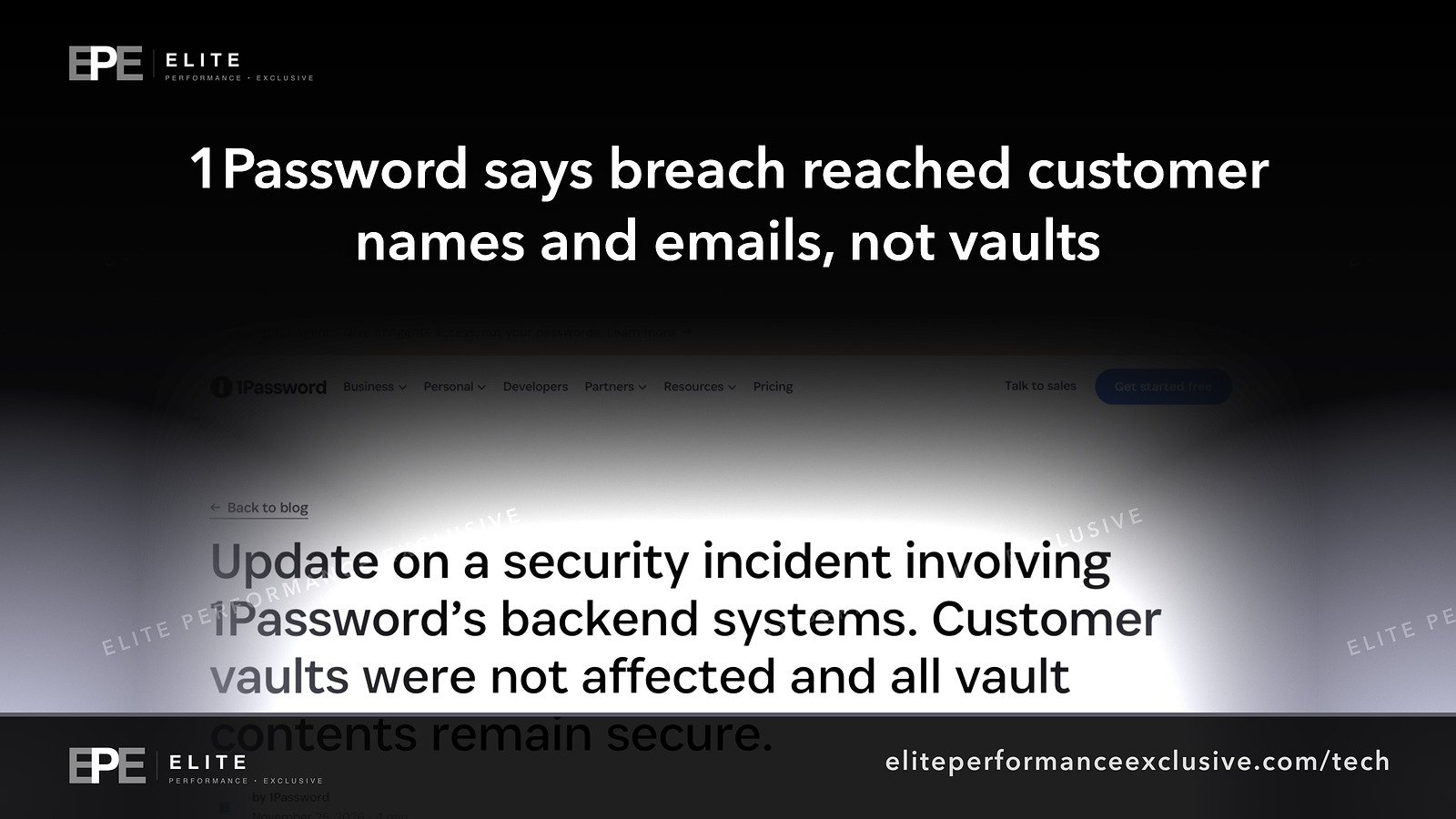
1Password says an attacker got into an employee's corporate GitHub account and reached customer names, emails and account metadata. The company says vaults were not affected. Here is what is confirmed, what is not known and what to do this week.
Where Worldwide
On this page 7 sections
1Password, the password manager, says an attacker got into an employee's corporate GitHub account and reached customer names, email addresses and some internal account details. The company says the passwords stored in customer vaults were not affected. But if your business uses 1Password, your team's names and work emails may now be held by someone who knows which security tool you rely on.
That is why you should act this week. Your stored passwords are not the worry, since 1Password says they were not exposed. The worry is that a list of 1Password customers with names and email addresses is exactly what someone needs to write a believable phishing email.
What happened in the 1Password breach
1Password's own update says that on November 19, 2026, the company began investigating signs that an attacker had gained access to an employee's corporate account. TechCrunch reported the story on November 25, 2026. It describes an intrusion detected on November 19 in which the attacker gained access to an employee's corporate account with GitHub.
GitHub is where software teams store and manage their code. As the company describes it, the attacker got in through an account belonging to someone who works at 1Password.
1Password says the attacker reached customer contact details and account metadata. In the company's words: "This data included customer names and email addresses, in addition to non-secret internal metadata about the account."
On the point most people care about, the company is direct: "Customer vaults were not affected and all vault contents remain secure." TechCrunch reports that 1Password said customer vaults, which store their passwords, were "at no point" available to the attacker.
1Password also says it has responded by triggering a rotation of all credentials which may have been exposed. Rotating credentials means replacing keys, tokens or passwords so that any copy an attacker took stops working.
For scale, TechCrunch notes that the company touts millions of customers and more than 200,000 businesses. That is 1Password's whole customer base, not the number of people affected.
1Password breach: what is confirmed and what is claimed
Everything below comes from 1Password itself, either in its own update or as reported by TechCrunch. None of the sources is an independent investigation, so each point is the company's own account.
| Point | What the sources say | Source |
|---|---|---|
| An attacker gained access to an employee's corporate GitHub account | Stated by 1Password, reported by TechCrunch | 1Password, TechCrunch |
| The investigation began November 19, 2026 | Stated by 1Password | 1Password |
| Customer names, emails and non-secret account metadata were reached | Stated by 1Password | 1Password |
| Vaults and stored passwords were not affected | Stated by 1Password, with no outside confirmation in the sources | 1Password, TechCrunch |
| Credentials that may have been exposed are being rotated | Stated by 1Password | 1Password |
The vault statement is the most important line here, and it comes from the company that was breached. It may be entirely accurate. It just has not been checked by anyone outside 1Password in the sources available.
What is not known about the 1Password breach
The sources leave several questions open:
- How the attacker got into the GitHub account. It could have been a stolen password, phishing, a leaked access token or something else. The sources do not say.
- Who the attacker is. No group or person is named.
- How many customers were affected. No number is given for the names and emails that were reached.
- What "non-secret internal metadata" includes. The sources do not list it.
- Which credentials are being rotated. The sources do not say whether these are 1Password's internal credentials or anything customers need to change.
- Whether affected customers will be contacted directly. The sources do not say.
If 1Password publishes more, check its own update page first, not summaries passed around on social media.
Why a password manager breach matters for a company
For a business, the risk right now is a targeted email, not a stolen vault.
An attacker with the names and work email addresses of 1Password customers knows three useful things: who works at your company, how to reach them and which password manager they use. That makes it easy to send a message that looks like a 1Password security notice, links to a convincing fake sign-in page and asks staff to confirm their account.
The timing also helps the attacker. People expect follow-up emails after a breach makes the news, so a fake one is less likely to look strange.
There is a second lesson for any company that builds or runs software. According to 1Password, this incident started with one employee's corporate GitHub account. If your business has a website, an app or internal tools, the accounts that can reach that code matter as much as your customer database.
What to do this week after the 1Password breach
| Action | Who | How to check |
|---|---|---|
| Warn staff that fake 1Password emails are possible | Owner or IT lead | Send a short note today asking staff to report any email about the incident instead of clicking it |
| Open 1Password only through the app or an address you type yourself | Every user | Use a bookmark or type the address, and never sign in from an email link |
| Never enter your 1Password password on a page reached from an email | Every user | If an email asks you to sign in, close it and open the app instead |
| Read 1Password's update directly | IT lead | Use the link in the sources below, not a forwarded copy |
| List everyone who can reach your company's code | IT lead or developer | Review the members on GitHub or wherever your code lives, and remove former staff and unused access |
| Make sure code accounts need more than a password | IT lead or developer | Check each member's sign-in protection in your code host's settings |
| Do not rush to switch password managers | Owner | Decide based on facts as they are published, not on headlines |
1Password breach questions people are asking
Was 1Password hacked?
Yes. 1Password says an attacker gained access to an employee's corporate GitHub account. The company began investigating on November 19, 2026.
Were passwords stolen in the 1Password breach?
1Password says no. Its update states: "Customer vaults were not affected and all vault contents remain secure."
What data was exposed in the 1Password breach?
Customer names, email addresses and what the company calls non-secret internal metadata about the account.
How many 1Password customers were affected?
That is not known, because the sources give no number. The figure of more than 200,000 businesses is 1Password's total customer base.
Do I need to change my 1Password password?
The sources we reviewed do not tell customers to change it. The more important step is to never type it into a page you reached from an email link.
Is 1Password still safe to use?
The company says vaults were never exposed. That is 1Password's own assessment, and the sources include no outside confirmation. The clear risk right now is phishing that uses the names and emails the attacker reached.
How did hackers get into 1Password?
Through an employee's corporate GitHub account, according to the company. The sources do not say how that account was taken over.
The bigger lesson
By 1Password's account, the attacker got in through one employee's account, not through the product customers use. Every business has accounts like that: the developer with access to the website code, the office manager with the customer list, the owner with the domain login. Most of the work is knowing who holds those accounts and how each one is protected.
To have those accounts reviewed, see security hardening or get a quote.
Get security alerts like this one by email, with our free checklist, at security alerts.
Sources: 1Password security incident update; TechCrunch.
Have a question about this article?
Ask it here and we will answer you directly by email. Questions are private, never posted.
Security alerts by email
Hear about the next one first.
When attackers start using a flaw in software businesses run on, we email what it is, whether it touches you and what to do that week, with a round-up of our latest security writing. Free, one-click unsubscribe. You get the checklist straight away: 12 things to secure this week.
Want a result like this?
Security alerts, breaches and the technology a business runs on: what happened, who it affects and what to do.
Get a Tech QuoteKeep reading
SAP GitHub Breach: Stolen Employee Tokens Reportedly Used to Copy and Change Source Code, What Is Confirmed and What Businesses Should Check
An insider told Der Spiegel that attackers used SAP employees' authentication tokens to copy and change SAP so...
PolinRider GitHub Malware: North Korea-Linked Campaign Planted a Loader in 7,609 Repositories, What Is Confirmed and What to Check This Week
Reports say the PolinRider campaign planted a loader in at least 7,609 GitHub repositories owned by 2,330 real...
Erlang/OTP Vulnerability CVE-2026-55953: TLS 1.2 and DTLS Clients Accept an Unoffered Anonymous Cipher Suite, What Is Confirmed and the Fixed Versions to Install
A flaw in Erlang/OTP lets TLS 1.2 and DTLS clients accept an anonymous cipher suite they never offered, so an...
