AI Infostealer Marketplace: Stolen Computer Data Sold With Searchable Profiles of Each Owner and Workplace, What Is Confirmed and What to Do This Week
Hudson Rock describes a criminal marketplace that attaches AI-written profiles to infected computers, covering owner, workplace and apps, and lets buyers search them in plain language.
Where Worldwide
On this page 7 sections
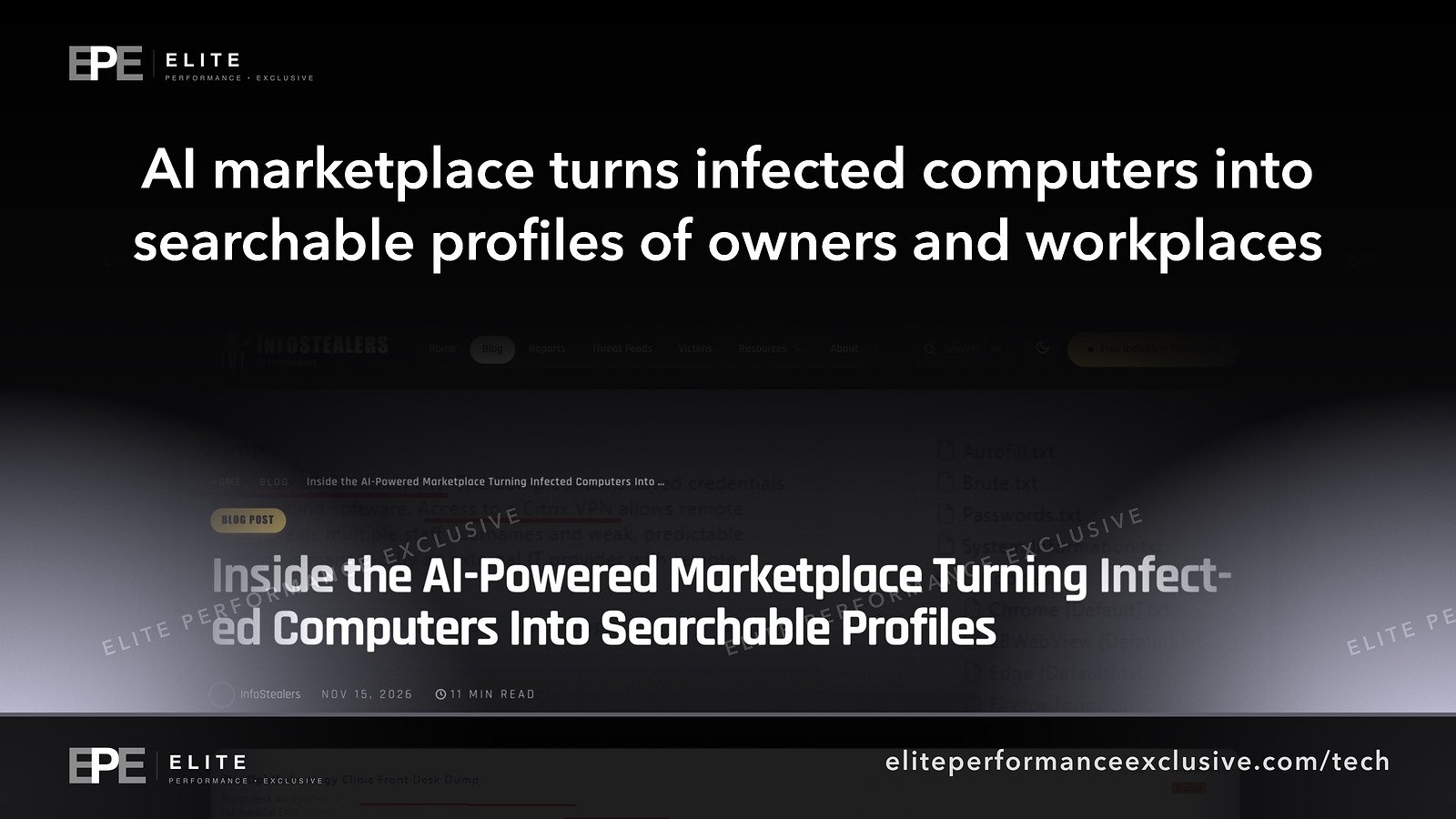
Hudson Rock researchers have described a criminal marketplace that sells data stolen from infected computers. Each machine comes with an AI-written profile of its apparent owner, workplace, applications and potentially valuable data. For a business, this means one employee's infected laptop is no longer an anonymous file in a pile. A buyer looking for a company like yours can describe it, search for it and pick it out.
What Hudson Rock found
Hudson Rock, a threat-intelligence research firm, published its write-up on November 15, 2026. It centres on a forum advertisement dated November 14, 2026 that promotes a marketplace for infostealer logs and account combinations.
An infostealer (also written info stealer or info-stealer) is malware that copies data off the computer it infects, such as saved logins and the session tokens that keep people signed in. The bundle collected from one machine is called a log. Criminals have traded stolen logs for a long time. What is new in Hudson Rock's report is the way they are packaged.
The researchers say the listings they reviewed present each computer with a description of its apparent owner, workplace, applications, and potentially valuable data. Buyers can search those descriptions using natural language and combine the results with filters. Put simply, a buyer no longer has to dig through raw files. They can type a description of the victim they want and get matching computers back.
AI infostealer marketplace: claimed vs confirmed
| Point | Status |
|---|---|
| A forum ad dated November 14, 2026 promotes the marketplace | Reported by Hudson Rock |
| Listings include AI-written descriptions of owner, workplace, applications and valuable data | Hudson Rock says it reviewed listings showing this |
| Buyers can search the descriptions in natural language and add filters | Reported by Hudson Rock |
| Tens of millions of logs and more than one billion parsed accounts | Claimed by the operator, not independently confirmed |
| The stolen logins still work today | Not known |
The size figures come from the seller. The operator claims a database of tens of millions of logs and more than one billion parsed accounts. Criminal sellers have reasons to inflate their numbers, and nothing in the sources confirms these. Hudson Rock draws the line clearly: "Exposure is established; current usability is a separate question."
That distinction matters. The data was taken and is being offered for sale. Whether a particular password or session still works depends on what the victim has changed since.
Why searchable stolen data matters for a company network
Most businesses think about stolen passwords one account at a time. A written profile changes that. Suppose the description of an infected computer names the owner's employer and lists the business applications on the machine. Anyone hunting for a way into that kind of organisation can then find it just by typing a plain description, with no technical sorting needed.
The risk goes beyond the person whose computer was infected. One machine used for work can hold logins for company email, cloud storage, accounting software, your website's admin panel, your hosting account and your domain registrar. Personal computers count too. If an employee signed in to work systems from a home laptop that was later infected, those work logins are in the log.
The profile is itself a leak. "That information can already be exposed before an attacker uses any stolen token," Gal concluded, in comments reported by Help Net Security. Even before anyone tries a password, a description of who someone is, where they work and what they use is useful to a scammer writing a convincing phishing email or a fake call to your help desk.
For a related case of malware going after browser sign-ins, see our post on Abe Office malware and Chrome cookies.
What is not known
The sources we used do not confirm:
- whether the operator's figures for logs and accounts are accurate
- how many of the infected computers belong to businesses, or which industries
- which countries the victims are in
- which malware families supplied the logs
- how accurate the AI-written profiles are
- whether any particular company is listed, or any way to check
We will not fill those gaps with guesses. The practical response is the same either way: assume any computer that has ever had malware exposed the logins on it.
How to protect your business from infostealer logs this week
None of this involves a software patch. It comes down to cleaning devices and cutting off old logins.
| Action | Why it matters | How to check |
|---|---|---|
| Ask staff about any malware warnings or odd behaviour on computers used for work, including home machines | Logs come from infected computers, not from your servers | Review your antivirus or endpoint dashboard for detections in the past year |
| Clean or rebuild any suspect computer before resetting passwords | New passwords typed on an infected machine get stolen too | Confirm the device was scanned clean or reinstalled |
| Reset passwords for business accounts used on that computer | Old passwords in the log stop working | List email, cloud, banking, website, hosting and domain logins used on it |
| Sign out of all active sessions on those accounts | Stolen session tokens can keep someone signed in after a password change | Use each service's sign-out-everywhere option or session list |
| Turn on multi-factor sign-in for email, admin and finance accounts | A stolen password alone is no longer enough | Check each admin console for accounts without it |
| Stop saving work passwords in browsers on personal devices | Saved browser logins are an easy target for this malware | Move work logins to a company password manager |
| Review who has admin access to your website, hosting and domain | Fewer admin logins means fewer to steal | Remove former staff and unused accounts |
If your website or servers are part of the picture, our guide to security hardening covers locking down admin access, and self-hosting infrastructure explains how we keep those logins under the owner's control.
AI infostealer marketplace questions people are asking
What is an infostealer marketplace?
It is a criminal shop selling data that malware has copied off infected computers. The one Hudson Rock describes adds AI-written profiles to each computer so that buyers can search them.
Is the one billion accounts figure confirmed?
No. The operator claims more than one billion parsed accounts and tens of millions of logs. No source we used has confirmed these numbers.
How do criminals search the stolen data?
Hudson Rock says buyers can search the profiles in natural language and combine the results with filters. That means typing a plain description rather than sorting raw files.
Does changing my password fix it?
Only in part. Clean the computer first, change the password, then sign out of all sessions so stolen tokens stop working, and turn on multi-factor sign-in.
How do I know if my company is listed?
The sources do not give a way to check this marketplace. Treat any computer that has had malware as exposed and follow the checklist above.
Who found the marketplace?
Hudson Rock, a threat-intelligence research firm, published the report on November 15, 2026. Help Net Security also covered the report.
The bigger lesson
A password is only as safe as the computer it is typed into. Your servers and website can be fully patched and still be opened with a login copied from an employee's home laptop. With AI making stolen data easier to search, the businesses that come off best are the ones that know which devices touch their systems, keep admin access tight and can cut off old sessions quickly.
Want your logins and admin access locked down? See security hardening or get a quote.
Get security alerts by email, plus the free checklist, at security alerts.
Sources: Hudson Rock, Infostealers.com; Help Net Security.
Have a question about this article?
Ask it here and we will answer you directly by email. Questions are private, never posted.
Security alerts by email
Hear about the next one first.
When attackers start using a flaw in software businesses run on, we email what it is, whether it touches you and what to do that week, with a round-up of our latest security writing. Free, one-click unsubscribe. You get the checklist straight away: 12 things to secure this week.
Want a result like this?
Security alerts, breaches and the technology a business runs on: what happened, who it affects and what to do.
Get a Tech QuoteKeep reading
Coles Cyber Security Incident: What Australia's Second-Largest Retailer Has Confirmed, What Is Not Known, and What Businesses Should Do Now
Coles Group says it is investigating a cyber security incident. Coles has not said whether customer or Flybuys...
Siri Conversation History: The Siri App Kept Conversations "Forever" by Default on a Researcher's Device, What Is Confirmed and How to Shorten It
A forensic researcher found the Siri app keeps a database of conversations, with retention set to "Forever" by...
ARTEX AI Attacks: FBI Warns Criminals Reached Privileged Access in Under Three Hours, What Is Confirmed and What to Check This Week
The FBI warns that attackers are abusing ARTEX, an open-source penetration-testing tool that connects to AI mo...
