Java Vulnerability CVE-2026-114938: CISA Urges Immediate Patching of a Base64 Flaw That Could Allow Remote Code Execution, and the Fixed Versions to Install
CISA urges organizations to immediately patch CVE-2026-114938, a Java Base64 decoder flaw that could allow remote code execution without a login. Here are the affected builds, the fixed versions and what to check this week.
Where Worldwide
On this page 8 sections
CISA is urging organizations to immediately patch CVE-2026-114938. It is a flaw in the Base64 decoder built into Java that could let an attacker run their own code on a server without logging in. If your website, customer portal or internal tools run on Java 17, 21, 25 or 27 on x86-64 servers, add this to this week's patch list.
There is some good news. No attacks using the flaw have been reported so far, and fixed versions are available. The conditions for being affected are also specific enough that whoever runs your IT can check them quickly.
What is the CVE-2026-114938 Java vulnerability?
CVE-2026-114938 is a bug in the part of Java that turns Base64 text back into raw data. Base64 is a common way to pack files, images and tokens into plain text so they can travel inside web requests, APIs and emails.
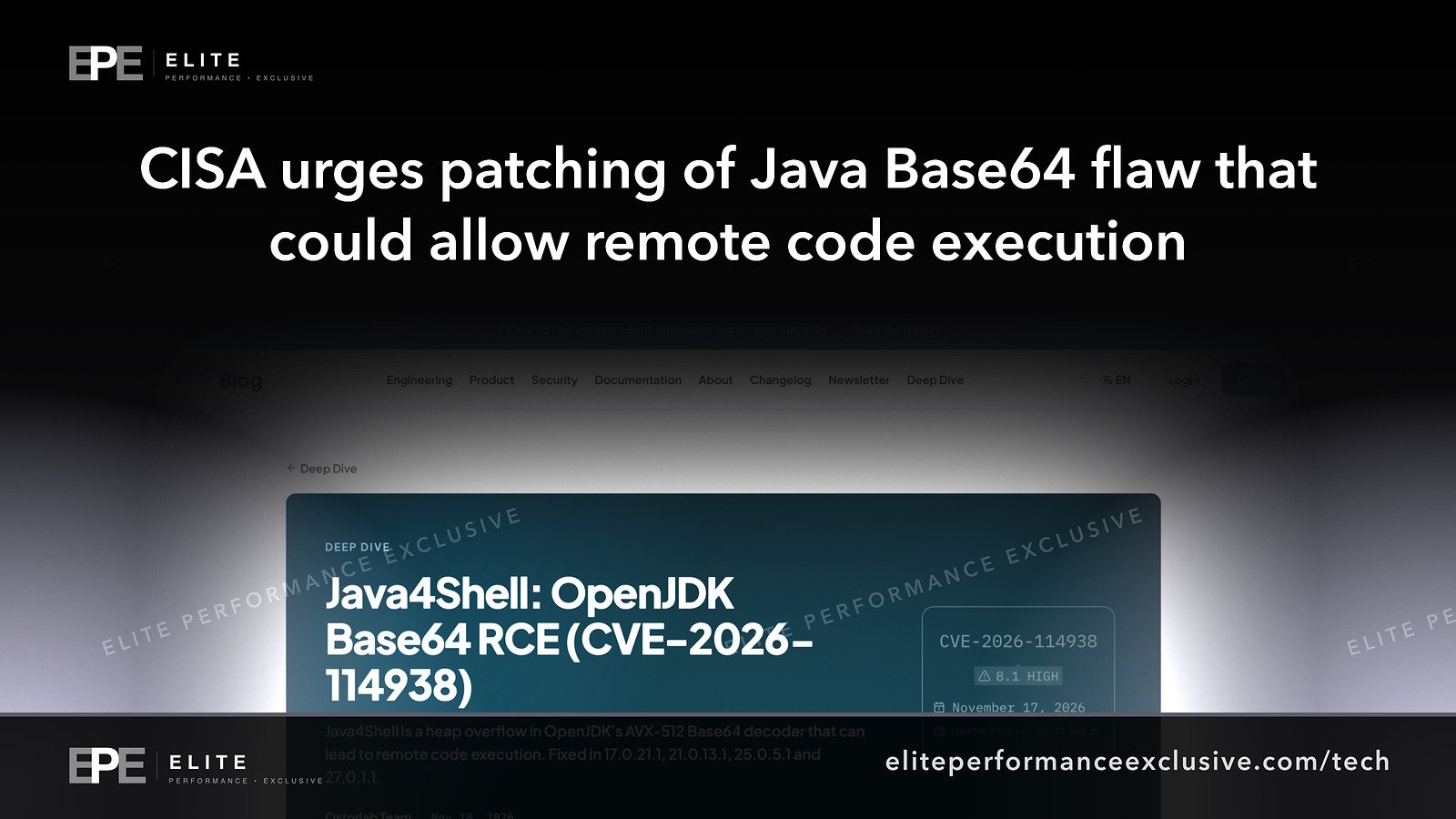
CISA's alert says the flaw "affects the Base64 decoder of the x86-64 HotSpot Java Virtual Machine (JVM)". HotSpot is the engine that runs Java programs. The Ostorlab write-up describes it as "a heap overflow in OpenJDK's AVX-512 Base64 decoder that can lead to remote code execution." In plain terms, a speed-tuned version of the decoder, which uses special processor instructions, can write data past the edge of the memory it was given.
CISA puts the risk this way: "Specially crafted Base64 input could crash the JVM and allow for unauthenticated remote code execution." Unauthenticated means no login is needed. Remote code execution means an attacker's commands run on your server.
According to the Ostorlab write-up, Calif disclosed the flaw on November 17, 2026. You may also see it called Java4Shell, the nickname used in the web address of the Ostorlab page.
Which Java versions are affected by CVE-2026-114938?
The Ostorlab write-up gives two conditions, and both have to be true: "Any OpenJDK 17.0.6 or later on the 17 line, or any 21, 25 or 27 build, is affected on an x86-64 CPU with AVX-512 VBMI."
| Java line | Affected builds | Upgrade to |
|---|---|---|
| Java 17 | 17.0.6 and later, before the fix | 17.0.21.1 |
| Java 21 | Builds before the fix | 21.0.13.1 |
| Java 25 | Builds before the fix | 25.0.5.1 |
| Java 27 | Builds before the fix | 27.0.1.1 |
AVX-512 VBMI is a feature found on some x86-64 processors, and the listed conditions cover x86-64 only. The sources we used say nothing about Java 8, Java 11 or other release lines. Treat those as unknown rather than safe.
CISA calls this an Oracle Java vulnerability, but the version list above is written in OpenJDK terms. If you run a vendor's Java build, such as Oracle JDK or another distribution, check that vendor's release notes for the build that carries the fix.
How serious is the Java Base64 flaw?
It depends on who is scoring it. Oracle rates it CVSS v3.1 8.1 High, and Calif rates it CVSS v4.0 9.2 Critical. The two scores use different versions of the scoring system and come from different parties, so the gap is not a contradiction. Either way, CISA's own wording is direct: "CISA strongly urges organizations to immediately patch the recently disclosed Oracle Java vulnerability".
What is confirmed and what is not known
Confirmed by CISA: the flaw is in the Base64 decoder of the x86-64 HotSpot JVM. Crafted Base64 input could crash Java and allow remote code execution without a login, and CISA wants it patched immediately.
Reported in the Ostorlab write-up: the affected and fixed versions, the processor condition, the two severity scores, the heap overflow cause and the November 17, 2026 disclosure by Calif.
Exploitation status: the same write-up says no exploitation in the wild has been reported. The flaw is not in CISA's Known Exploited Vulnerabilities (KEV) catalog as of November 18, 2026.
Not known from the sources: we don't know which applications pass outside Base64 input to the affected decoder, whether working exploit code is public, or how many systems meet both conditions. If any of that changes, the urgency goes up, not down.
What to do this week
- Find every copy of Java. Check web and application servers, build machines, scheduled job servers and vendor software that ships its own Java runtime. Running
java -versionon each one shows the installed build. - Compare against the table. Builds on the 17 line from 17.0.6 onward need attention, and so do builds on the 21, 25 or 27 lines older than the fixed build.
- Upgrade to the fixed build: 17.0.21.1, 21.0.13.1, 25.0.5.1 or 27.0.1.1.
- Restart the applications. A Java program that is already running keeps using the old runtime until it is restarted.
- Rebuild containers. If your apps run in containers, update the base image to a fixed Java build and redeploy.
- Ask your software vendors. If a product bundles its own Java, ask the vendor when a build with the fix ships. Our post on why updated is not the same as patched explains why vendor bundles can lag behind.
- Use the processor check to set priority, not to skip. Servers on x86-64 processors with AVX-512 VBMI meet the listed condition, so patch them first. On cloud servers the hardware underneath can change, so plan to patch everything on the affected lines.
- Watch for exploitation news. If CISA adds CVE-2026-114938 to KEV, treat any remaining unpatched system as an emergency.
Why this matters for a business website or network
A lot of business software runs on Java: customer portals, online ordering systems, internal dashboards, reporting tools and the APIs that connect them. Base64 data often comes in from outside, in form uploads, API calls and login tokens. A flaw that crafted input can trigger, with no login, matters most on systems that face the internet.
Even the milder outcome hurts. CISA says crafted input could crash the JVM, and when the Java process crashes, the website or tool stays down until someone restarts it. The worse outcome is code running on your server. That can expose customer data and give an attacker a foothold inside your network.
Often the harder question is not how to patch but who is responsible for it. If a contractor built your Java apps, or they came bundled in vendor software, it may not be clear who owns the update. That gap is the subject of our post Who Is Patching the Software That Runs Your Business?
CVE-2026-114938 questions people are asking
What is Java4Shell?
Java4Shell is the nickname used in the Ostorlab write-up's web address for CVE-2026-114938. It is a heap overflow in OpenJDK's AVX-512 Base64 decoder that could allow remote code execution without a login.
Is CVE-2026-114938 being exploited?
No exploitation in the wild has been reported, and it is not in CISA's KEV catalog as of November 18, 2026. Patch anyway, because CISA urges immediate patching.
Which Java versions fix CVE-2026-114938?
17.0.21.1, 21.0.13.1, 25.0.5.1 and 27.0.1.1.
Am I affected if my processor lacks AVX-512 VBMI?
The listed conditions require an x86-64 processor with AVX-512 VBMI. Cloud hardware can change, so patching is still the safe answer.
Does it affect Oracle Java or only OpenJDK?
CISA describes it as an Oracle Java vulnerability, and the affected version list is written for OpenJDK. Check your Java vendor's notes for its fixed build.
Is CVE-2026-114938 high or critical?
It depends on who you ask. Oracle scores it 8.1 High under CVSS v3.1, and Calif scores it 9.2 Critical under CVSS v4.0.
The bigger lesson
Most of the work in a flaw like this is not the upgrade. It is knowing where Java runs in the first place. Companies that keep an up-to-date list of their servers, runtimes and vendor bundles can answer whether they are affected in an hour, while everyone else spends the week searching. Build that inventory now, while no attacks have been reported. Then the next urgent alert is a routine update instead of a scramble.
See how we approach security hardening, or get a quote for help finding and patching Java across your systems.
Get security alerts by email, plus our free checklist, at /security-alerts.
Sources: CISA: Critical Java Vulnerability Requires Immediate Patching; Ostorlab: Java4Shell OpenJDK Base64 RCE CVE-2026-114938.
Have a question about this article?
Ask it here and we will answer you directly by email. Questions are private, never posted.
Security alerts by email
Hear about the next one first.
When attackers start using a flaw in software businesses run on, we email what it is, whether it touches you and what to do that week, with a round-up of our latest security writing. Free, one-click unsubscribe. You get the checklist straight away: 12 things to secure this week.
Want a result like this?
Security alerts, breaches and the technology a business runs on: what happened, who it affects and what to do.
Get a Tech QuoteKeep reading
Automated AI Cyberattack: Google Finds exploit_agent Turning Software Patches Into Live Attacks With No Human in the Loop, and What to Do This Week
Google says attackers used an AI framework called exploit_agent to find and exploit flaws in popular web softw...
SignDrop Windows Zero-Day: Public Exploit Claims SYSTEM Access Through CLFS, No Microsoft Patch or CVE Yet, and What to Do This Week
A researcher has published SignDrop, exploit code they say turns a normal Windows login into full SYSTEM contr...
TSMC Data Breach: 46,000 Employee Records Reportedly for Sale, TSMC Finds No Evidence Its Systems Were Hit, and What to Check at Your Own Vendors
Anonymous sellers reportedly offered 46,000 TSMC employee records for three Bitcoins. TSMC says it found no ev...
