WeaveLotus Breach: GeoServer CVE-2024-36401 and osTicket CVE-2021-42235 Named in Government Hacks in Thailand and the Philippines, What Is Confirmed and What to Check
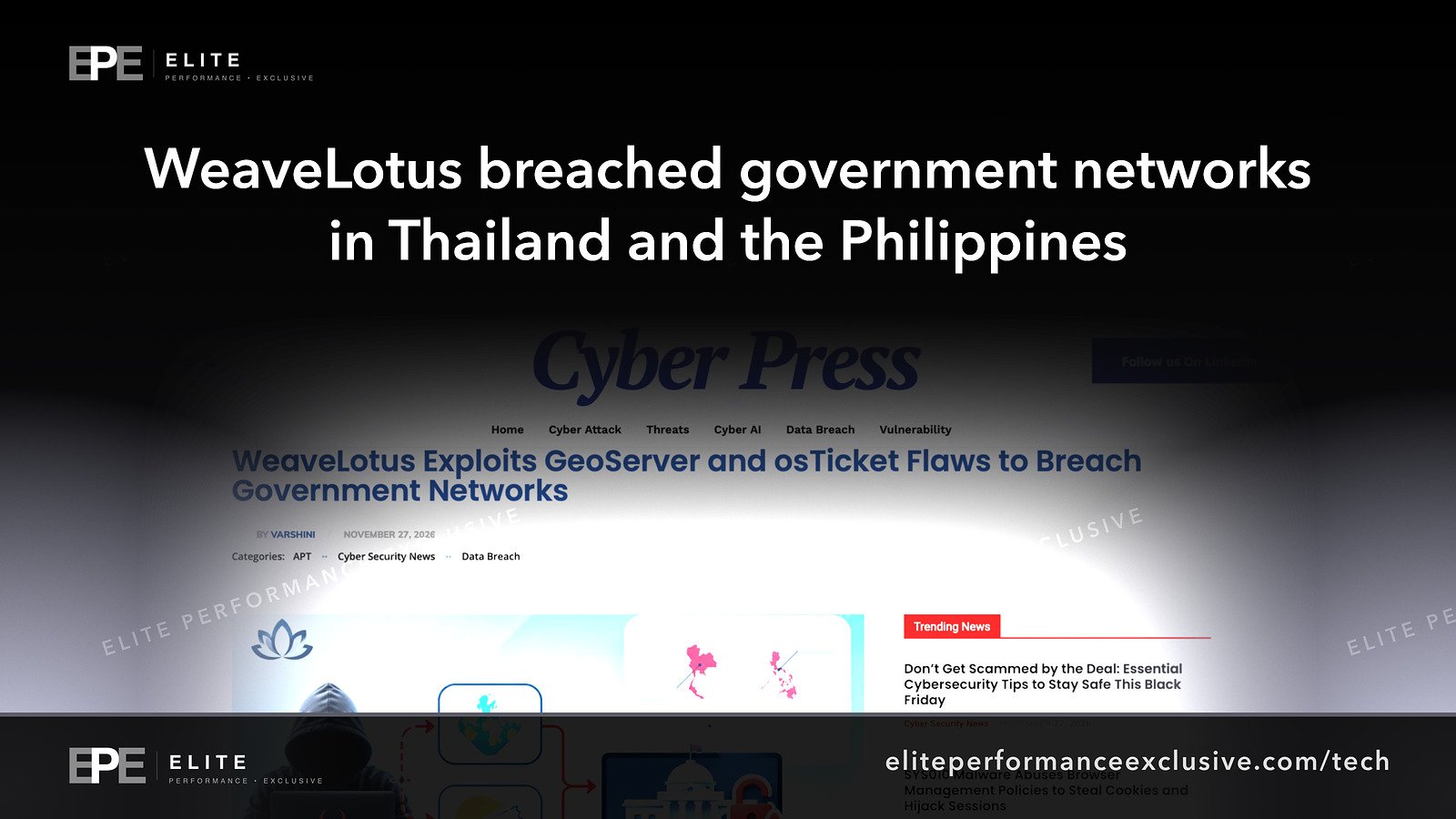
Researchers say WeaveLotus likely used GeoServer CVE-2024-36401 and exploited osTicket CVE-2021-42235, then downloaded 31,418 files from a Directus file interface that needed no login. Here is what is confirmed and what to check this week.
Where Thailand, Philippines · Asia, Southeast Asia
On this page 9 sections
A hacking group that researchers call WeaveLotus broke into government, military and legislative organizations in Thailand and the Philippines. Its way in was server software that businesses also run: GeoServer, the osTicket help desk and a Directus file interface. If your company uses any of these, check versions and logins this week. The flaws involved already had public advisories.
The findings come from a Cyberpress report dated November 27, 2026, which describes research by a team called STRU. This post uses only what that report and the official vulnerability advisories say, and it states plainly what is still unknown.
What happened in the WeaveLotus breach
According to the report, WeaveLotus ran a campaign called RedOps that hit government, military and legislative organizations in Thailand and the Philippines. Researchers also saw the group carry out reconnaissance against more than 30 Indonesian government organizations. Reconnaissance means probing and mapping targets. The report does not confirm a breach in Indonesia.
Three pieces of software appear in the account:
- GeoServer: WeaveLotus likely exploited CVE-2024-36401, a critical flaw that lets attackers run code without logging in.
- osTicket: the group exploited CVE-2021-42235, a SQL injection flaw, to pull out staff usernames and other credential data.
- Directus: the group reached a Directus file interface that did not require a login and downloaded 31,418 files.
WeaveLotus: what is confirmed and what is claimed
| Statement | How solid it is |
|---|---|
| Government, military and legislative organizations in Thailand and the Philippines were hit | Reported by Cyberpress from the researchers' findings |
| WeaveLotus had Vietnamese state backing | An assessment, not proof: "STRU assesses with moderate confidence that WeaveLotus had Vietnamese state backing" |
| GeoServer CVE-2024-36401 was the way in | Described as likely, not confirmed |
| osTicket CVE-2021-42235 was used to pull staff usernames | Reported as exploited |
| 31,418 files were downloaded through Directus | Reported |
| Indonesian government organizations | Reconnaissance only, no breach confirmed |
The sources do not tell us which organizations were hit, when the intrusions started, how long the attackers stayed, what the 31,418 files contained, or whether any private companies were affected. We have not reviewed STRU's original report, so this post does not cover details such as indicators of compromise.
GeoServer CVE-2024-36401: what the flaw does
The GitHub security advisory for this bug (GHSA-6jj6-gm7p-fcvv) says multiple OGC request parameters allow remote code execution by unauthenticated users. In plain terms, anyone on the internet can send crafted requests to a GeoServer instance and run their own code on that server, with no account.
The advisory's CVSS 4.0 vector shows why the flaw is rated critical:
- it can be attacked over the network
- the attack is low complexity
- it needs no privileges and no user interaction
- it has a high impact on confidentiality, integrity and availability
If your company uses GeoServer to publish maps or location data, put any instance that faces the internet at the top of the list.
osTicket CVE-2021-42235: the SQL injection in the login page
The OSV entry for CVE-2021-42235 describes a SQL injection in osTicket versions before 1.14.8 and 1.15.4. It sits in the login and password reset process and lets attackers reach the osTicket administration profile functionality. Login and password reset pages are usually the parts of a help desk that face the outside world, so a flaw there is exposed by design.
WeaveLotus used the flaw to pull out staff usernames and other credential data. If staff reuse passwords, stolen help desk credentials can work in other systems too. Patching closes the flaw, but it does not undo an earlier exposure.
The Directus file interface that needed no login
The largest reported haul needed no exploit at all. The Directus file interface did not require a login, and WeaveLotus downloaded 31,418 files from it. The report does not say whether someone left a setting open or the software had a problem. Either way, a file store that anyone can reach without logging in is easy pickings for the first person who finds it.
Why this matters for a business network or website
None of this software is only for governments. Help desks, map servers and content back ends run on company networks and behind company websites. Sometimes a contractor installs one and nobody looks at it again. The pattern in this campaign is a familiar one: get in through an old, unpatched service, collect credentials, then find data nobody locked.
Two points stand out for businesses:
- These were known flaws. The CVE identifiers date to 2021 and 2024. This was not a new attack with no fix. It worked because the software had not been updated.
- The software matters more than the sector. If you run the same tools, the same flaws apply to you. If you have offices, partners or suppliers in the affected countries, ask whether they run these tools too.
What to check this week
| System | What to check | What to do |
|---|---|---|
| GeoServer | Your installed version against advisory GHSA-6jj6-gm7p-fcvv | Upgrade to a patched release listed in the advisory. If you cannot yet, take the instance off the public internet |
| osTicket | Your installed version | Move to 1.14.8 or later, or 1.15.4 or later |
| osTicket staff accounts | Whether an older version was ever reachable from the internet | Reset staff passwords and check whether they were reused elsewhere |
| Directus | Open a file link in a private browser window while logged out | Make sure file access requires a login |
| All three | Server and access logs | Look for unexpected requests, new admin accounts and large downloads |
A short checklist for whoever runs your IT:
- List every GeoServer, osTicket and Directus instance you run, including any a vendor set up.
- Note which ones can be reached from the internet.
- Check each version against the advisories above.
- Patch anything older, or take it offline.
- Test every file and admin interface while logged out.
WeaveLotus questions people are asking
Is GeoServer CVE-2024-36401 being exploited?
Not confirmed. Researchers say WeaveLotus likely exploited CVE-2024-36401 in this campaign, but that is described as likely, not confirmed.
Which osTicket versions fix CVE-2021-42235?
The flaw affects osTicket before 1.14.8 and 1.15.4. Run 1.14.8 or later, or 1.15.4 or later.
Who is behind WeaveLotus?
STRU assesses with moderate confidence that the group had Vietnamese state backing. That is an assessment, not a confirmed attribution.
Was Indonesia breached?
Not according to the report. Researchers saw reconnaissance against more than 30 Indonesian government organizations, and no breach was confirmed.
What was in the 31,418 files?
The sources do not say. The report gives the count and says the Directus file interface required no login.
Should a business worry if it is not a government agency?
Yes, if it runs the same software. The flaws are in widely used tools, not in systems built only for governments.
The bigger lesson
The attackers in this story needed nothing new. They needed a server that had not been patched, a help desk login page with an old flaw, and a file store anyone could open without a password. Knowing what you run, keeping it patched and testing it while logged out closes all three doors.
For a second set of eyes on your servers, see our security hardening service or request a quote.
Get security alerts by email, with the free checklist, at /security-alerts.
Sources: Cyberpress, WeaveLotus breaches government networks; GitHub Advisory GHSA-6jj6-gm7p-fcvv; OSV, CVE-2021-42235.
Have a question about this article?
Ask it here and we will answer you directly by email. Questions are private, never posted.
Security alerts by email
Hear about the next one first.
When attackers start using a flaw in software businesses run on, we email what it is, whether it touches you and what to do that week, with a round-up of our latest security writing. Free, one-click unsubscribe. You get the checklist straight away: 12 things to secure this week.
Want a result like this?
Security alerts, breaches and the technology a business runs on: what happened, who it affects and what to do.
Get a Tech QuoteKeep reading
SAP GitHub Breach: Stolen Employee Tokens Reportedly Used to Copy and Change Source Code, What Is Confirmed and What Businesses Should Check
An insider told Der Spiegel that attackers used SAP employees' authentication tokens to copy and change SAP so...
PolinRider GitHub Malware: North Korea-Linked Campaign Planted a Loader in 7,609 Repositories, What Is Confirmed and What to Check This Week
Reports say the PolinRider campaign planted a loader in at least 7,609 GitHub repositories owned by 2,330 real...
Erlang/OTP Vulnerability CVE-2026-55953: TLS 1.2 and DTLS Clients Accept an Unoffered Anonymous Cipher Suite, What Is Confirmed and the Fixed Versions to Install
A flaw in Erlang/OTP lets TLS 1.2 and DTLS clients accept an anonymous cipher suite they never offered, so an...
